Jun 02 2023
Where bliss begins
Where bliss begins
everything else ends.
May 26 2023
a star
by Gabriel Rosenstock
a star
a tree
and the longing in between
réalta
crann
is an tnúthán eatarthu
 — from The Longing in Between: Sacred Poetry from Around the World (A Poetry Chaikhana Anthology), Edited by Ivan M. Granger

/ Image by AlicePopkorn /
Yesterday I was a guest on Dr. Laurel Trujillo’s podcast The Yoga Hour. We had a delightful, far reaching conversation on sacred poetry, healing, the importance of inspiration to feed the spirit… and the path of longing.
We started our conversation off with this poem by Gabriel Rosenstock, so naturally I decided to share it with all of you.
–
Without even formulating a complete sentence, Irish poet Gabriel Rosenstock gives us the whole spiritual endeavor—rootedness and aspiration, life, light, a terrible void, and the aching heart that impels us onward.
If longing poses the question, then union is the answer.
This vibrant tension between longing and union reminds me of a story told by the 10th century Persian Sufi master Junayd. When asked why spiritually realized masters weep, he responded by telling of two brothers who had been apart for years. Upon their reunion, they embraced and were filled with tears. The first brother declared, “What longing!” to which the second brother replied, “What joy!” Longing and fulfillment, the one is not separate from the other.
We think of longing as a state of lack. There is something or someone we want in our lives, but it is not there. Longing can feel hopeless. But longing is really a spectrum. That ache, that longing pulsates on one end, while union, wholeness, and completion eternally await on the other. It’s not that they’re separate, longing and union; they are connected. The one naturally flows into the other. Longing is not the lack of union; longing leads to union. Longing is an aspect of union. Longing is a landscape we learn and explore as part of the spiritual journey. As seekers we traverse that space between longing and union, becoming its student.
The mystic maps the territory between the soul and God, between lover and Beloved, between the little self and the true Self, between the transitory and the Eternal. The road connecting these is the road of longing. Mysticism is the science of longing.
Star and tree, longing fills their dreams, but they awaken touching.
=
Ivan Interview on The Yoga Hour
If you want to listen my discussion of sacred poetry on The Yoga Hour podcast, you can find it here:
https://www.theyogahour.com/episodes/sacred-poetry-insight-and-inspiration
Recommended Books: Gabriel Rosenstock

|
Gabriel Rosenstock
Ireland (1949 – ) |
May 26 2023
Yesterday I was a guest on Dr. Laurel Trujillo’s podcast The Yoga Hour. We had a delightful, far reaching conversation on sacred poetry, healing, the importance of inspiration to feed the spirit… and the path of longing.
The Yoga Hour
https://www.theyogahour.com/episodes/sacred-poetry-insight-and-inspiration
0:00 Introduction
– Introduction to Ivan
– Short meditation by the host
6:15 Poem: a star, a tree…
7:40 The Longing in Between
– The path of longing
– spectrum between longing and union
10:42 continues
12:30 Poetry and prose
16:22 Poem: Navajo Prayer
– restored in beauty
– healing and wholeness
– bridge or meeting point between earth and heaven
22:20 How to form a relationship with a poem
– Poem as participation in the breath and consciousness of poet
29:25 Poem by Yogacharya O’Brien: OM
32:53 What does “chaikhana” mean?
– Teahouses along the Silk Road
– Connection of East and West
– Sufi story of Tea as the drink of initiates
36:10 Mystics
– The word “mystic” preferred to words like, saint or sage
– Free from cultural baggage
– Avoids dogma
– Someone who seeks the living truth, not just following rules
40:17 Poem: Last night as I was sleeping…
43:34 Metaphor and describing the indescribable
– Mundane awareness can work with simile
– Expanded awareness witness union, the interconnectedness of things
– Real metaphor emerges from this realization
– This is what sacred poetry emerges from
46:27 Poem by Yogacharya O’Brien: Satsanga
48:02 Through poetry the illuminated state becomes contagious…
– How poetry conveys the sacred experience
52:30 Poem: One Thread Only
53:07 Inspiration is essential food for the spirit
May 12 2023
Return within
by Abhishiktananda, Swami (Henri Le Saux)
English version by H. Sandeman (?)
Return within,
to the place where there is nothing,
and take care that nothing comes in.
Penetrate to the depths of yourself,
to the place where thought no longer exists,
and take care that no thought arises there!
There where nothing exists,
Fullness!
There where nothing is seen,
the Vision of Being!
There where nothing appears any longer,
the sudden appearing of the Self!
Dhyana is this!
 — from Guru and Disciple: An Encounter with Sri Gnanananda, a Contemporary Spiritual Master, by Swami Abhishiktananda / Translated by H. Sandeman
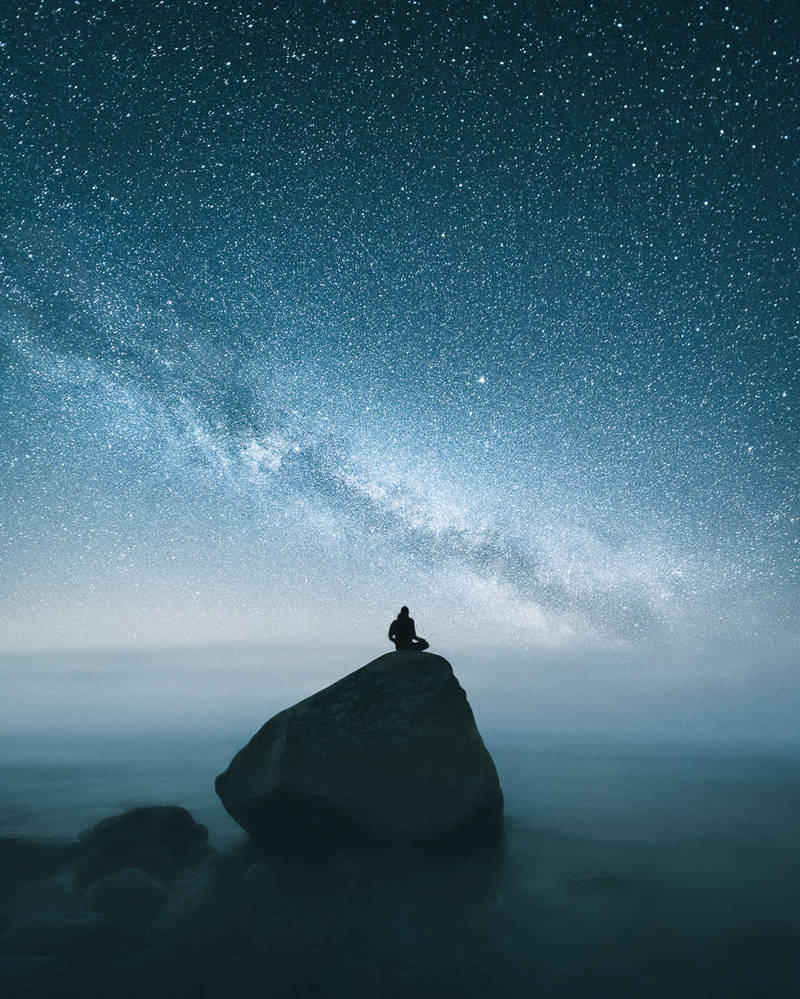
/ Image by MikkoLagerstedt /
Return within…
A powerful description of deep meditation. (The word dhyana in the last line means meditation.)
There where nothing exists,
Fullness!
Abhishiktananda keeps mentioning nothing and nothingness, but each time that nothingness is entered into, we are greeted with fullness, the vision of Being, and ultimately, the appearance of the Self.
In the practice of Advaita Vedanta, everything is recognized as the Self — which a Catholic might recognize as the purified sense of being that is utterly identified with God until only God remains. When the thinking mind is brought to deep silence (“the place where thought no longer exists”), and we get so quiet that we allow the spacious stillness to wash over us, clearing away everything, including the small, grasping ego-self, that is the place “where nothing exists.”
But, in that place “where there is nothing,” that is, nothing that feels like a thing or an object, not even the personal self-thing, we then discover an unexpected flood of life and fullness and bliss.
There where nothing is seen,
the Vision of Being!
Perception shifts and everything is seen as a radiant Unity, the Vision of Being
There where nothing appears any longer,
the sudden appearing of the Self!
One’s very identity changes. What one was has ceased to exist, swept away in the vision of vastness. One’s sense of self is no longer a collection of qualities and habits and social projections. Instead, everything is found within and that Self has no boundaries!
Dhyana is this!
That is dhyana, true meditation.
Recommended Books: Abhishiktananda, Swami (Henri Le Saux)

|
Abhishiktananda, Swami (Henri Le Saux)
France, India (1910 – 1973) Timeline |
May 05 2023
The Path of Amazement
by Seyyid Seyfullah Nizamoglu
English version by Jennifer Ferraro and Latif Bolat
I cannot say who it is I am
I am amazed, I am amazed!
I cannot call this self ‘myself’
I am amazed, I am amazed!
Who is in my eyes seeing?
Who is in my heart enduring?
Who is inhaling and exhaling?
I am amazed, I am amazed!
Who is speaking with my tongue?
Who is listening with my ears?
Who is understanding with my mind?
I am amazed, I am amazed!
Who is stepping with these feet?
Who is tasting with my mouth?
Who is chewing and who swallowing?
I am amazed, I am amazed!
Who holds these riches in his hand?
Who is the one throwing them away?
Who is buying and who selling?
I am amazed, I am amazed!
Why is there life coursing below my skin?
Why are my eyes bloodshot from crying?
Why this religion, why this faith?
I am amazed, I am amazed!
O Seyyid Nizamoglu, hear this:
Everything comes from the One.
Abandon yourself to this mighty beauty
I am amazed, I am amazed!
 — from Quarreling with God: Mystic Rebel Poems of the Dervishes of Turkey, Translated by Jennifer Ferraro / Translated by Latif Bolat
/ Image by Randy Jacob /
I cannot say who it is I am
I am amazed, I am amazed!
This poem so interesting to me because of the way it fits with non-dualist traditions. The term “non-dualism” comes from the assertion or realization that there is no so such thing as duality. Despite the apparent multiplicity of existence, with its dizzying kaleidoscope of people and places and things, there is in reality only one unified Being. Carrying this insight further, there is no separate self, no self separate from other selves, no self separate from God.
Who is in my eyes seeing?
Who is in my heart enduring?
Who is inhaling and exhaling?
Some non-dualist pathways specifically use practices like this, a rigorous inquiry into the senses and perception, working through the layers of awareness. You might start by asking, What is it I see? What is it I feel with my touch? Then, How does perceiving this make me feel? What are my reactions? How do I tense or relax? Do I become agitated with anticipation of pleasure or pain? What thoughts does this perception trigger, and do I believe them?
And so the practice progresses, moving deeper until we begin to ask questions about the source of perception and awareness, from what to who. Who is thinking and feeling and perceiving? Who is it looking through my eyes? Who is it, really, who tastes that orange or listens to that songbird?
When we really look for that self, we don’t find it. There is an unexpected emptiness where we have always imagined the most important thing in the universe — one’s self — to be.
But then something wondrous happens. That emptiness lights up! We find instead a spacious, radiant being of bliss that is timeless and utterly whole.
We find not the self, but the Self.
I cannot call this self ‘myself’
I am amazed, I am amazed!
We find that we are not the wounded, isolated being we so long imagined ourselves to be.
Instead, seated there in grandeur is something unimagined, immense beyond description, filled with an all-embracing love and quiet clarity. And amazingly, that someone is at rest within you! (If you can say you exist at all, which you can’t.)
Abandon yourself to this mighty beauty
I am amazed, I am amazed!
Have a beautiful day on this path of amazement!
Recommended Books: Seyyid Seyfullah Nizamoglu
|
||||
| Quarreling with God: Mystic Rebel Poems of the Dervishes of Turkey | ||||
|
Seyyid Seyfullah Nizamoglu
Turkey (16th Century) Timeline |
Apr 28 2023
Meditate on Kali! Why be anxious?
by Ramprasad (Ramprasad Sen)
English version by Rachel Fell McDermott
Meditate on Kali! Why be anxious?
The night of delusion is over; it’s almost dawn.
The sun is rising, dispelling
thick nets of darkness, and lotuses are blooming thanks to Siva
at the top of your head.
The Vedas throw dust in your eyes; blind too
the six philosophies. If even the planets
can’t fathom Her
who will break up these fun and games?
There are no lessons between teacher and student
in a market of bliss.
Since She owns the actors, the stage, and the play itself
who can grasp the truth of the drama?
A valiant devotee who knows the essence — he
enters that city.
Ramprasad says, My delusion is broken;
who can bundle up fire?
 — from Singing to the Goddess: Poems to Kali and Uma from Bengal, Translated by Rachel Fell McDermott
/ Image by Keenan Constance /
I have been rereading The Gospel of Sri Ramakrishna. Ramakrishna was a devotee of the Mother Goddess Kali and, in fact, was a priest in the Kali temple of Dakshineswar in Kolkata (Calcutta). He loved to recite the poems of Ramprasad…
Meditate on Kali! Why be anxious?
The night of delusion is over; it’s almost dawn.
Kali is a form of the Great Mother who is usually associated with darkness and the night. As the Mother, she brings all into birth, but she is also often identified with death and destruction. The death she brings, however, is the death of illusion. For this reason she is sometimes thought of as representing the terrifying aspect of the Divine, but Kali is only terrifying when we cling to our illusions. She destroys our illusions to free us from them. Her destruction, properly understood, is an act of maternal love. So, why be anxious?
The sun is rising, dispelling
thick nets of darkness, and lotuses are blooming thanks to Siva
at the top of your head.
In Indian metaphysics, there is often discussion of the Kundalini energy — which is an expression of the Goddess — rising from the base of the spine up lighting up the chakras and the awareness until it reaches the crown chakra, which is often described as a thousand-petalled lotus and the seat of Siva. Ramprasad’s simple line is an encapsulation of enlightenment, where the Goddess energy of Kundalini/Kali joins with the God energy of Siva “at the top of your head.” That marriage of divine energies within the individual dispels the “thick nets of darkness” amidst enlightenment.
Ramprasad then goes wild! Filled with the ecstasy of enlightenment, he taunts us with the ineffectiveness of scriptures and philosophy:
The Vedas throw dust in your eyes; blind too
the six philosophies.
We can’t read our way to Truth. We can’t philosophize our way to Truth. We can’t think our way into heaven. The intellect can find truths but not Truth.
What to do?
If even the planets
can’t fathom Her
who will break up these fun and games?
Ramprasad refers to the fundamental dilemma of existence as “fun and games.” The Divine Mother is mistress of creation, existence, as well as the karmas and illusions that keep us caught within them. But so too does She clear them away. To Kali, this is all play — lila — a vast game of manifestation and return to Source.
So, what if we’ve grown tired of these fun and games?
There are no lessons between teacher and student
in a market of bliss.
This is the line that stands out to me. Ramprasad seems to be saying that techniques and philosophies — the lessons — are not the essential element passed from teacher to student. It is the bliss. Bliss is direct and pure, the experience itself, free from conceptual trappings.
To use a modern analogy, we might think of the lessons, the teachings and techniques and rituals, as being the capsule. They are the delivery mechanism. But bliss is the medicine.
Of course, at a certain point we recognize that bliss is everywhere. We stand in the midst of a bustling “market of bliss.”
Ramprasad says, My delusion is broken;
who can bundle up fire?
Can the fire of enlightenment be contained? Can it be organized into a nice, neat teaching? Or do we just let it consume us and light up the world in the process?
=
It’s a beautiful spring day here in Oregon. I hope you are having a lovely day too!
Recommended Books: Ramprasad (Ramprasad Sen)
|
Ramprasad (Ramprasad Sen)
India (1718? – 1775?) Timeline |
Apr 14 2023
If you keep seeking the jewel of understanding
by Abu-Said Abil-Kheir
English version by Vraje Abramian
If you keep seeking the jewel of understanding,
then you are a mine of understanding in the making.
If you live to reach the Essence one day,
then your life itself is an expression of the Essence.
Know that in the final analysis you are that
which you search for.
 — from Nobody, Son of Nobody: Poems of Shaikh Abu-Saeed Abil-Kheir, Translated by Vraje Abramian
/ Image by saeed mhmdi /
Easter was last Sunday. Passover just ended. And, for my Muslim friends, it is the holy month of Ramadan. Regardless of spiritual tradition, it is a good time of year to recognize new life and renewed spirit ready to awaken within us…
This poem speaks a direct truth that should be obvious, but somehow isn’t.
If you live to reach the Essence one day,
then your life itself is an expression of the Essence.
When we focus on a goal, when we turn our hearts and all our thoughts and energies toward it, we begin to take on the qualities of that which we strive for. We could say that we become what we seek, but that’s not exactly what Abu-Said Abil-Kheir is saying; rather, we eventually discover that we are what we seek. What we seek we find inside. It has always been there, we must simply search.
When we are reminded of this truth, a hidden tension in the soul eases. There is always a nagging question: Will I achieve my goal? Am I foolish to even pursue it? This poem’s insight dismantles that self-defeating inner dialog. Through seeking we necessarily succeed. The seeking itself defines us and opens us, awakening recognition of the goal with us always.
Know that in the final analysis you are that
which you search for.
Have a beautiful day!
Recommended Books: Abu-Said Abil-Kheir
|
Abu-Said Abil-Kheir
Turkmenistan (967 – 1049) Timeline |
Apr 14 2023
Let your story
dissolve in the light
and let your meditation
grow bright.
Mar 24 2023
I live my life in widening circles
by Rainer Maria Rilke
English version by Anita Barrows and Joanna Macy
I live my life in widening circles
that reach out across the world.
I may not ever complete the last one,
but I give myself to it.
I circle around God, that primordial tower.
I have been circling for thousands of years,
and I still don’t know: am I a falcon,
a storm, or a great song?
/ Image by GPS /
I don’t normally pay much attention to website statistics, but a few days ago I received a notice that one page on the Poetry Chaikhana website was spiking — the page with this poem by Rilke. That always gets me wondering, why the sudden interest in this poem? Is this poem part of a school curriculum and all the students decided to Google the same poem at once? Was this poem featured somewhere, on a radio program maybe, and all of the listeners wanted to look it up online? Another mystery of the Poetry Chaikhana…
But, when I went to my website and reread the poem myself, I thought, Ooh, this is good. I should share it again with everyone. So here you go, thanks to the mysterious actions of the world wide web…
I live my life in widening circles
that reach out across the world…
I circle around God, that primordial tower.
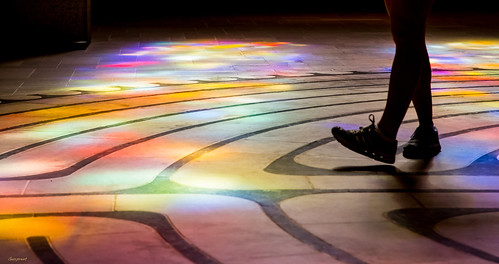
These images of circles and circling, revolving around a great center he names God, it makes me think of the cathedral labyrinths of Europe. Or the ancient spiral glyphs carved into rocks and cave faces. I see the circling pathway around some secret center. The road can be bewildering, twisting and turning, keeping us disoriented and uncertain of how near we are, but ever moving inward.
And that courageous line–
I may not ever complete the last one,
but I give myself to it.
We walk the winding path, not out of certainty, but because it is the only path worth walking. Walking that road, quietly, with attention, one foot in front of the other, becomes meditation. It becomes worship. Each ring, whether near or far, is a layer of our lives that is blessed by our passing through it.
Walking the circling path is not only the way to the center, it is actually part of the center. We learn to participate in the center by first walking the path. Obsession with the destination becomes an impediment to reaching it. Instead, by patiently inhabiting each step, we discover the center in ourselves… and then our feet naturally end up there.
We walk with our whole selves–
but I give myself to it…
and I still don’t know: am I a falcon,
a storm, or a great song?
On this roundabout road to God, we question our own nature. We encounter the mystery of self. Who and what are we really? Ultimately, it is in that questioning of a self that eludes definition where we find the still center.
Recommended Books: Rainer Maria Rilke
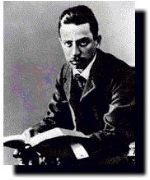
|
Rainer Maria Rilke
Germany (1875 – 1926) Timeline |
Mar 17 2023
I taste a liquor never brewed
by Emily Dickinson
I taste a liquor never brewed —
From Tankards scooped in Pearl —
Not all the Vats upon the Rhine
Yield such an Alcohol!
Inebriate of Air — am I —
And Debauchee of Dew —
Reeling — thro endless summer days —
From inns of Molten Blue —
When “Landlords” turn the drunken Bee
Out of the Foxglove’s door —
When Butterflies — renounce their “drams” —
I shall but drink more!
Till Seraphs swing their snowy Hats —
And Saints — to windows run —
To see the little Tippler
Leaning against the — Sun —
 — from The Complete Poems of Emily Dickinson, Edited by Thomas H. Johnson
/ Image by Matheus Ferrero /
I taste a liquor never brewed —
From Tankards scooped in Pearl…
This poem should be read alongside the ecstatic wine poems of the Sufi saints.
None but the drunkard knows
the tavern’s secrets —
how could the sober unveil
the mysteries of that street?
~ Fakhruddin Iraqi
So let him weep for himself,
one who wasted his life
never having won a share
or measure of this wine.
~ Umar ibn al-Farid
Wine… Why do so many mystics from all traditions talk of wine and drunkenness when speaking of ecstatic states of enlightenment? How do I, as a person who does not drink alcohol, understand this sacred wine fixation? Is it just a universally agreed upon metaphor to shock the orthodox? Well, yes, but it is more than that. The mystic’s wine is not wine, yet it is also more than a game of words. This wine is subtle but very real. It can be experienced in a profound, even physical manner.
Inebriate of Air — am I —
And Debauchee of Dew —
In certain states, a flowing substance is felt upon the palette, with a taste of ethereal sweetness that can be compared with wine or honey. This is the amrita of yogis, the ambrosia of the Greeks, the prophetic mead of the Norse shamans, the awen of the druids. There is a sensation of drinking a subtle liquid, accompanied by a warming and expanding of the heart. The attention blissfully turns inward, the eyelids grow pleasantly heavy and the gaze may become unfocused. A giddy smile naturally spreads across the face for no apparent reason. When the ecstasy comes on strongly, the body can tremble, sometimes the consciousness even leaves the body.
With these experiences, it not only makes sense for mystics to use the language of wine. Observers sometimes mistake this state for actual drunkenness.
This is the drink of initiation.
To many modern commentators, Emily Dickinson was a victim of unfulfilled love, a recluse who had become obsessed with death. I read this poem and I hear the words of a radiant awakened soul, someone ecstatically reeling through endless summer days.
Have a beautiful day discovering that sweet, secret dew!
Recommended Books: Emily Dickinson
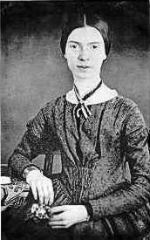
|
Emily Dickinson
US (1830 – 1886) Timeline |
Mar 10 2023
On Angels
by Czeslaw Milosz
All was taken away from you: white dresses,
wings, even existence.
Yet I believe in you,
messengers.
There, where the world is turned inside out,
a heavy fabric embroidered with stars and beasts,
you stroll, inspecting the trustworthy seams.
Short is your stay here:
now and then at a matinal hour, if the sky is clear,
in a melody repeated by a bird,
or in the smell of apples at close of day
when the light makes the orchards magic.
They say somebody has invented you
but to me this does not sound convincing
for the humans invented themselves as well.
The voice — no doubt it is a valid proof,
as it can belong only to radiant creatures,
weightless and winged (after all, why not?),
girdled with the lightening.
I have heard that voice many a time when asleep
and, what is strange, I understood more or less
an order or an appeal in an unearthly tongue:
day draw near
another one
do what you can.
 — from Against Forgetting: Twentieth-Century Poetry of Witness, Edited by Carolyn Forche
/ Image by Sixteen Miles Out /
This poem raises some interesting questions as it wrestles with the idea of angels and spiritual realities in general.
In the opening verse, although Milosz asserts that he believes in the “messengers” or angels, it also speaks from a thoroughly modern viewpoint. First, he points out the process of demythologizing, the stripping away of tangibility from the notion of angels in modern consciousness: “All was taken away from you: white dresses, / wings, even existence.”
When Milosz proclaims “Yet I believe in you, messengers,” he knows he is making a bold statement. Because of modern sensibilities, it is assumed that one does not believe in angels, at least not publicly among intellectuals. What would have been, in past centuries, a bland statement of belief, reads as startlingly sincere, maybe even intentionally naive in a modern poem.
As the poem continues, however, we begin to wonder if he is talking about the same notion of angels that the religiously minded might imagine. He offers us not winged, robed titans of the sky, but instead something ephemeral, delicate, all too easily missed. Milosz’s angels are the presence that rides in upon living moments and touch a hidden part of ourselves…
Short is your stay here:
now and then at a matinal hour, if the sky is clear,
in a melody repeated by a bird…
His angels seem to be that special touch upon the awareness when we truly encounter the moment… through the call of a bird before dawn, the warm scent of apples at sunset, when we pause and recognize that magic reaching out to us. What is it that reaches out to us? What is it that touches us and revives? Why not name it an angel? A messenger, a voice.
Czeslaw Milosz is a modern poet writing for a modern audience, what isn’t modern is his internal quiet. The modern mind is too often caught in staccato details, yet gently filling this entire poem is a sense of rest, wholeness, even timelessness. This poem quietly glows.
When we adopt Milosz’s stillness and learn to truly pay attention, we might just feel the brush of angel wings “in the smell of apples at close of day / when the light makes the orchards magic.”
Recommended Books: Czeslaw Milosz

|
Czeslaw Milosz
Poland (1911 – 2004) Timeline |