Archive for January, 2017

Jan 23 2017

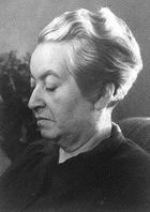
Gabriela Mistral – Those Who Do Not Dance

Published by under Poetry

Those Who Do Not Dance
by Gabriela Mistral

English version by Helene Masslo Anderson

A crippled child
Said, “How shall I dance?”
Let your heart dance
We said.

Then the invalid said:
“How shall I sing?”
Let your heart sing
We said

Then spoke the poor dead thistle,
“But I, how shall I dance?”
Let your heart fly to the wind
We said.

Then God spoke from above
“How shall I descend from the blue?”
Come dance for us here in the light
We said.

All the valley is dancing
Together under the sun,
And the heart of him who joins us not
Is turned to dust, to dust.


/ Image by tasiaraye /

I thought this poem might be a good choice in honor of the weekend’s Women’s Marches across the world.

With this poem, the great Chilean poet, Gabriela Mistral, through simple language, is exploring how we move beyond our assumed limitations and express joy, creativity, life. How do we dance when the body does not respond? When we have grown dry and prickly and lost most of our substance, is it possible we can fly? Even God, at least the God of our imaginations, needs an invitation in which we gather together in the light.

The more we remember, as we see our limitations as new pathways rather than roadblocks, we begin to come alive, reconnect, and dance, until all valley is in movement with us under the sun.


Recommended Books: Gabriela Mistral

Women in Praise of the Sacred: 43 Centuries of Spiritual Poetry by Women Selected Poems of Gabriela Mistral


Gabriela Mistral, Gabriela Mistral poetry, Secular or Eclectic poetry Gabriela Mistral

Chile (1889 – 1957) Timeline
Secular or Eclectic
Christian : Catholic

Continue Reading »

5 responses so far

Jan 23 2017

The Power of Poetry — and “Nasty Women”

I posted this on the Poetry Chaikhana’s Facebook page over the weekend, but I thought I should share it here, as well. This is a video of the actress Ashley Judd reciting a poem by a 19-year-old young woman about “Nasty Women.” As she speaks this poem, she stalks across the stage and channeling the shared experience of outrage combined with a renewed spirit of self-assertion. It is blunt, the language and imagery will be uncomfortable for many. But I share it for this reason: This poem, and the way it is delivered, is undeniably powerful. This poem has become one of the focal points of this massive movement. Refusing to mince words, this poem gives voice to the feelings of so many women who participated in this weekend’s events.

That is the power of poetry. Crystalizing and magnifying the sense of identity and purpose within the collective awareness.

Whether or not you like the poem or the mood it represents, I encourage you to watch in order to see the power of poetry as it operates within society.

Ashley Judd’s “Nasty Woman” Speech

One response so far

Jan 18 2017

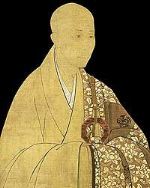
Muso Soseki – Satori Poem

Published by under Poetry

Toki-no-Ge (Satori Poem)
by Muso Soseki

English version by W. S. Merwin

Year after year
      I dug in the earth
            looking for the blue of heaven
only to feel
      the pile of dirt
            choking me
until once in the dead of night
      I tripped on a broken brick
            and kicked it into the air
and saw that without a thought
      I had smashed the bones
            of the empty sky

— from Sun at Midnight: Muso Soseki – Poems and Sermons, Translated by W. S. Merwin / Translated by Soiku Shigematsu


/ Image by Questavia /

Don’t you like the way this short Zen poem says so much?

Year after year
      I dug in the earth
            looking for the blue of heaven

The spiritual quest is first seen as some sort of construction project, but he doesn’t really know what to build or what he’s doing so he just digs deeper.

He is digging into the earth searching for heaven. We might take this to mean that he is delving into worldly, material existence. Or perhaps it is merely to suggest the heavy effort of spiritual striving. Either way, the effort, rather than freeing him is choking him.

only to feel
      the pile of dirt
            choking me

It is as if he has been digging his own grave. Even then he doesn’t know what else to do.

But insight, that moment of satori or enlightenment, comes almost by accident.

until once in the dead of night
      I tripped on a broken brick
            and kicked it into the air

Though it may be an accident, it is not random. If he hadn’t been digging in the first place, he never would have stumbled. So, in an ironic way, the effort has served its purpose, but not in the purposeful cause-and-effect manner he imagined.

Significantly, it is “in the dead of night” when he stumbles and falls, what we might interpret as the dark night of the soul when he feels most hopeless and drained.

and saw that without a thought
      I had smashed the bones
            of the empty sky

Yet in falling on his back he is face up and finally sees the sky. He’s stunned into silence (“without a thought”). The sky itself shatters. He pierces through the false sky, which is a construction of his mind — his thoughts about the sky and the heavenly realms, his concepts and assumptions of all that encompasses his world. He finally sees clearly sky, as it is, the living, empty spaciousness that overarches and permeates everything.

A reminder to us that earnest seekers labor hard, but the masters know how to fall back — and so see the sky.

=

Big energies are circulating because of the inauguration this week in the US. It’s okay to not go along with the pretense that things are okay.

The challenge going forward — cultivating a peaceful heart in coordination with a strong voice and a willing hand.


Recommended Books: Muso Soseki

Sun at Midnight: Muso Soseki – Poems and Sermons East Window: Poems from Asia Roaring Stream: A New Zen Reader


Muso Soseki, Muso Soseki poetry, Buddhist poetry Muso Soseki

Japan (1275 – 1351) Timeline
Buddhist : Zen / Chan

Continue Reading »

3 responses so far

Jan 18 2017

The real you

The real you
is much too big to be your own.

One response so far

Jan 12 2017

John O’Donohue – For Light

Published by under Poetry

For Light
by John O’Donohue

Light cannot see inside things.
That is what the dark is for:
Minding the interior,
Nurturing the draw of growth
Through places where death
In its own way turns into life.

In the glare of neon times,
Let our eyes not be worn
By surfaces that shine
With hunger made attractive.

That our thoughts may be true light,
Finding their way into words
Which have the weight of shadow
To hold the layers of truth.

That we never place our trust
In minds claimed by empty light,
Where one-sided certainties
Are driven by false desire.

When we look into the heart,
May our eyes have the kindness
And reverence of candlelight.

That the searching of our minds
Be equal to the oblique
Crevices and corners where
The mystery continues to dwell,
Glimmering in fugitive light.

When we are confined inside
The dark house of suffering
That moonlight might find a window.

When we become false and lost
That the severe noon-light
Would cast our shadow clear.

When we love, that dawn-light
Would lighten our feet
Upon the waters.

As we grow old, that twilight
Would illuminate treasure
In the fields of memory.

And when we come to search for God,
Let us first be robed in night,
Put on the mind of morning
To feel the rush of light
Spread slowly inside
The color and stillness
Of a found word.

— from To Bless the Space Between Us: A Book of Blessings, by John O’Donohue
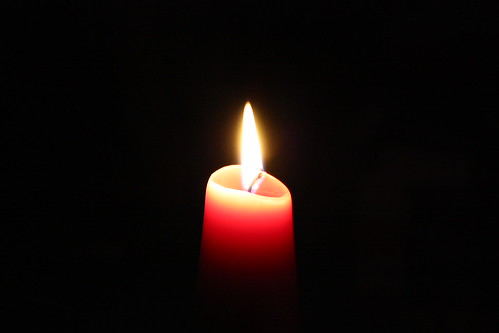

/ Image by Darren Bertram /

After the holidays I have been having difficulty getting back into a regular rhythm of work and poetry and life in general. Do I need to refocus? Should I intensify my spiritual practice? Fast for a day or two? Should I be spending more time with poetry and writing, or should I let it sit until it bubbles up inside me? Do I push or do I putter?

There’s a part of me that starts to spin in agitation when I feel like the rhythm of my life has shifted and I don’t know my next step. But then there is also a nameless part of my awareness that finds a certain pleasure at resting in that uncertain space. That feeling of being out of sync and uncomfortable, as if I’m an alien in the center my own life, is also an opportunity to forget what it means to be “me.”

It can feel like a period of darkness, but it also allows us to see by a new light. When our accustomed patterns of feeling and activity shift, there is a period of time before we settle into the forward focus of new rhythms when the alleyways and secondary spaces of our lives become visible. Some of these are the most fascinating quirks of who we are. Here we may find troubled spaces, secret wounds, but also immense creativity, playfulness, and forgotten treasures and inner life.

O’Donohue’s poem seems like the perfect meditation. Light and darkness. The illumination of awareness and the shadow that allows us to see what is missed in the glare of too much light. How both shadow and light reveal in different ways. How light can be gentle or harsh, how the light and the dark can interact to shape the quality of the light and affect not just what we see but how we react to what is seen.

And just as important as seeing is how we choose to see.

When we look into the heart,
May our eyes have the kindness
And reverence of candlelight.


Recommended Books: John O’Donohue

To Bless the Space Between Us: A Book of Blessings Eternal Echoes: Celtic Reflections on Our Yearning to Belong Conamara Blues Anam Cara: A Book of Celtic Wisdom Echoes of Memory
More Books >>


John O'Donohue, John O'Donohue poetry, Christian poetry John O’Donohue

Ireland (1956 – 2008) Timeline
Christian : Catholic
Secular or Eclectic

Continue Reading »

4 responses so far

Jan 04 2017

Shah Nematollah Vali – The Point of the Circle

Published by under Poetry

The Point of the Circle
by Shah Nematollah Vali

The point appeared in the circle
And was not;
But it was the dot
That the circle begot.

The point appears
As a circle, as it revolves
In the eyes of him
Who a circle draws.

When the point
Completed the circle
Its beginning and end
Were one.

When the compass
Did the circle complete
It was wrapped up
And rested its feet.

Without existence
Not-being are we;
We who are Not
And You existence free.

I said the whole world was His dream;
Then I saw His dream was He.
Sweeter than the words of our guide,
Nimatullah knows no other words.

— from Islamic Mystical Poetry: Sufi Verse from the Early Mystics to Rumi, Translated by Mahmood Jamal


/ Image by ratravarman /

When I was in high school I loved geometry. Something about the visual, spatial nature of geometry just clicked for me. This poem reminds me of the way I’d get lost in geometrical contemplations on hot afternoons in the classroom…

The point appeared in the circle
And was not;
But it was the dot
That the circle begot.

The point appears
As a circle, as it revolves…

In geometry, a point has no dimension. It has no diameter, no depth. It does not really exist in space; it is only an idea, a point of reference. Yet when you start to move it in a single direction, its trail creates a line. Move it around another point, you create an arc. Continue describing that arc, and its end will eventually meet its beginning, and form an endless circle.

From nothing, something has taken form. From the point, a circle emerges. It is the existence of the circle that proves the existence of the point. The point is not-being; the circle is being.

Here’s another image: A circle encloses a limited area. We can calculate the area with the formula pi multiplied by the radius squared. Yet, although the area is limited and specific, we can still fit an infinite number of points within the circle. Since a point does not take up space but can still have a location, its possibilities within the circle are unlimited.

Let’s meditate on this for a moment. Imagine that you are that point and the circle is the canvas of reality — your life. Your life has a limited number of years to it, a limited number of places you can go, people you will meet, experiences you will have. Being human, we instinctively rebel against that feeling of limitation. But we are like the point within the circle: Within the limited area of our lives, the possibilities available to us are, in reality, without limit. Just the slightest shift in point-of-view, and everything around us is made new. So, is our limited life really limited?

These are the sorts of things nerdy teenaged Ivan used to daydream about in geometry class…

I said the whole world was His dream;
Then I saw His dream was He.


Recommended Books: Shah Nematollah Vali

Poetry for the Spirit: Poems of Universal Wisdom and Beauty The Drunken Universe: An Anthology of Persian Sufi Poetry Islamic Mystical Poetry: Sufi Verse from the Early Mystics to Rumi


Shah Nematollah Vali, Shah Nematollah Vali poetry, Muslim / Sufi poetry Shah Nematollah Vali

Iran/Persia (1330 – 1431) Timeline
Muslim / Sufi

Continue Reading »

4 responses so far