Aug 25 2017
Forgive the whole world
Every nation, every person, every object
is within yourself.
Forgive the whole world
and watch what happens within yourself.
Aug 25 2017
Every nation, every person, every object
is within yourself.
Forgive the whole world
and watch what happens within yourself.
Aug 23 2017
I touch God in my song
by Rabindranath Tagore
English version by Rabindranath Tagore
I touch God in my song
as the hill touches the far-away sea
with its waterfall.
The butterfly counts not months but moments,
and has time enough.
Let my love, like sunlight, surround you
and yet give you illumined freedom.
Love remains a secret even when spoken,
for only a lover truly knows that he is loved.
Emancipation from the bondage of the soil
is no freedom for thee.
In love I pay my endless debt to thee
for what thou art.
 — from The Fugitive, by Rabindranath Tagore

/ Image by Edgar Pierce /
…only a lover truly knows that he is loved.
In this poem’s few short lines, Rabindranath Tagore marries the bhakti path of utter love for God with the heart of karma yoga’s union through service and action.
In traditional Indian metaphysics, the goal is usually understood to be enlightenment and freedom from the karmic tug that traps us in the cycle of earthly embodiment, “emancipation from the bondage of the soil.” But here Tagore challenges the otherworldliness that often engenders.
Even the spiritual idea of liberation can become a selfish goal. For one utterly in love with God, the paying of that “debt” is simply a labor of love. Every effort, every experience, even suffering, is simply an expression of one’s love for God. That is enough right there for the true lover of God. Rather than seeking escape from “the soil,” the world is seen as a panorama that offers endless opportunities to worship and experience the Divine.
This is the great vision of karma yoga.
It is also the attitude that finally allows us to be at rest on our spiritual journey, rather than live as a convict on the run. What some see as the prison yard, becomes instead an exercise yard… or a playground! It is a courageous way of acknowledging that freedom is not escape, it is deep presence.
And we find that we live not in fleeting time, but in the ever expanding present moment.
The butterfly counts not months but moments,
and has time enough.
Recommended Books: Rabindranath Tagore
 |
 |
 |
|
|
| The Longing in Between: Sacred Poetry from Around the World (A Poetry Chaikhana Anthology) | Gitanjali | The Lover of God | The Fugitive | Lover’s Gift and Crossing |
| More Books >> | ||||
|
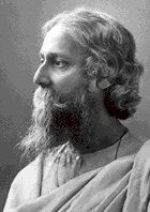
Rabindranath Tagore
India (1861 – 1941) Timeline |
Aug 16 2017
Master I’s Chamber in the Ta-yu Temple
by Meng Hao-jan
English version by J. P. Seaton
I-Kung’s place to practice Ch’an:
a hut in an empty grove.
Outside the door, a single pretty peak.
Before the stair, deep valleys.
Sunset confused in footprints of the rain.
Blue of the void in the shade of the court.
Look, and see the lotus blossom’s purity:
know then that nothing taints this heart.
 — from The Poetry of Zen: (Shambhala Library), Edited by Sam Hamill / Edited by J. P. Seaton

/ Image by toehk /
The first several lines of this poem paint for us serene, somewhat lonely images:
a meditation hut in an empty grove…
a mountain peak spied through the doorway…
stairs descending into valleys…
rain puddles reflecting the sunset…
space enclosed by a shaded court…
(By the way, isn’t that a wonderful phrase, “footprints of the rain”? As if the rain — or some spirit of the natural world — is walking toward us in reflections upon the earth…)
Besides the peace and stillness suggested by these images, what else do you notice? These are human spaces at the edge of the natural world… but there is no human presence here.
These are all images of meditation: harmony, simplicity, nature, and no agitated ego there to stir up the dust.
That last couple of lines–
Look, and see the lotus blossom’s purity:
know then that nothing taints this heart.
The purity of the lotus blossom is an important esoteric theme in the poetry of both Hinduism and Buddhism. Picture a lotus flower for a moment. The lotus rises through the murky waters of ponds and lakes yet, when it blooms, it floats upon the surface, its petals shining and untainted by the mud from which it emerged. In the scriptural language and sacred poetry of Hinduism and Buddhism, the lotus perfectly embodies the soul, rising up through the murkiness of worldly experience until it reaches the surface of the spiritual realm and blooms, vibrant and pure, free from all taint and attachment.
This is why Meng Hao-jan immediately follows his mention of the lotus blossom’s purity with his reference to the untainted heart. No matter what the heart experiences, loss, sorrow, suffering, disgrace, when it truly opens, it is surprisingly untouched. So much of life wounds. Who can deny it? Yet somehow the battered heart blossoms with such beauty and love, no hint of past hurts.
This untainted opening of the heart is not an emotion, not even something one works at. This is simply what happens. With meditation or prayer, the cultivation of inner quiet and generosity and humility, the heart surprises with its unexpected budding and blossoming. Just wait and watch.
Recommended Books: Meng Hao-jan
|
 |
 |
||
| The Poetry of Zen: (Shambhala Library) | Sunflower Splendor: Three Thousand Years of Chinese Poetry | The Mountain Poems of Meng Hao-jan | ||
|
Meng Hao-jan
China (689 – 740) Timeline |
Aug 09 2017
Always Mine!
by Emily Dickinson
Always Mine!
No more Vacation!
Term of Light this Day begun!
Failless as the fair rotation
Of the Seasons and the Sun.
Old the Grace, but new the Subjects —
Old, indeed, the East,
Yet upon His Purple Programme
Every Dawn, is first.
 — from The Complete Poems of Emily Dickinson, Edited by Thomas H. Johnson

/ Image by capt_tain Tom /
When I was first introduced to Emily Dickinson’s poetry as a teenager, I immediately responded to the power of her writing. Her short, staccato lines, words and phrases connected by dashes and strange punctuation. Statements filled with intensity, as if she can barely get the words out. But it wasn’t always clear to me what she was really saying.
It wasn’t until much later, re-reading her writing as an adult, that a light went off in my mind, and I realized that much of the commentary I had read of her poetry had missed the essential element of her poetry — that Emily Dickinson was, in fact, a mystic describing ecstatic states of awareness.
Don’t take my word for it, just consider the possibility. And then reread her poetry with that idea in mind.
This poem, for example. Why does she rapturously proclaim, “Always Mine!” Something or someone she had been passionately seeking is discovered to already belong to her, to have always been hers. There is “no more vacation,” no longer a sense of separation or distance. For her, it is as if a new day has begun, filled with light, as dependable as the seasons.
I especially respond to the line:
Old the Grace, but new the Subjects —
The sense of grace that fills her is “old,” ancient, familiar, as if it has always been there, yet she notices for the first time how it shines anew on everything. Everything is new when seen in this new light.
She expands on this with:
Old, indeed, the East,
Yet upon His Purple Programme
Every Dawn, is first.
The East, the direction of the sunrise, the direction of enlightenment, has always been there, yet amidst its royal purple majesty, every dawn is new and wondrous.
Re-reading this poem, does it seem like a lonely recluse’s breathless praise of the morning or perhaps a secret love, or is it genuinely ecstatic, describing an awareness that is profound and alive?
Recommended Books: Emily Dickinson
|
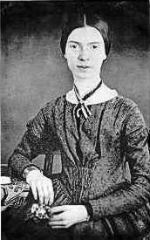
Emily Dickinson
US (1830 – 1886) Timeline |
Aug 09 2017
Never accept the logic of expediency
over compassion.
We need a world that’s less efficient
and more humane.
Aug 04 2017
You ask why I make my home in the mountain forest
by Li Bai
English version by Sam Hamill
You ask why I make my home in the mountain forest,
and I smile, and am silent,
and even my soul remains quiet:
it lives in the other world
which no one owns.
The peach trees blossom,
The water flows.
— from Endless River: Li Po and Tu Fu: A Friendship in Poetry, Translated by Sam Hamill

/ Image by neil alejandro /
I thought I’d share a moment of peace…
I smile, and am silent,
and even my soul remains quiet…
These lines bring me to rest.
The mind at rest, the entire self at rest, all silt having settled, leaving only quiet clarity. One becomes empty, a spacious, silent witness to the world’s unfolding.
The peach trees blossom,
The water flows
Have a beautiful weekend!

|
Li Bai |
Aug 04 2017
Commune with nature.
But don’t go out and do something in nature.
Go out and let nature do something in you!


