Jan 31 2018
blank page
Instead of memorizing the words of scripture,
become the blank page
that effortlessly displays them.
Jan 31 2018
Instead of memorizing the words of scripture,
become the blank page
that effortlessly displays them.
Jan 26 2018
Miles of frost
by Buson
English version by Lucien Stryk and Takashi Ikemoto
Miles of frost —
on the lake
the moon’s my own.
 — from Zen Poetry: Let the Spring Breeze Enter, Translated by Lucien Stryk / Translated by Takashi Ikemoto
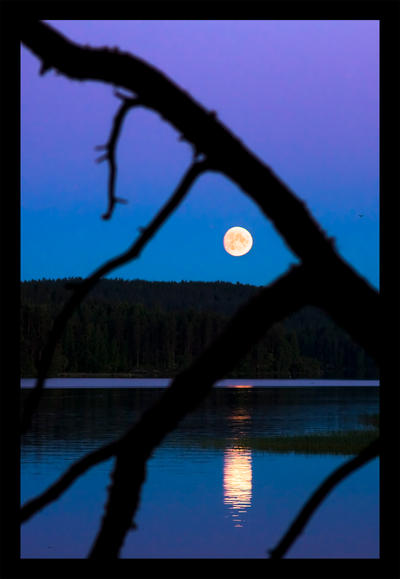
/ Image by 4k1 /
This haiku doesn’t emphasize that pivot that startles the awareness into new insight. Instead, it offers us a pure moment of winter solitude at dusk.
Miles of frost —
This phrasing suggests not only a chilly evening, but a landscape of silence. No activity. No carts on the road. No animals scurrying in the underbrush. Nothing but untouched frost upon the land.
In the midst of this scene of chill stillness stands the implied observer — us. We stand there alone in the quiet scene, elevated as the solitary presence, wrapped in curling mist of our own breath.
And then we see the moon reflected upon the lake’s surface at twilight.
on the lake
the moon’s my own.
With no one else to witness it, the moon becomes a private gift. The moon and the observer share this moment of intimacy in the silent company of the lake.
We can, if we choose, read this in a more consciously spiritual light: The full moon is often used to suggest enlightened awareness. The lake is mind. When the surface is still, the mind has grown quiet and it reflects the serene light of the moon. The miles of frost can suggest the wider world as perceived by the senses has also been quieted through spiritual practice. In this unified state of stillness, the moon, enlightenment, becomes one’s own.
Or perhaps it is only a lake and the moon on a quiet night. Then again, perhaps the moon’s reflection whispers to us of enlightenment, whether we recognize it or not.
|
 |
 |
||
| Zen Poetry: Let the Spring Breeze Enter | The Poetry of Zen: (Shambhala Library) | The Moon Over Tagoto: Selected Haiku of Buson | ||

|
Buson
Japan (1716 – 1784) Timeline |
Jan 12 2018
A Contribution to Statistics
by Wislawa Szymborska
English version by Clare Cavanagh and Stanislaw Baranczak
Out of a hundred people
those who always know better
— fifty-two
doubting every step
— nearly all the rest,
glad to lend a hand
if it doesn’t take too long
— as high as forty-nine,
always good
because they can’t be otherwise
— four, well maybe five,
able to admire without envy
— eighteen,
suffering illusions
induced by fleeting youth
— sixty, give or take a few,
not to be taken lightly
— forty and four,
living in constant fear
of someone or something
— seventy-seven,
capable of happiness
— twenty-something tops,
harmless singly, savage in crowds
— half at least,
cruel
when forced by circumstances
— better not to know
even ballpark figures,
wise after the fact
— just a couple more
than wise before it,
taking only things from life
— thirty
(I wish I were wrong),
hunched in pain,
no flashlight in the dark
— eighty-three
sooner or later,
righteous
— thirty-five, which is a lot,
righteous
and understanding
— three,
worthy of compassion
— ninety-nine,
mortal
— a hundred out of a hundred.
Thus far this figure still remains unchanged.
 — from Poems New and Collected, by Wislawa Szymborska / Translated by Stanislaw Baranczak
/ Image by Andy Maguire /
I always knew statistics had a poetic heart. After such terrible abuse by advertisers and politicians, statistics will redeem themselves in great and painful art.
worthy of compassion
— ninety-nine,
mortal
— a hundred out of a hundred.
Thus far this figure still remains unchanged.
Of course, even the best-natured of statistics exist to taunt us, to challenge us. Then again, that’s what those irascible poets do too…
Recommended Books: Wislawa Szymborska
|
 |
 |
 |
 |
| Poems New and Collected | Miracle Fair: Selected Poems of Wislawa Szymborska | View with a Grain of Sand: Selected Poems | Nothing Twice: Selected Poems | Dancing with Joy: 99 Poems |
| More Books >> | ||||

|
Wislawa Szymborska
Poland (1923 – 2012) Timeline |
Jan 10 2018
The holiest place
we can discover
is immediately behind the breastbone.
Jan 05 2018
The Patience of Ordinary Things
by Pat Schneider
It is a kind of love, is it not?
How the cup holds the tea,
How the chair stands sturdy and foursquare,
How the floor receives the bottoms of shoes
Or toes. How soles of feet know
Where they’re supposed to be.
I’ve been thinking about the patience
Of ordinary things, how clothes
Wait respectfully in closets
And soap dries quietly in the dish,
And towels drink the wet
From the skin of the back.
And the lovely repetition of stairs.
And what is more generous than a window?
 — from Another River: New and Selected Poems, by Pat Schneider

/ Image by snap713 /
I’m back. We’re back. The Poetry Chaikhana is back.
Sorry about the unannounced hiatus, but I decided I should take some time to recharge my batteries.
I hope it was a special Christmas, Hanukkah, Solstice, New Year (pick any or all of the above) for you and your families.
=
I want to say, Thank you, Lalita, for introducing me to this poem. Since I am new to Pat Schneider’s writing, I don’t know much about her. I look forward to learning more.
It is a kind of love, is it not?
How the cup holds the tea…
There is something supremely settling about this poem. The poet reminds us to see how each object, simply by acting according to their nature is actually an embodiment of a sort of universal love.
How the chair stands sturdy and foursquare,
How the floor receives the bottoms of shoes
Or toes. How soles of feet know
Where they’re supposed to be.
Objects simply are as they are, and their “actions” naturally flow from their form. Through being, self-acceptance, and natural self-expression, these objects express a humble enlightenment and service in the world.
We just need to see it. And learn from these quiet teachers.
And what is more generous than a window?
Recommended Books: Pat Schneider

|
Pat Schneider |


