Archive for October, 2018

Oct 31 2018

Abhishiktananda – Return within

Published by under Ivan's Story,Poetry

Return within
by Abhishiktananda, Swami (Henri Le Saux)

English version by H. Sandeman (?)

Return within,
to the place where there is nothing,
and take care that nothing comes in.
Penetrate to the depths of yourself,
to the place where thought no longer exists,
and take care that no thought arises there!
There where nothing exists,
Fullness!
There where nothing is seen,
the Vision of Being!
There where nothing appears any longer,
the sudden appearing of the Self!
Dhyana is this!

— from Guru and Disciple: An Encounter with Sri Gnanananda, a Contemporary Spiritual Master, by Swami Abhishiktananda / Translated by H. Sandeman


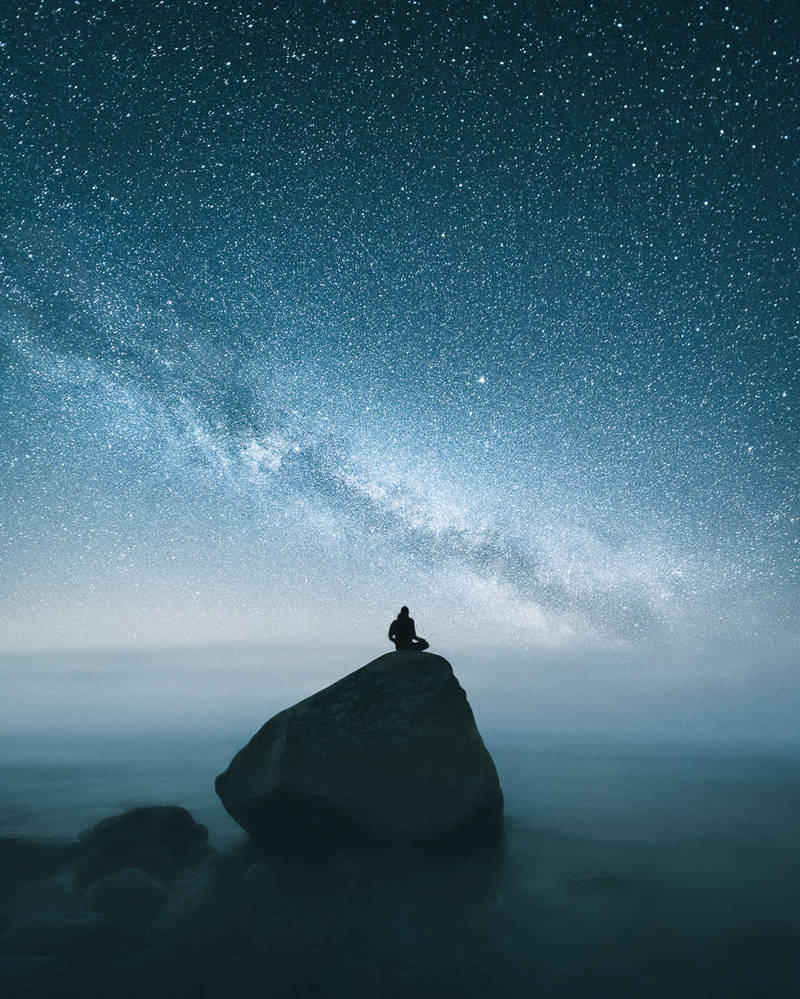
/ Image by MikkoLagerstedt /

Return within…

A powerful description of deep meditation. (The word dhyana in the last line means meditation.)

There where nothing exists,
Fullness!

=

I have received several notes asking when the poem emails will resume. I had a particularly challenging chronic fatigue crash a couple of weeks ago, and I have been regrouping since then, recalibrating my health regime while doing my best to maintain my work hours with my day job. It may take me a couple more weeks to get into a regular pattern with the poetry emails once again. But I am generally improving and more Poetry Chaikhana will be coming your way soon!

I am also very aware of how much our attention here in the US and in the world is being taken up by the upcoming mid-term elections, by the terrible shooting of worshippers at the synagogue in Pittsburgh, and, for many, the sense of betrayal at the recent confirmation of Kavanaugh to the US Supreme Court. That’s just a partial list.

It is important that, in the midst of however we reach out to help in the world, we remember to regularly “return within.” It is that inner connection that imbues our outer action with its meaning and strength and resonance in the world.

Sending love to you all.


Recommended Books: Abhishiktananda, Swami (Henri Le Saux)

Guru and Disciple: An Encounter with Sri Gnanananda, a Contemporary Spiritual Master The Secret of Arunachala: A Christian Hermit on Shiva’s Holy Mountain The Further Shore Swami Abhishiktananda: Essential Writings Prayer
More Books >>


Abhishiktananda, Swami (Henri Le Saux), Abhishiktananda, Swami (Henri Le Saux) poetry, Christian poetry Abhishiktananda, Swami (Henri Le Saux)

France, India (1910 – 1973) Timeline
Christian : Catholic
Yoga / Hindu : Advaita / Non-Dualist

Continue Reading »

4 responses so far

Oct 31 2018

find out

The question is not
whether or not you believe.
The real question is
whether or not you are determined
to find out for yourself.

One response so far

Oct 12 2018

Kamalakanta – O Kali, my Mother full of Bliss!

Published by under Poetry

O Kali, my Mother full of Bliss!
by Kamalakanta

O Kali, my Mother full of Bliss!
Enchantress of the almighty Shiva!
In Thy delirious joy Thou dancest,
clapping Thy hands together!
Eternal One! Thou great First Cause,
clothed in the form of the Void!
Thou wearest the moon upon Thy brow.
Where didst Thou find Thy garland of heads
before the universe was made?
Thou art the Mover of all that move,
and we are but Thy helpless toys;
We move alone as Thou movest us
and speak as through us Thou speakest.
But worthless Kamalakanta says,
fondly berating Thee:
Confoundress! With Thy flashing sword
Thoughtlessly Thou hast put to death
my virtue and my sin alike!

— from Kali: The Black Goddess of Dakshineswar, by Elizabeth U. Harding


/ Image by Chobist /

Many of my Hindu friends are celebrating Navratri right now, the nine nights of the Great Goddess. Some traditions divide Navratri into three sets of three nights: the first three dedicated to Durga or Kali, who clears out the old and out of balance to make way for more divine manifestations of life; the next three nights are dedicated to Lakshmi, who grants wealth, both spiritual and material; while the final three nights are dedicated to Saraswati, the goddess of wisdom.

I thought I’d select this poem for us today…

To appreciate this poem we need to know a few things about the traditional Hindu representations of the Goddess.

In Hindu tradition and metaphysics, the Goddess represents many aspects of the Divine. The iconography we find in Hinduism gives us a fascinating kaleidoscope of meaning. The Goddess can represent Mother, the Great Source, the Void/Womb from which all are born, Manifestation, Creation, Vibration, Speech, Song, the Arts, Beauty, Darkness, Mystery, all of the World (and all its Illusions). But with birth, also comes death, with manifestation, also comes dissolution; anything with a beginning also has an end. Only the eternal is eternal. So the Goddess, Mother and Manifestor, is also sometimes portrayed as Destroyer. She is Life and Death both. She is the Power that brings all into being, animates and enlivens the universe, and also draws it back into non-being. But even in Her fiercest aspect, the Mother Goddess is loving. For Her, death is merely the death of illusion and the return to Self.

Many Westerners at first find the iconography associated with the goddess Kali unsettling and can’t understand why so many beloved saints, like the gentle Ramakrishna, were so deeply devoted to her. Let’s spend a few moments contemplating this powerful representation of the Divine Feminine…

Kali is sometimes called the Dark Mother: beautiful, wild, and terrible. She is depicted dancing in ecstasy upon a battle field, slaying demons in her fierce bliss.

Her skin is black and she is naked, symbolic of the Eternal Void with which she clothes herself.

Thou wearest the moon upon Thy brow.

She wears the moon upon her brow (as does her husband, Shiva), symbolizing the open spiritual eye and spiritual illumination. The crescent moon has the additional metaphorical meaning of mastery over the feminine, cyclical aspect of manifest nature, the way it ebbs and flows, grows full and then diminishes.

Where didst Thou find Thy garland of heads
before the universe was made?

Kali wears a garland of severed heads, a startling image, but one of deep spiritual significance. These are the heads of slain demons, each a spiritual impediment that she has removed. Well, she hasn’t really removed them; in slaying the demons, she has freed them, so that now their heads rest in bliss upon her breast.

Further, each head, severed at the neck, represents a specific sound; collectively, the heads represent the sound of divine speech, the foundational vibration or Eternal Word, through which the universe is manifested.

Confoundress! With Thy flashing sword
Thoughtlessly Thou hast put to death
my virtue and my sin alike!

We often get teasing lines like this in sacred poetry. In the deep spaces of bliss, when the ego identity has disappeared and thought has ceased, the tensions we associated with doing “good” or “bad” also disappear. This does not mean that one cannot distinguish between right and wrong, quite the opposite; one sees clearly for the first time. But there is no projection of “should” or “shouldn’t.” Instead, there is a profound sense of what simply is, and what is potential. The feeling of being caught in a tug-of-war between opposites and social compulsions vanishes. To the thinking mind, the mind chained to the ego, this is indeed confounding.

Kali can express a terrifying face of the Divine, but there is a reverse side to this. She may inspire terror, yes, but only in that which is out of harmony with the Eternal Will; seeing the Goddess, such energies know their end has come. If we ourselves cling to such disharmonious qualities, then we too may fear her. But when we let go of such clinging, approaching this great, formless Goddess with humility and courage, then terror is transformed into awe and overwhelming bliss.

You can say that this Dark Mother loves all her children so fiercely that she refuses to let any of us remain chained to comfortable but lethal delusions. Every soul needs such a loving, liberating mother, even when we don’t always appreciate her…

It’s a crisp autumn morning here. The snow from the last few days never quite stuck, the air is clear. The aspen leaves dance in green and gold, glistening in the light. Remember the beauty all around you!


Recommended Books: Kamalakanta

Singing to the Goddess: Poems to Kali and Uma from Bengal Kali: The Black Goddess of Dakshineswar


Kamalakanta

India (1769? – 1821?) Timeline
Yoga / Hindu : Shakta (Goddess-oriented)

Continue Reading »

4 responses so far

Oct 10 2018

Izumi Shikibu – Although the wind

Published by under Poetry

Although the wind
by Izumi Shikibu

English version by Jane Hirshfield

Although the wind
blows terribly here,
the moonlight also leaks
between the roof planks
of this ruined house.

— from Women in Praise of the Sacred: 43 Centuries of Spiritual Poetry by Women, Edited by Jane Hirshfield


/ Image by Manwathiell /

I have several loved ones feeling particular frustration and rage at how they have been treated after finding the courage to speak out about private traumas, only to be ignored and treated with contempt by a system that would rather maintain its fading myths than its heart.

An excerpt of something I posted on Facebook a few days ago–

I try to remind myself that the greatest healers in the world are often themselves wounded in some way. The ways we find to survive trauma can open us to deep truths about ourselves and the world, unlocking hidden strength. We might, for the first time, find our authentic voice. Sometimes our job is just to cry out with such a great pure ache that the world has no choice but to stop and let its heart break open. Survivors carry the medicine the world needs, whether or not the world is smart enough to recognizes it.


Recommended Books: Izumi Shikibu

Women in Praise of the Sacred: 43 Centuries of Spiritual Poetry by Women The Enlightened Heart: An Anthology of Sacred Poetry


Izumi Shikibu

Japan (974? – 1034?) Timeline
Buddhist : Zen / Chan

Continue Reading »

3 responses so far

Oct 10 2018

embody

We embody
each other.

One response so far

Oct 01 2018

Mevlana Jelaluddin Rumi – Inner Wakefulness

Published by under Poetry

Inner Wakefulness
by Mevlana Jelaluddin Rumi

English version by Coleman Barks

This place is a dream
only a sleeper considers it real
then death comes like dawn
and you wake up laughing
at what you thought
was your grief

A man goes to sleep in the town
where he has always lived
and he dreams
he’s living in another town
in the dream he doesn’t remember
the town he’s sleeping in his bed in
he believes the reality
of the dream town
the world is that kind of sleep

Humankind is being led
along an evolving course,
through this migration
of intelligences
and though we seem
to be sleeping
there is an inner wakefulness,
that directs the dream
and that will eventually
startle us back
to the truth of
who we are

— from The Essential Rumi, Translated by Coleman Barks


/ Image by psdlights /

Yesterday, September 30th, was Rumi’s 811th birthday. Happy birthday, Rumi!

Mevlana Jelaluddin Rumi is a titanic, open-hearted figure in the world, and his influence throughout the world and down through the centuries is immense. The continuing ripple effects of his poetry and his spirit have much more impact on most lives today than mere kings or generals. That’s the sort of hero the world really needs.

There is something so gentle about this selection, an easy description of sleeping, dreaming, evolution, and waking up laughing. Yet it can startle us awake.

This place is a dream
only a sleeper considers it real

Dreams and waking up… The metaphor of being spiritually “awake” is used a lot but not always with deep reflection. It is an easy concept to grasp, though it’s not taken very seriously most of the time because, of course, the person thinking about the idea of waking up is already awake in the most literal sense, right? The surprising answer is, Not really.

The experience of sudden spiritual opening reported by most mystics is surprisingly one of actually waking up. It’s as if we have been drifting through life in a dream state and just not known it. Nothing around us has changed, but we finally, truly see things as they are. The dream-like trance-mind of assumptions and projections that has stifled our perception for so long falls away like a heavy blanket. We blink, look around, and are surprised to realize we have been in a sort of half-seeing fog all of our life… and now we are awake for the first time.

and you wake up laughing
at what you thought
was your grief

Perhaps just as surprising — and much more confusing to the intellect — is the simultaneous recognition that while we were in that dream state, there was still some part of our awareness that was always fully awake, patiently watching in the background. It’s just that now that inner wakefulness has come to the forefront.

and though we seem
to be sleeping
there is an inner wakefulness

…A reminder to us that we don’t really need to “wake up;” instead, we just need to get out of the way of that part of ourselves that is already awake.

From a purely poetic point of view, I really like the lines–

Humankind is being led
along an evolving course,
through this migration
of intelligences

To me this suggests that each experience, each “dream,” each person’s life is part of a grand migration of the human spirit, a journey of deepening remembrance and renewal.


Recommended Books: Mevlana Jelaluddin Rumi

The Longing in Between: Sacred Poetry from Around the World (A Poetry Chaikhana Anthology) Poetry for the Spirit: Poems of Universal Wisdom and Beauty Music of a Distant Drum: Classical Arabic, Persian, Turkish & Hebrew Poems Perfume of the Desert: Inspirations from Sufi Wisdom Open Secret: Versions of Rumi
More Books >>


Mevlana Jelaluddin Rumi, Mevlana Jelaluddin Rumi poetry, Muslim / Sufi poetry Mevlana Jelaluddin Rumi

Afghanistan & Turkey (1207 – 1273) Timeline
Muslim / Sufi

Continue Reading »

4 responses so far

Oct 01 2018

blossoms

somehow the battered heart
blossoms with such beauty,
no hint of past hurts

One response so far