Archive for January, 2022

Jan 28 2022

Thich Nhat Hanh – Please Call Me by My True Names

Published by under Poetry

Please Call Me by My True Names
by Thich Nhat Hanh

Don’t say that I will depart tomorrow —
even today I am still arriving.

Look deeply: every second I am arriving
to be a bud on a Spring branch,
to be a tiny bird, with still-fragile wings,
learning to sing in my new nest,
to be a caterpillar in the heart of a flower,
to be a jewel hiding itself in a stone.

I still arrive, in order to laugh and to cry,
to fear and to hope.

The rhythm of my heart is the birth and death
of all that is alive.

I am the mayfly metamorphosing
on the surface of the river.
And I am the bird
that swoops down to swallow the mayfly.

I am the frog swimming happily
in the clear water of a pond.
And I am the grass-snake
that silently feeds itself on the frog.

I am the child in Uganda, all skin and bones,
my legs as thin as bamboo sticks.
And I am the arms merchant,
selling deadly weapons to Uganda.

I am the twelve-year-old girl,
refugee on a small boat,
who throws herself into the ocean
after being raped by a sea pirate.
And I am the pirate,
my heart not yet capable
of seeing and loving.

I am a member of the politburo,
with plenty of power in my hands.
And I am the man who has to pay
his “debt of blood” to my people
dying slowly in a forced-labor camp.

My joy is like Spring, so warm
it makes flowers bloom all over the Earth.
My pain is like a river of tears,
so vast it fills the four oceans.

Please call me by my true names,
so I can hear all my cries and my laughter at once,
so I can see that my joy and pain are one.

Please call me by my true names,
so I can wake up,
and so the door of my heart
can be left open,
the door of compassion.

— from Call Me by My True Names: The Collected Poems of Thich Nhat Hanh, by Thich Nhat Hanh
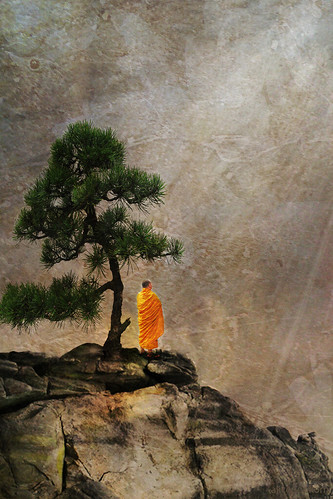

/ Image by AlicePopkorn /

This past week the great soul – spiritual teacher, peace activist, embodiment of compassion – Thich Nhat Hanh passed away at the age of 95.

Thich Nhat Hanh has been such an important international figure of spirituality, integrity, and compassion, all combined with peace activism, that his passing will be felt by so many across the globe.

Perhaps more than any other, this is the poem I think of first when I think of Thich Nhat Hanh, so I thought I would share it again today.

=

This is a lovely, unflinching meditation on how all of being and all of human experience weaves together into a single tapestry of the whole. It can even draw comparisons with Walt Whitman’s “Song of Myself,” where everything, terrible and beautiful, is one, is witnessed, and is found within oneself.

Don’t say that I will depart tomorrow —
even today I am still arriving.

Most of us have learned to anticipate what will happen next, and we end up mentally dwelling in our fantasies and fears about the future. But the future is merely an idea; it never has reality. The present moment is all that is ever real. And that is where we must dwell if we want to truly be alive and know what is real.

The present is a state of “still arriving.” Because the present moment is not a fixed space in time, we can’t say that anything encountered in the present is fixed and settled either. The present is a gossamer thin, moving thread of light where all things are just barely stepping into the visibility of being… as the moment keeps moving. Everything, everyone, in every second is always just arriving. The present is a continuous becoming.

Look deeply: every second I am arriving
to be a bud on a Spring branch,
to be a tiny bird, with still-fragile wings,
learning to sing in my new nest…

Another fascinating thing is discovered when we truly, deeply perceive the present moment: Not only are we and all things “still arriving,” but the illusion of boundaries and separate being falls away. The notion of identity expands and recognizes itself just as naturally in all things witnessed. We find we are not just the person watching the bud on the Spring branch, but in our arriving we are equally the Spring bud itself, the young bird, the caterpillar in the flower, the jewel waiting in the stone. This is not some poetic game of words; it is what we actually perceive ourselves to be.

The rhythm of my heart is the birth and death
of all that is alive.

When we finally see this truth, for the first time we can truly witness the world as it is. And that is what this poem is most about: witnessing. Thich Nhat Hanh invites us to courageously witness the panorama of life, wonders and horrors alike. Through this honest witnessing, we are not spectators watching others from a distance; no, it all unfolds upon us and in us. We are witnessing ourselves in many forms. We recognize that anything that happens anywhere in the world, is actually happening to us. Everything done, is done by ourselves… to ourselves. There is no unfolding experience in the world that we are not participants in.

Please call me by my true names,
so I can wake up,
and so the door of my heart
can be left open,
the door of compassion.

This is why compassion is not altruistic. This is why service is no effort. When we finally see things as they are, it is all part of our own selves. When we offer our heart, when we offer our hand, we are simply helping ourselves. Who among us, when he touches a hot iron, doesn’t immediately pull back and then soothe the burn under cool water? That’s not altruism, it is the natural response to pain in one’s body. When we see clearly, we see we are all of one body, and the joys and pains of any other is our own as well.

Compassion and a heart that has broken open are the natural result of being awake to this truth, and they are no effort at all.


Recommended Books: Thich Nhat Hanh

Call Me by My True Names: The Collected Poems of Thich Nhat Hanh The Heart of the Buddha’s Teaching: Transforming Suffering Into Peace, Joy & Liberation


Thich Nhat Hanh, Thich Nhat Hanh poetry, Buddhist poetry Thich Nhat Hanh

Vietnam/France/US (1926 – 2022) Timeline
Buddhist : Zen / Chan

More poetry by Thich Nhat Hanh

5 responses so far

Jan 28 2022

already brought about

Liberation is already brought about. It is already here.
What is truly essential is to fully engage yourself.

One response so far

Jan 21 2022

Thomas Merton – O Sweet Irrational Worship

Published by under Ivan's Story,Poetry

O Sweet Irrational Worship
by Thomas Merton

Wind and a bobwhite
And the afternoon sun.

By ceasing to question the sun
I have become light,

Bird and wind.

My leaves sing.

I am earth, earth

All these lighted things
Grow from my heart.

A tall, spare pine
Stands like the initial of my first
Name when I had one.

When I had a spirit,
When I was on fire
When this valley was
Made out of fresh air
You spoke my name
In naming Your silence:
O sweet, irrational worship!

I am earth, earth

My heart’s love
Bursts with hay and flowers.
I am a lake of blue air
In which my own appointed place
Field and valley
Stand reflected.

I am earth, earth

Out of my grass heart
Rises the bobwhite.

Out of my nameless weeds
His foolish worship.

— from Selected Poems of Thomas Merton, by Thomas Merton


/ Image by Begbie Images /

Well, I seem to be mostly recovered from the Covid I picked up a couple of weeks ago. It’s been no fun, certainly, a miserable sort of flu, but not the sort of thing to bring society to a halt. I know that different people have different reactions, that the vaccine can lessen symptoms, and that vulnerable individuals can end up in the hospital, but, having come through, I find myself asking if it is truly worth all of the fear and blame and isolation that has gripped society.

I shake my head and step outside where life continues. I listen to the wind. I wait for the winter clouds to part to feel the afternoon sun on my face.

Wind and a bobwhite
And the afternoon sun.

Bobwhite, if you don’t know what it is, is a quail-like bird with a unique whistle that sounds like bob-WHITE, bob-bob-WHITE. Reading the opening lines to Merton’s poem, I imagine a walk on a slow afternoon, a gentle breeze, the airy space cut by the clear whistle of the bobwhite.

By ceasing to question the sun
I have become light,
Bird and wind.

I can see a few possible reactions to this statement. Some might read the phrase “ceasing to question” as one of religious dogma, suggesting that a certain freedom comes from no longer questioning one’s belief system. Knowing Merton’s spiritually inclusive philosophy, I don’t think that’s what he intended.

Rather than standing outside of the moment, turning the scene into an external landscape for the questioning mind to define and label and remain apart from, we become quiet and present. We merge into the moment. We don’t see a pretty seen awash in light, we become the light itself… and the birdsong and the breeze. We fill the space.

I am earth, earth
All these lighted things
Grow from my heart.

The boundaries of identity expand. Who we are is not limited by the body or the stories we tell ourselves. We are everything spread out before us, the earth itself. From the earth’s deep heart, our heart, all things grow and emerge to be bathed in the light of the sun.

A tall, spare pine
Stands like the initial of my first
Name when I had one.

I love the way a bold, solitary tree stands forth to become a signifier of — what? An initial, one’s first name, one’s personal name. But that name itself has become ephemeral, lost in the larger self. With a quiet mind, we have become not only wordless, but nameless. Finding the wider self in the wider reality, we have moved beyond names.

Out of my nameless weeds
His foolish worship.

However we define worship, reverence, the celebration of life and innate goodness, may we allow ourselves to be swept up in it fully — foolishly.


Recommended Books: Thomas Merton

Selected Poems of Thomas Merton The Collected Poems of Thomas Merton A Thomas Merton Reader The Strange Islands: Poems by Thomas Merton Thomas Merton Monk & Poet: A Critical Study


Thomas Merton, Thomas Merton poetry, Christian poetry Thomas Merton

US (1915 – 1968) Timeline
Christian : Catholic

Continue Reading »

7 responses so far

Jan 21 2022

gentle prodding

We all feel it, a gentle prodding
to let the heart open,
to know ourselves truly, to be present
and radiate ourselves into the world.

No responses yet

Jan 14 2022

Denise Levertov – Looking, Walking, Being

Published by under Poetry

Looking, Walking, Being
by Denise Levertov

“The World is not something to
look at, it is something to be in.”
— Mark Rudman

I look and look.
Looking’s a way of being: one becomes,
sometimes, a pair of eyes walking.
Walking wherever looking takes one.

The eyes
dig and burrow into the world.
They touch
fanfare, howl, madrigal, clamor.
World and the past of it,
not only
visible present, solid and shadow
that looks at one looking.

And language? Rhythms
of echo and interruption?
That’s
a way of breathing.

breathing to sustain
looking,
walking and looking,
through the world,
in it.

— from Poems of Denise Levertov: 1960-1967, by Denise Levertov


/ Image by Amizyolaroid /

Okay, let’s start off with those wonderful lines:

Looking’s a way of being: one becomes,
sometimes, a pair of eyes walking.

This poem is a response to the Mark Rudman quote, “The World is not something to / look at, it is something to be in.” Denise Levertov answers that looking IS being.

The eyes
dig and burrow into the world.
They touch…

I suspect that Rudman was discouraging passivity and lack of presence, but Levertov, I think, is getting at something deeper still. Humans, all beings, in fact, are fundamentally beings of awareness. Each individual is a point of perception, a viewpoint in the universe. We are, each of us, “a pair of eyes walking.”

We are present through perception, not action. Yes, action and interaction can be a powerful way to force us to pay attention, but it is also common to use action to shut down the awareness. Whether in movement or in stillness, the real goal is to keep the eyes open and feel fully with the heart and with the gut. We want to do more than look, but to see and see deeply. We need to see what is ignored and glossed over, to “dig and burrow in the world.”

Even in complete stillness, truly seeing is one of the most profound actions we can engage in. People are brought to tears by a gentle gaze in the eyes. This is what the soul craves, to be seen, to be recognized, to be truly acknowledged. This is true not just of the human soul, but of the world soul. I think of this when Denise Levertov writes of how the world “looks at one looking.”

And language? Rhythms
of echo and interruption?
That’s
a way of breathing.

We forget that language is built of breath. We see the written word and we read it silently. Words become mental concepts, tools of the intellect. But words are not fundamentally discrete units of meaning. They flow and stop and flow again, as the breath does. Words aren’t inherently meaningful; they are the ornaments that accompany the flow of awareness.

Words affect breath. Thoughts affect breath. Breath guides awareness.

…breathing to sustain
looking…

Through the breath, we bring the outside world inside us, inside the body, inside the awareness. The boundary between self and the world is bridged by the breath. Through breath, we touch, we feel, we internalize, we connect, we participate, we come alive. Through breath we move and we see.

…walking and looking,
through the world,
in it.

Vision, language, breath… communion.


Recommended Books: Denise Levertov

Denise Levertov: Selected Poems Poems of Denise Levertov: 1960-1967 Breathing the Water The Great Unknowing: Last Poems Candles in Babylon
More Books >>


Denise Levertov, Denise Levertov poetry, Secular or Eclectic poetry Denise Levertov

US (1923 – 1997) Timeline
Secular or Eclectic : Beat
Jewish

More poetry by Denise Levertov

2 responses so far

Jan 14 2022

The deepest mystery

The deepest mystery
is in the mirror.

No responses yet