Archive for March, 2023

Mar 24 2023

Rainer Maria Rilke – I live my life in widening circles

Published by under Poetry

I live my life in widening circles
by Rainer Maria Rilke

English version by Anita Barrows and Joanna Macy

I live my life in widening circles
that reach out across the world.
I may not ever complete the last one,
but I give myself to it.

I circle around God, that primordial tower.
I have been circling for thousands of years,
and I still don’t know: am I a falcon,
a storm, or a great song?
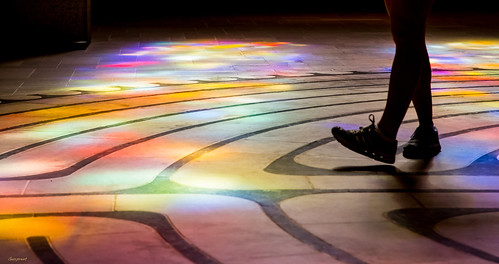

/ Image by GPS /

I don’t normally pay much attention to website statistics, but a few days ago I received a notice that one page on the Poetry Chaikhana website was spiking — the page with this poem by Rilke. That always gets me wondering, why the sudden interest in this poem? Is this poem part of a school curriculum and all the students decided to Google the same poem at once? Was this poem featured somewhere, on a radio program maybe, and all of the listeners wanted to look it up online? Another mystery of the Poetry Chaikhana…

But, when I went to my website and reread the poem myself, I thought, Ooh, this is good. I should share it again with everyone. So here you go, thanks to the mysterious actions of the world wide web…

I live my life in widening circles
that reach out across the world…

I circle around God, that primordial tower.

These images of circles and circling, revolving around a great center he names God, it makes me think of the cathedral labyrinths of Europe. Or the ancient spiral glyphs carved into rocks and cave faces. I see the circling pathway around some secret center. The road can be bewildering, twisting and turning, keeping us disoriented and uncertain of how near we are, but ever moving inward.

And that courageous line–

I may not ever complete the last one,
but I give myself to it.

We walk the winding path, not out of certainty, but because it is the only path worth walking. Walking that road, quietly, with attention, one foot in front of the other, becomes meditation. It becomes worship. Each ring, whether near or far, is a layer of our lives that is blessed by our passing through it.

Walking the circling path is not only the way to the center, it is actually part of the center. We learn to participate in the center by first walking the path. Obsession with the destination becomes an impediment to reaching it. Instead, by patiently inhabiting each step, we discover the center in ourselves… and then our feet naturally end up there.

We walk with our whole selves–

but I give myself to it…

and I still don’t know: am I a falcon,
a storm, or a great song?

On this roundabout road to God, we question our own nature. We encounter the mystery of self. Who and what are we really? Ultimately, it is in that questioning of a self that eludes definition where we find the still center.


Recommended Books: Rainer Maria Rilke

The Enlightened Heart: An Anthology of Sacred Poetry Ahead of All Parting: The Selected Poetry and Prose of Rainer Maria Rilke The Soul is Here for its Own Joy: Sacred Poems from Many Cultures Rilke’s Book of Hours: Love Poems to God In Praise of Mortality: Rilke’s Duino Elegies & Sonnets to Orpheus
More Books >>


Rainer Maria Rilke, Rainer Maria Rilke poetry, Secular or Eclectic poetry Rainer Maria Rilke

Germany (1875 – 1926) Timeline
Secular or Eclectic

More poetry by Rainer Maria Rilke

6 responses so far

Mar 24 2023

encounters of this moment

The encounters of this moment
fill the world.

No responses yet

Mar 17 2023

Emily Dickinson – I taste a liquor never brewed

I taste a liquor never brewed
by Emily Dickinson

I taste a liquor never brewed —
From Tankards scooped in Pearl —
Not all the Vats upon the Rhine
Yield such an Alcohol!

Inebriate of Air — am I —
And Debauchee of Dew —
Reeling — thro endless summer days —
From inns of Molten Blue —

When “Landlords” turn the drunken Bee
Out of the Foxglove’s door —
When Butterflies — renounce their “drams” —
I shall but drink more!

Till Seraphs swing their snowy Hats —
And Saints — to windows run —
To see the little Tippler
Leaning against the — Sun —

— from The Complete Poems of Emily Dickinson, Edited by Thomas H. Johnson


/ Image by Matheus Ferrero /

I taste a liquor never brewed —
From Tankards scooped in Pearl…

This poem should be read alongside the ecstatic wine poems of the Sufi saints.

None but the drunkard knows
      the tavern’s secrets —
how could the sober unveil
      the mysteries of that street?
~ Fakhruddin Iraqi

So let him weep for himself,
      one who wasted his life
            never having won a share
      or measure of this wine.
~ Umar ibn al-Farid

Wine… Why do so many mystics from all traditions talk of wine and drunkenness when speaking of ecstatic states of enlightenment? How do I, as a person who does not drink alcohol, understand this sacred wine fixation? Is it just a universally agreed upon metaphor to shock the orthodox? Well, yes, but it is more than that. The mystic’s wine is not wine, yet it is also more than a game of words. This wine is subtle but very real. It can be experienced in a profound, even physical manner.

Inebriate of Air — am I —
And Debauchee of Dew —

In certain states, a flowing substance is felt upon the palette, with a taste of ethereal sweetness that can be compared with wine or honey. This is the amrita of yogis, the ambrosia of the Greeks, the prophetic mead of the Norse shamans, the awen of the druids. There is a sensation of drinking a subtle liquid, accompanied by a warming and expanding of the heart. The attention blissfully turns inward, the eyelids grow pleasantly heavy and the gaze may become unfocused. A giddy smile naturally spreads across the face for no apparent reason. When the ecstasy comes on strongly, the body can tremble, sometimes the consciousness even leaves the body.

With these experiences, it not only makes sense for mystics to use the language of wine. Observers sometimes mistake this state for actual drunkenness.

This is the drink of initiation.

To many modern commentators, Emily Dickinson was a victim of unfulfilled love, a recluse who had become obsessed with death. I read this poem and I hear the words of a radiant awakened soul, someone ecstatically reeling through endless summer days.

Have a beautiful day discovering that sweet, secret dew!


Recommended Books: Emily Dickinson

The Longing in Between: Sacred Poetry from Around the World (A Poetry Chaikhana Anthology) The Complete Poems of Emily Dickinson This Dance of Bliss: Ecstatic Poetry from Around the World Women in Praise of the Sacred: 43 Centuries of Spiritual Poetry by Women The Enlightened Heart: An Anthology of Sacred Poetry
More Books >>


Emily Dickinson, Emily Dickinson poetry, Secular or Eclectic poetry Emily Dickinson

US (1830 – 1886) Timeline
Secular or Eclectic
Christian : Protestant

Continue Reading »

One response so far

Mar 17 2023

last gasp

The ego, drowning in bliss,
laughs with its last gasp.

No responses yet

Mar 10 2023

Czeslaw Milosz – On Angels

Published by under Poetry

On Angels
by Czeslaw Milosz

All was taken away from you: white dresses,
wings, even existence.
Yet I believe in you,
messengers.

There, where the world is turned inside out,
a heavy fabric embroidered with stars and beasts,
you stroll, inspecting the trustworthy seams.

Short is your stay here:
now and then at a matinal hour, if the sky is clear,
in a melody repeated by a bird,
or in the smell of apples at close of day
when the light makes the orchards magic.

They say somebody has invented you
but to me this does not sound convincing
for the humans invented themselves as well.

The voice — no doubt it is a valid proof,
as it can belong only to radiant creatures,
weightless and winged (after all, why not?),
girdled with the lightening.

I have heard that voice many a time when asleep
and, what is strange, I understood more or less
an order or an appeal in an unearthly tongue:

day draw near
another one
do what you can.

— from Against Forgetting: Twentieth-Century Poetry of Witness, Edited by Carolyn Forche


/ Image by Sixteen Miles Out /

This poem raises some interesting questions as it wrestles with the idea of angels and spiritual realities in general.

In the opening verse, although Milosz asserts that he believes in the “messengers” or angels, it also speaks from a thoroughly modern viewpoint. First, he points out the process of demythologizing, the stripping away of tangibility from the notion of angels in modern consciousness: “All was taken away from you: white dresses, / wings, even existence.”

When Milosz proclaims “Yet I believe in you, messengers,” he knows he is making a bold statement. Because of modern sensibilities, it is assumed that one does not believe in angels, at least not publicly among intellectuals. What would have been, in past centuries, a bland statement of belief, reads as startlingly sincere, maybe even intentionally naive in a modern poem.

As the poem continues, however, we begin to wonder if he is talking about the same notion of angels that the religiously minded might imagine. He offers us not winged, robed titans of the sky, but instead something ephemeral, delicate, all too easily missed. Milosz’s angels are the presence that rides in upon living moments and touch a hidden part of ourselves…

Short is your stay here:
now and then at a matinal hour, if the sky is clear,
in a melody repeated by a bird…

His angels seem to be that special touch upon the awareness when we truly encounter the moment… through the call of a bird before dawn, the warm scent of apples at sunset, when we pause and recognize that magic reaching out to us. What is it that reaches out to us? What is it that touches us and revives? Why not name it an angel? A messenger, a voice.

Czeslaw Milosz is a modern poet writing for a modern audience, what isn’t modern is his internal quiet. The modern mind is too often caught in staccato details, yet gently filling this entire poem is a sense of rest, wholeness, even timelessness. This poem quietly glows.

When we adopt Milosz’s stillness and learn to truly pay attention, we might just feel the brush of angel wings “in the smell of apples at close of day / when the light makes the orchards magic.”


Recommended Books: Czeslaw Milosz

New and Collected Poems 1931 – 2001 The Collected Poems Against Forgetting: Twentieth-Century Poetry of Witness To Begin Where I Am: The Selected Prose of Czeslaw Milosz A Treatise on Poetry
More Books >>


Czeslaw Milosz, Czeslaw Milosz poetry, Secular or Eclectic poetry Czeslaw Milosz

Poland (1911 – 2004) Timeline
Secular or Eclectic
Christian : Catholic

Continue Reading »

One response so far

Mar 10 2023

right action

Right action heals
in ways that even “success” cannot match.

No responses yet