Archive for May, 2023

May 26 2023

Gabriel Rosenstock – a star

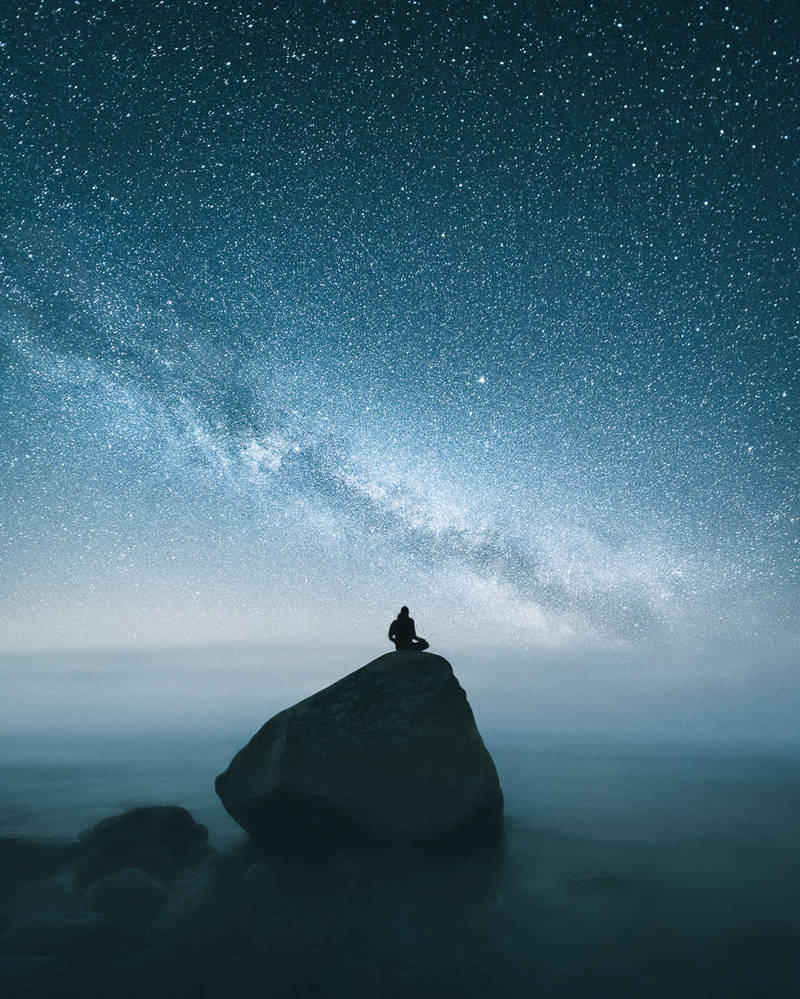
a star
by Gabriel Rosenstock

a star
a tree
and the longing in between

réalta
crann
is an tnúthán eatarthu

— from The Longing in Between: Sacred Poetry from Around the World (A Poetry Chaikhana Anthology), Edited by Ivan M. Granger


/ Image by AlicePopkorn /

Yesterday I was a guest on Dr. Laurel Trujillo’s podcast The Yoga Hour. We had a delightful, far reaching conversation on sacred poetry, healing, the importance of inspiration to feed the spirit… and the path of longing.

We started our conversation off with this poem by Gabriel Rosenstock, so naturally I decided to share it with all of you.

Without even formulating a complete sentence, Irish poet Gabriel Rosenstock gives us the whole spiritual endeavor—rootedness and aspiration, life, light, a terrible void, and the aching heart that impels us onward.

If longing poses the question, then union is the answer.

This vibrant tension between longing and union reminds me of a story told by the 10th century Persian Sufi master Junayd. When asked why spiritually realized masters weep, he responded by telling of two brothers who had been apart for years. Upon their reunion, they embraced and were filled with tears. The first brother declared, “What longing!” to which the second brother replied, “What joy!” Longing and fulfillment, the one is not separate from the other.

We think of longing as a state of lack. There is something or someone we want in our lives, but it is not there. Longing can feel hopeless. But longing is really a spectrum. That ache, that longing pulsates on one end, while union, wholeness, and completion eternally await on the other. It’s not that they’re separate, longing and union; they are connected. The one naturally flows into the other. Longing is not the lack of union; longing leads to union. Longing is an aspect of union. Longing is a landscape we learn and explore as part of the spiritual journey. As seekers we traverse that space between longing and union, becoming its student.

The mystic maps the territory between the soul and God, between lover and Beloved, between the little self and the true Self, between the transitory and the Eternal. The road connecting these is the road of longing. Mysticism is the science of longing.

Star and tree, longing fills their dreams, but they awaken touching.

=

Ivan Interview on The Yoga Hour

If you want to listen my discussion of sacred poetry on The Yoga Hour podcast, you can find it here:
https://www.theyogahour.com/episodes/sacred-poetry-insight-and-inspiration


Recommended Books: Gabriel Rosenstock

The Longing in Between: Sacred Poetry from Around the World (A Poetry Chaikhana Anthology) Haiku Enlightenment: New Expanded Edition Bliain an Bhandé – Year of the Goddess Uttering Her Name Where Light Begins: Haiku
More Books >>


Gabriel Rosenstock, Gabriel Rosenstock poetry, Secular or Eclectic poetry Gabriel Rosenstock

Ireland (1949 – )
Secular or Eclectic
Primal/Tribal/Shamanic : Celtic

Continue Reading »

2 responses so far

May 26 2023

secondhand

Be unsatisfied
with secondhand ideas about God.

No responses yet

May 26 2023

Ivan Interview on The Yoga Hour

Yesterday I was a guest on Dr. Laurel Trujillo’s podcast The Yoga Hour. We had a delightful, far reaching conversation on sacred poetry, healing, the importance of inspiration to feed the spirit… and the path of longing.

The Yoga Hour
https://www.theyogahour.com/episodes/sacred-poetry-insight-and-inspiration

0:00 Introduction
– Introduction to Ivan
– Short meditation by the host
6:15 Poem: a star, a tree…
7:40 The Longing in Between
– The path of longing
– spectrum between longing and union
10:42 continues
12:30 Poetry and prose
16:22 Poem: Navajo Prayer
– restored in beauty
– healing and wholeness
– bridge or meeting point between earth and heaven
22:20 How to form a relationship with a poem
– Poem as participation in the breath and consciousness of poet
29:25 Poem by Yogacharya O’Brien: OM
32:53 What does “chaikhana” mean?
– Teahouses along the Silk Road
– Connection of East and West
– Sufi story of Tea as the drink of initiates
36:10 Mystics
– The word “mystic” preferred to words like, saint or sage
– Free from cultural baggage
– Avoids dogma
– Someone who seeks the living truth, not just following rules
40:17 Poem: Last night as I was sleeping…
43:34 Metaphor and describing the indescribable
– Mundane awareness can work with simile
– Expanded awareness witness union, the interconnectedness of things
– Real metaphor emerges from this realization
– This is what sacred poetry emerges from
46:27 Poem by Yogacharya O’Brien: Satsanga
48:02 Through poetry the illuminated state becomes contagious…
– How poetry conveys the sacred experience
52:30 Poem: One Thread Only
53:07 Inspiration is essential food for the spirit

No responses yet

May 12 2023

Abhishiktananda, Swami (Henri Le Saux) – Return within

Published by under Poetry

Return within
by Abhishiktananda, Swami (Henri Le Saux)

English version by H. Sandeman (?)

Return within,
to the place where there is nothing,
and take care that nothing comes in.
Penetrate to the depths of yourself,
to the place where thought no longer exists,
and take care that no thought arises there!
There where nothing exists,
Fullness!
There where nothing is seen,
the Vision of Being!
There where nothing appears any longer,
the sudden appearing of the Self!
Dhyana is this!

— from Guru and Disciple: An Encounter with Sri Gnanananda, a Contemporary Spiritual Master, by Swami Abhishiktananda / Translated by H. Sandeman


/ Image by MikkoLagerstedt /

Return within…

A powerful description of deep meditation. (The word dhyana in the last line means meditation.)

There where nothing exists,
Fullness!

Abhishiktananda keeps mentioning nothing and nothingness, but each time that nothingness is entered into, we are greeted with fullness, the vision of Being, and ultimately, the appearance of the Self.

In the practice of Advaita Vedanta, everything is recognized as the Self — which a Catholic might recognize as the purified sense of being that is utterly identified with God until only God remains. When the thinking mind is brought to deep silence (“the place where thought no longer exists”), and we get so quiet that we allow the spacious stillness to wash over us, clearing away everything, including the small, grasping ego-self, that is the place “where nothing exists.”

But, in that place “where there is nothing,” that is, nothing that feels like a thing or an object, not even the personal self-thing, we then discover an unexpected flood of life and fullness and bliss.

There where nothing is seen,
the Vision of Being!

Perception shifts and everything is seen as a radiant Unity, the Vision of Being

There where nothing appears any longer,
the sudden appearing of the Self!

One’s very identity changes. What one was has ceased to exist, swept away in the vision of vastness. One’s sense of self is no longer a collection of qualities and habits and social projections. Instead, everything is found within and that Self has no boundaries!

Dhyana is this!

That is dhyana, true meditation.


Recommended Books: Abhishiktananda, Swami (Henri Le Saux)

Guru and Disciple: An Encounter with Sri Gnanananda, a Contemporary Spiritual Master The Secret of Arunachala: A Christian Hermit on Shiva’s Holy Mountain The Further Shore Swami Abhishiktananda: Essential Writings Prayer
More Books >>


Abhishiktananda, Swami (Henri Le Saux), Abhishiktananda, Swami (Henri Le Saux) poetry, Christian poetry Abhishiktananda, Swami (Henri Le Saux)

France, India (1910 – 1973) Timeline
Christian : Catholic
Yoga / Hindu : Advaita / Non-Dualist

Continue Reading »

5 responses so far

May 12 2023

silence will teach

Read these words, but ignore them.
The silence will teach you.

No responses yet

May 05 2023

Nizamoglu – The Path of Amazement

Published by under Poetry

The Path of Amazement
by Seyyid Seyfullah Nizamoglu

English version by Jennifer Ferraro and Latif Bolat

I cannot say who it is I am
      I am amazed, I am amazed!

I cannot call this self ‘myself’
      I am amazed, I am amazed!

Who is in my eyes seeing?
Who is in my heart enduring?
Who is inhaling and exhaling?
      I am amazed, I am amazed!

Who is speaking with my tongue?
Who is listening with my ears?
Who is understanding with my mind?
      I am amazed, I am amazed!

Who is stepping with these feet?
Who is tasting with my mouth?
Who is chewing and who swallowing?
      I am amazed, I am amazed!

Who holds these riches in his hand?
Who is the one throwing them away?
Who is buying and who selling?
      I am amazed, I am amazed!

Why is there life coursing below my skin?
Why are my eyes bloodshot from crying?
Why this religion, why this faith?
      I am amazed, I am amazed!

O Seyyid Nizamoglu, hear this:
Everything comes from the One.
Abandon yourself to this mighty beauty
      I am amazed, I am amazed!

— from Quarreling with God: Mystic Rebel Poems of the Dervishes of Turkey, Translated by Jennifer Ferraro / Translated by Latif Bolat


/ Image by Randy Jacob /

I cannot say who it is I am
      I am amazed, I am amazed!

This poem so interesting to me because of the way it fits with non-dualist traditions. The term “non-dualism” comes from the assertion or realization that there is no so such thing as duality. Despite the apparent multiplicity of existence, with its dizzying kaleidoscope of people and places and things, there is in reality only one unified Being. Carrying this insight further, there is no separate self, no self separate from other selves, no self separate from God.

Who is in my eyes seeing?
Who is in my heart enduring?
Who is inhaling and exhaling?

Some non-dualist pathways specifically use practices like this, a rigorous inquiry into the senses and perception, working through the layers of awareness. You might start by asking, What is it I see? What is it I feel with my touch? Then, How does perceiving this make me feel? What are my reactions? How do I tense or relax? Do I become agitated with anticipation of pleasure or pain? What thoughts does this perception trigger, and do I believe them?

And so the practice progresses, moving deeper until we begin to ask questions about the source of perception and awareness, from what to who. Who is thinking and feeling and perceiving? Who is it looking through my eyes? Who is it, really, who tastes that orange or listens to that songbird?

When we really look for that self, we don’t find it. There is an unexpected emptiness where we have always imagined the most important thing in the universe — one’s self — to be.

But then something wondrous happens. That emptiness lights up! We find instead a spacious, radiant being of bliss that is timeless and utterly whole.

We find not the self, but the Self.

I cannot call this self ‘myself’
      I am amazed, I am amazed!

We find that we are not the wounded, isolated being we so long imagined ourselves to be.

Instead, seated there in grandeur is something unimagined, immense beyond description, filled with an all-embracing love and quiet clarity. And amazingly, that someone is at rest within you! (If you can say you exist at all, which you can’t.)

Abandon yourself to this mighty beauty
      I am amazed, I am amazed!

Have a beautiful day on this path of amazement!


Recommended Books: Seyyid Seyfullah Nizamoglu

Quarreling with God: Mystic Rebel Poems of the Dervishes of Turkey


Seyyid Seyfullah Nizamoglu

Turkey (16th Century) Timeline
Muslim / Sufi

Continue Reading »

2 responses so far

May 05 2023

Unlimited

Unedited memory.
Undistracted mind.
Unbound identity.
Unlimited awareness.

No responses yet