Archive for December, 2023

Dec 22 2023

Teresa of Avila (attributed) – You are Christ’s Hands

Published by under Ivan's Story,Poetry

You are Christ’s Hands
by Teresa of Avila

Christ has no body now on earth but yours,
      no hands but yours,
      no feet but yours,
Yours are the eyes through which to look out
      Christ’s compassion to the world
Yours are the feet with which he is to go about
      doing good;
Yours are the hands with which he is to bless men now.

— from The Longing in Between: Sacred Poetry from Around the World (A Poetry Chaikhana Anthology), Edited by Ivan M. Granger


/ Image by Jackson David /

It is the Solstice and Christmas is just a few days away. It will be a modest one for myself and my wife this year, but one with a lot of gratitude. We recently moved, still within our hometown of Eugene, Oregon. Because previously we had been renting a furnished place and our new home is not pre-furnished, we had to scramble to buy the basics so we weren’t living in an empty house. Also, amidst the grief over the loss of our beloved family dog of many years, Apollo, we adopted a new dog, Bowie, through a local rescue organization. So, rather than exchange a lot of gifts this year, my wife and I decided to make a list of all the gifts we have received or given to ourselves and our household over the past couple of months — everything from dishes and silverware to a bed. Even without wrapped packages, it feels like an abundant Christmas.

As some of you may recall, soon after we moved back to Eugene a little over a year ago, I was taken aback by the homeless population here. Frankly, homelessness had not seemed like such a prominent issue where we previously lived in Colorado. But not only here in Eugene, we are discovering that America’s homeless population is rapidly growing in many cities.

My wife and I have been trying to find ways to help or, at a minimum, not turn our hearts away. Of course we offer a few dollars during street encounters, when we have the cash, and when the situation feels safe. And we contribute to some local groups that work with the homeless and the hungry in the area. I know I can do more, though remaining in balance, both with health and other life commitments, is always a challenge.

I feel a tug-of-war that plays out in me. There is the Aries part of my personality that is a natural activist, that part of me that wants to go out and fix things, that wants to make the world a better place, to help the world recognize what a beautiful place it can be and should be. It’s that part of me that wants to do (and sometimes wants to force). And then there is an inner part of me that whispers, “Don’t do. Flow. In that way the small actions born naturally from your heart, actions that hardly feel like actions, will resonate in the world.”

Is there such a thing as being an actionless activist?

I am still figuring that one out.

=

While this poem is popularly attributed to St. Teresa of Avila, it is not among her officially recognized works. Scholars tell us that it was probably actually written in the late 19th century by Guy Pearse, a Methodist minister, and Sarah Eliza Rowntree, an English Quaker.

Regardless of the actual composer, this is one of my favorite prayer-poems. It is a prayer of supreme spiritual maturity. It is not someone imploring Christ to come and fix everything in the external way imagined by so many fundamentalist sects; rather, it recognizes the presence of the Divine within each of us and our sacred responsibility to embody that compassion and service within the world. Each one of us is the vehicle through which Christ (or Ishwara or the Buddha) enacts blessings in the world. Our job is to let that sacred current flow through us unhindered.

Yours are the hands with which he is to bless men now…

May we each find ways to uncoil ourselves and allow the divine flow of compassion to run unhindered through our hearts and our hands.


Recommended Books: Teresa of Avila

The Longing in Between: Sacred Poetry from Around the World (A Poetry Chaikhana Anthology) Women in Praise of the Sacred: 43 Centuries of Spiritual Poetry by Women Poetry for the Spirit: Poems of Universal Wisdom and Beauty For Lovers of God Everywhere: Poems of the Christian Mystics All Saints: Daily Reflections on Saints, Prophets, and Witnesses for Our Time
More Books >>


Teresa of Avila, Teresa of Avila poetry, Christian poetry Teresa of Avila

Spain (1515 – 1582) Timeline
Christian : Catholic

Continue Reading »

2 responses so far

Dec 22 2023

magic

Every word is an incantation,
each thought a spell.
Use your magic
wisely.

No responses yet

Dec 15 2023

Mirabai – The Heat of Midnight Tears

Published by under Poetry

The Heat of Midnight Tears
by Mirabai

English version by Robert Bly

Listen, my friend, this road is the heart opening,
Kissing his feet, resistance broken, tears all night.

If we could reach the Lord through immersion in water,
I would have asked to be born a fish in this life.
If we could reach Him through eating nothing but berries and wild nuts,
Then surely the saints would have been monkeys when they came from the womb!
If we could reach him by munching lettuce and dry leaves,
Then the goats would surely go to the Holy One before us!

If the worship of stone statues could bring us all the way,
I would have adored a granite mountain years ago.

Mirabai says: The heat of midnight tears will bring you to God.

— from The Winged Energy of Delight, Translated by Robert Bly


/ Image by Megyarsh /

Mirabai says that if we could reach God through bathing in sacred waters, fish would be the holiest creatures; if by subsisting only on nuts and berries, then monkeys would be better than saints. In other words, God is not limited to one thing or one place or one form of worship. God is not outside ourselves to be found elsewhere. And simple, mindless fixation on something we define as holy will not make us holy.

But what really caught my attention is how similar these lines are to the Gnostic Christian teachings in the Gospel of Thomas, which was only rediscovered in the early 1900s:

If those who lead you say, “Look, the kingdom is in the heavens,” then the birds of heaven will get there before you. If they say, “It is in the sea,” then the fish will be there first. Rather, the kingdom is within you and all around you. When you know yourself, you will be known, and you will know you are children of the living father…

– Jesus, The Gospel of Thomas

Now, reread Mirabai’s words. Pretty striking similarity, isn’t it? It’s so nearly identical that one suspects the Gospel of Thomas was circulating through India in Mirabai’s time.

Both the Gospel of Thomas and Mirabai’s song are telling us that the Eternal One is not found some-where, nor in one specific form of worship. No place or object or action embodies God to the exclusion of others. That Presence is, in truth, everywhere, but is always discovered within.

Mirabai says: The heat of midnight tears will bring you to God.

Midnight is the time of lovers and longing.

The ego acts as the prim nurse standing guard to make certain the secret tryst cannot occur. But lovers always find a way. The magnetic power of intense longing cannot be denied. Such midnight tears finally shame even the ego (“resistance broken”), who disappears into the shadows that the Beloved may emerge.

The pathway is open, and that pathway is the heart.

This is what Mirabai is telling us: God is already there, waiting, hidden, but we must clear the pathway of the heart. Only then can we finally recognize the smiling features of the Beloved that have always been there.

Listen, my friend, this road is the heart opening…

=

I have been dealing with chronic fatigue issues for the first time in quite a while. Maintaining work hours has been challenging. I haven’t been keeping up with all of my Poetry Chaikhana correspondence — apologies if you have been waiting on a response from me. Even when I may seem unreachable, you are all still very much in my heart.

Have a beautiful day!


Recommended Books: Mirabai

Women in Praise of the Sacred: 43 Centuries of Spiritual Poetry by Women The Enlightened Heart: An Anthology of Sacred Poetry To Touch the Sky: Poems of Mystical, Spiritual & Metaphysical Light The Winged Energy of Delight Songs of the Saints of India
More Books >>


Mirabai, Mirabai poetry, Yoga / Hindu poetry Mirabai

India (1498 – 1565?) Timeline
Yoga / Hindu : Vaishnava (Krishna/Rama)

Continue Reading »

5 responses so far

Dec 15 2023

miracle

A miracle isn’t an event or an experience.
It is a moment of recognition:
We glimpse the wider reality,
and what we witness washes us away.

No responses yet

Dec 01 2023

Walt Whitman – What is the grass?

Published by under Poetry

What is the grass?
by Walt Whitman

A child said What is the grass? fetching it to me with full hands,
How could I answer the child? I do not know what it is any more than he.
I guess it must be the flag of my disposition, out of hopeful green stuff woven.
Or I guess it is the handkerchief of the Lord,
A scented gift and remembrancer designedly dropped,
Bearing the owner’s name someway in the corners, that we may see and remark, and say Whose?
Or I guess the grass is itself a child, the produced babe of the vegetation.

Or I guess it is a uniform hieroglyphic,
And it means, Sprouting alike in broad zones and narrow zones,
Growing among black folks as among white,
Canuck, Tuckahoe, Congressman, Cuff, I give them the same, I receive them the same.

And now it seems to me the beautiful uncut hair of graves.
Tenderly will I use you curling grass,
It may be you transpire from the breasts of young men,
It may be if I had known them I would have loved them,
It may be you are from old people, or from offspring taken soon out of their mothers’ laps,
And here you are the mothers’ laps.
This grass is very dark to be from the white heads of old mothers,
Darker than the colorless beards of old men,
Dark to come from under the faint red roof of mouths.
O I perceive after all so many uttering tongues,
And I perceive they do not come from the roofs of mouths for nothing.
I wish I could translate the hints about the dead young men and women,
And the hints about old men and mothers, and the offspring taken soon out of their laps.
What do you think has become of the young and old men?
And what do you think has become of the women and children?
They are alive and well somewhere,
The smallest sprout shows there is really no death,
And if ever there was it led forward life, and does not wait at the end to arrest it,
And ceased the moment life appeared.
All goes onward and outward, nothing collapses,
And to die is different from what anyone supposed, and luckier.

— from The Longing in Between: Sacred Poetry from Around the World (A Poetry Chaikhana Anthology), Edited by Ivan M. Granger


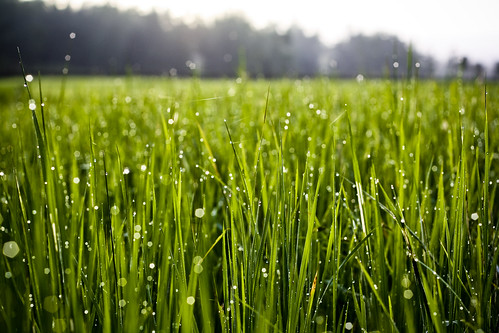
/ Image by NJ /

A comment on the Poetry Chaikhana blog from a couple days ago reminded me of this poem and commentary in The Longing in Between. I thought I’d share it with everyone.

=

Why does Whitman give us this prolonged meditation on grass? After all, it is just, well, grass. It is the same green plant surrounding every suburban home, and growing tall in every field and hillside all over the world. We tread on it every day. We know what grass is: it’s forgettable.

Not so, says Whitman. We think we know what grass is and remain ignorant. It is easy through familiarity to become blind. We see a lawn, mentally label it as “grass,” and never really look or bother to know this plant with which we share so much of the world.

This is what is so startling and refreshing about Whitman’s opening line–

A child said What is the grass? fetching it to me with full hands,
How could I answer the child? I do not know what it is any more than he

I love his utterly honest response. Most people presume they know exactly what grass is and can therefore dismiss it from their awareness. But the poet properly sees in the child’s fistful of grass a living mystery to be considered.

With Whitman we ask, what is grass really?

It is green hope. It is a handkerchief flirtatiously dropped by God to draw our thoughts to the lovely Face. It is the “babe of vegetation,” the embodiment of new life and new growth in the plant world.

What is grass? It is a hieroglyphic, a message layered with hidden meaning. It is a universal teaching encoded in life itself: Like the world’s green grasses, we must give generously of ourselves, equally to high and low, without regard to race or nation. Like the grass, it is our nature to grow and to be present, to share our life in every land and landscape.

Then Whitman enters an extended meditation on how grass connects life and death–

And now it seems to me the beautiful uncut hair of graves…
It may be you transpire from the breasts of young men…

Why this gloomy turn? He doesn’t just imagine the graves of the elderly who had lived the full measure of their lives, but he sees too the graves of young men and even infants “taken soon out of their mothers’ laps.” It is important to remember that Whitman is writing in the aftermath of the American Civil War. In fact, during the war, he worked in the New York hospitals. He well knew the bloody reality of young men sacrificed in war.

But here, and elsewhere in his poetry, Whitman makes room even for suffering and violence and death in his philosophy. While he clearly has a compassionate heart, he does not simply label some experiences as unjust, which then must be heroically opposed. Instead, it is as if he watches it all — the beauty and the suffering, everything — unfolding… within himself. It is all him. It is all in the scope of his being. Doing this, he accomplishes a truly courageous feat: integration.

Through that integration, we gain a new vision. We see not life with its end in death, but a living, organic flow of life becoming life becoming life: a perpetual vision of self-renewal. And the grass is the embodiment of this process.

While the dead lie beneath the ground, this green life grows from their now quiet bodies, nourished by their hopes. From the dead comes such pure, delicate new life.

Though there is much to be mourned in Whitman’s catalog of the dead, I find the totality of his vision to be reassuring. The grass, the growth of new life, draws even the most premature and unjust deaths into a realm of wholeness and continuity. This vision, which has made room for death, yet is understood as part of a greater unfolding of life, welcomes us back into the family of life.

The smallest sprout shows there is really no death

Don’t you love that line? And–

All goes onward and outward — nothing collapses;
And to die is different from what anyone supposed, and luckier.

That last line, every time I read it I am brought to a halt, ready to laugh out loud. What is he saying? “To die is different from what anyone supposed, and luckier.”

This whole poem has been his observation on how life renews itself, even through death. But here Whitman seems to be implying something more personal and open-ended, as if his meditation has led him to the notion that death is a sort of initiation into a new and unexpected participation in existence. He has left us with a teasing, Zen-like riddle that offers few answers, yet opens up a pathway of vibrant questions…

=

PS – If you missed it from earlier this week, check out my Holiday Book Recommendations for 2023. Some wonderful collections to spend some long quiet moments with.


Recommended Books: Walt Whitman

The Longing in Between: Sacred Poetry from Around the World (A Poetry Chaikhana Anthology) The Oxford Book of English Mystical Verse Song of Myself Leaves of Grass Dead Poets Society (DVD)


Walt Whitman, Walt Whitman poetry, Secular or Eclectic poetry Walt Whitman

US (1819 – 1892) Timeline
Secular or Eclectic : Transcendentalist

Walt Whitman grew up in Brooklyn and Long Island. He trained as a printer starting at the age of twelve. He learned to love the written word and read all he could. In his late teens he became a teacher, then turned to journalism in his 20s, eventually moving to New Orleans as editor of a local newspaper. Having witnessed the cruelties of slavery in the South, he returned to Brooklyn as a confirmed abolitionist. Whitman self-published the first edition of what would come to be seen as his masterpiece, Leaves of Grass, in 1855, revising it several times in subsequent years. During the Civil War, Walt Whitman worked as a reporter and aided the wounded in local hospitals. Whitman struggled financially for many years, but with the successful publication of the 1882 edition of Leaves of Grass he finally began to earn enough money to purchase a house and live comfortably through his final years.

More poetry by Walt Whitman

2 responses so far

Dec 01 2023

deeply

Accept yourself
so deeply
that you are not afraid to let go
of what is not you.

No responses yet