May 15 2026
Emily Dickinson – I’m ceded
I’m ceded–I’ve stopped being Theirs
by Emily Dickinson
I’m ceded–I’ve stopped being Theirs–
The name They dropped upon my face
With water, in the country church
Is finished using, now,
And They can put it with my Dolls,
My childhood, and the string of spools,
I’ve finished threading–too–
Baptized, before, without the choice,
But this time, consciously, of Grace–
Unto supremest name–
Called to my full–The Crescent dropped–
Existence’s whole Arc, filled up,
With one small Diadem.
My second Rank–too small the first–
Crowned–Crowing–on my Father’s breast–
A half unconscious Queen–
But this time–Adequate–Erect,
With Will to choose, or to reject,
And I choose–just a Crown–
 — from Women in Praise of the Sacred: 43 Centuries of Spiritual Poetry by Women, Edited by Jane Hirshfield

/ Image by live-showtime /
I believe this poem belongs among the great enlightenment poems. At the same time its words pointedly cut at religious convention.
Something has happened. Something that makes Emily Dickinson erupt from the opening lines, fiercely asserting that she is “ceded,” that she has “stopped being Theirs.” This is a proclamation of supreme yielding or dying to oneself that is also her escape into freedom.
She no longer has use for “The name They dropped upon my face” when she was baptized. That name is now something that she has set aside with other childish things. Not just set aside, it has fallen away. Her social identity, the person “They” call Emily has ceased to exist. She has discovered herself to be something larger, more essential, more true. She has exploded into an identity so immense and all-encompassing that it is the “supremest name” — the Ultimate, the Absolute. She has been “Called to my full,” a state of awareness in which “Existence’s whole Arc” is “filled up.”
But also notice the iconoclastic way she refers to baptism. The first baptism was a baptism given to her “without the choice” and imposes upon her a name that is “too small,” that must be grown out of and abandoned. She implies that that first baptism initiated her into the social world, not the spiritual one. That name that “They dropped upon my face” had trapped her, making her “Theirs,” somehow controlled and contained by societal conventions represented by the “country church.” She contrasts this with being “Crowned,” a second baptism, but one received inwardly, “consciously, of Grace.” She implies that this second baptism is the real anointing that gives true freedom, not the baptism she received as a child. For much of the Christian world that is a dangerous assertion even today, a century and a half later. Her words challenge fellow Christians to seek the inner anointing, of which the outer baptism is a reflection.
The last line particularly grabs my attention, “And I choose–just a Crown–” Rather than choosing (or rejecting) a new name or renewed social ego, she possesses the clarity and “Will” to choose instead to reside in the immensity of this “supremest name.” What else needs to be said?
Recommended Books: Emily Dickinson



|
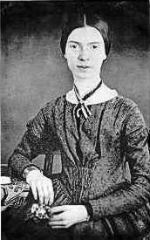
Emily Dickinson
US (1830 – 1886) Timeline |
Emily Dickinson was born in 1830 to a prominent family in Amherst, Massachusetts. Few of her poems were published during her lifetime, the bulk of her poetry having been discovered after her death in the 1880s. Despite this anonymity during her lifetime, Dickinson has come to be regarded as one of the greatest of American poets. Her unusual use of rhyme, meter, and grammar anticipates modernist trends in 20th century poetry.
She attended Amherst Academy and a year at Mount Holyoke Female Seminary.
While at the seminary, Dickinson famously refused to participate in the show of evangelical conversion sweeping through her community at the time. Much of her poetry, however, meditates on heaven and the inner life, often contrasting the private moment against public religious convention. She was clearly a critic of the common practice of religion, leading many to casually label her as an atheist, yet there is no denying that she experienced a rich inner life that she understood in religious terms. While unconventional by the religious standards of her day, the argument can be made that she was a deep mystic. If one reads her poetry side-by-side with the poet-saints of India, for example, the parallels in metaphoric language and insight become obvious.
Following her return from Mount Holyoke, Emily Dickinson almost never left Amherst again, rarely even leaving the grounds of her family home. Later in life she took to dressing entirely in white.
Much is made of Dickinson’s reclusive life, the fact that she never married, and the focus on death in much of her poetry, leading to descriptions of her as a morbid, sexually repressed recluse. One can see her in this way; or, recognizing the depth of her mysticism, we can imagine that she cultivated a self-defined monastic life of contemplation and poetry.
Wonder if you know my book “Cries of the Spirit,” which was the first anthology of women’s spiritual poetry–from Beacon Press?