Nov 04 2016
Yunus Emre – We entered the house of realization
We entered the house of realization
by Yunus Emre
English version by Kabir Helminski & Refik Algan
We entered the house of realization,
we witnessed the body.
The whirling skies, the many-layered earth,
the seventy-thousand veils,
we found in the body.
The night and the day, the planets,
the words inscribed on the Holy Tablets,
the hill that Moses climbed, the Temple,
and Israfil’s trumpet, we observed in the body.
Torah, Psalms, Gospel, Quran —
what these books have to say,
we found in the body.
Everybody says these words of Yunus
are true. Truth is wherever you want it.
We found it all within the body.
 — from The Drop That Became the Sea: Lyric Poems of Yunus Emre, Translated by Kabir Helminski / Translated by Refik Algan

/ Image by herfairytale /
We encountered the house of realization,
we witnessed the body.
Not only is the sacred always present — right here, right now — but that holiness is actually felt within the body.
When we talk of “the body” we tend to have a very concrete, materialistic idea of what we mean, this physical thing composed of muscle and bone. Its boundaries are hard and limited. In the end this body-thing contains very little.
But the body is more than this. Consider your dreams for a moment. In dreams, often you have a body there, as well. It is clearly not the same as the physical body, yet it too is your body within the reality of the dream. That dream body is capable of many actions and even transformations the physical body cannot. But is it not your body?
Both bodies, the physical body and the dream body, become the seat of our perception through which we experience the reality of the moment. Both bodies in some way are us.
These are just two of the many bodies we experience.
Let us call all of these collective bodies we inhabit the Body. Or we may call this the Self. This is the unedited and fully integrated being one is.
That limited package of organs and actions and sensory inputs doesn’t seem so claustrophobic to the spirit anymore.
The whirling skies, the many-layered earth,
the seventy-thousand veils,
we found in the body.
So when a mystic declares that entire worlds are found within the body, that isn’t just poetic metaphor. What this body actually is is much more than we first imagine. The boundaries of the body, which we once thought to end abruptly at the skin, are actually not there at all. The body continues, opening itself outward. All that we encounter and experience but imagine to be outside ourselves, all of that is actually contained within the body.
Here is what Yunus Emre is saying: By looking within the body, the body expands to encompass the universe. The fullness of reality is not outside oneself. It can never be fully recognized and integrated within the consciousness by looking outward. But by looking inward it is all there. And it is all you. Within the body.
Not only are all the pieces found within the body, but there they fit together harmoniously to form an integrated and harmonious whole. The natural interconnectedness of reality is recognized, which is the deep truth of all traditions.
Torah, Psalms, Gospel, Quran —
what these books have to say,
we found in the body.
In this expanded view of the Body/Self, let us not disregard the physical body, which was our starting point. The vision of harmonious immensity found within does, in fact, touch and affect the physical body too.
This vision is perceived as a rapturous bliss permeating all levels of awareness, including the physical body. In the physical body, every cell feels awakened, alive, sanctified. The whole body, from the most subtle to the most physical, vibrates with delight.
I am reminded of Kabir, the great Indian poet, who sang:
How could I ever express
How blessed I feel
To revel in such vast ecstasy
In my own body?
The touch of the Divine is tangible, it is felt… and it is always there, within the body.
Everybody says these words of Yunus
are true. Truth is wherever you want it.
We found it all within the body.


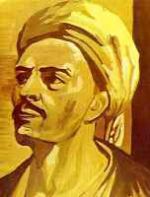
|
Yunus Emre
Turkey (1238 – 1320) Timeline |
Yunus Emre is considered by many to be one of the most important Turkish poets. Little can be said for certain of his life other than that he was a Sufi dervish of Anatolia. The love people have for his liberating poetry is reflected in the fact that many villages claim to be his birthplace, and many others claim to hold his tomb. He probably lived in the Karaman area.
His poetry expresses a deep personal mysticism and humanism and love for God.
He was a contemporary of Rumi, who settled in the same region after having moved from what is today Afghanistan. Rumi composed his collection of stories and songs for a well-educated urban circle of Sufis, writing primarily in the literary language of Persian. Yunus Emre, on the other hand, traveled and taught among the rural poor, singing his songs in the Turkish language of the common people.
A story is told of a meeting between the two great souls: Rumi asked Yunus Emre what he thought of his great work the Mathnawi. Yunus Emre said, “Excellent, excellent! But I would have done it differently.” Surprised, Rumi asked how. Yunus replied, “I would have written, ‘I came from the eternal, clothed myself in flesh, and took the name Yunus.'” That story perfectly illustrates Yunus Emre’s simple, direct approach that has made him so beloved.
You have explained the poem so well Ivan! According to the Hindu/Buddhist belief, even after death the causal body which is the repository of all thoughts, desires takes a new birth in a different form according to it’s past ‘karma’! The analogy given in the Buddhist tradition is that of a new lamp being lit by the old one! Nothing continues yet…
Thanks Ivan, I enjoy reading of your excellent site and regarding the Yunus’s poem i deeply believe and completely agree with your wonderful explanation that:’The natural interconnectedness of reality is recognized, which is the deep truth of all traditions.” One of the Persian poet says: “the universe became human being and human being became universe–who can put it concise better than this”. The Persian version is beautiful which i am not sure about my english translation. great job.