Jul 31 2018
Emily Dickinson – Who has not found the Heaven–below
Who has not found the Heaven–below
by Emily Dickinson
Who has not found the Heaven–below–
Will fail it above–
For Angels rent the House next ours,
Wherever we remove–
 — from The Longing in Between: Sacred Poetry from Around the World (A Poetry Chaikhana Anthology), Edited by Ivan M. Granger
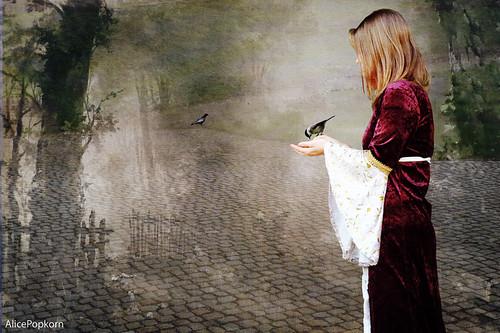
/ Image by Alice Popkorn /
These four lines by that reclusive American mystic, Emily Dickinson, proclaim a deep truth:
Who has not found the Heaven–below–
Will fail it above–
This statement has been getting mystics into trouble with orthodox religious authorities in every century. It is the assertion that heaven is not found somewhere ‘out there’–not in the future, not after death, not in some celestial otherworld. Heaven is here, now. It is within us and surrounds us, always! And–the most dangerous part of this insight—if we don’t discover it here “below,” it won’t be found elsewhere “above.”
A statement like this shatters the religious waiting game, waiting for death, waiting for the Second Coming (or for the Maitreya Buddha, or for a better rebirth, or whatever…) If the presence of Christ / Buddha-mind / fana / liberation is not recognized right here where we are, the passive expectation of it coming upon us some other day, at some other place, is sure to “fail.”
Another way of saying this is that, as we discover the heaven below, we find ourselves already dwelling in the heaven above. But, on the other hand, if we continue to deny the heaven below, we’ll fail to discover the gateway to heaven above.
Dickinson says, “For Angels rent the House next ours, / Wherever we remove–“ No matter where we go, the Divine Presence is right there with us. We just have to knock on the neighboring reality and introduce ourselves…
Recommended Books: Emily Dickinson


|
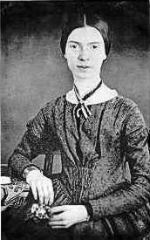
Emily Dickinson
US (1830 – 1886) Timeline |
Emily Dickinson was born in 1830 to a prominent family in Amherst, Massachusetts. Few of her poems were published during her lifetime, the bulk of her poetry having been discovered after her death in the 1880s. Despite this anonymity during her lifetime, Dickinson has come to be regarded as one of the greatest of American poets. Her unusual use of rhyme, meter, and grammar anticipates modernist trends in 20th century poetry.
She attended Amherst Academy and a year at Mount Holyoke Female Seminary.
While at the seminary, Dickinson famously refused to participate in the show of evangelical conversion sweeping through her community at the time. Much of her poetry, however, meditates on heaven and the inner life, often contrasting the private moment against public religious convention. She was clearly a critic of the common practice of religion, leading many to casually label her as an atheist, yet there is no denying that she experienced a rich inner life that she understood in religious terms. While unconventional by the religious standards of her day, the argument can be made that she was a deep mystic. If one reads her poetry side-by-side with the poet-saints of India, for example, the parallels in metaphoric language and insight become obvious.
Following her return from Mount Holyoke, Emily Dickinson almost never left Amherst again, rarely even leaving the grounds of her family home. Later in life she took to dressing entirely in white.
Much is made of Dickinson’s reclusive life, the fact that she never married, and the focus on death in much of her poetry, leading to descriptions of her as a morbid, sexually repressed recluse. One can see her in this way; or, recognizing the depth of her mysticism, we can suggest that she cultivated a self-defined monastic life of contemplation and poetry.
Could we dare to paraphrase Emily Dickinson
In another way,
From a bit another perspective
Like this:
Who has not found Heaven- INside
Will fail it –OUTside
For they MERGE in One
In ours Angel’s House
~
Let the power of Love Universe
from INside,Ivan,
make OUTside
smooth and easy the Path
Of the new Poetry Anthology…
Anna
I was blessed to play the part of Emily Dickinson in William Luce’s play “The Belle of Amherst” , reprising it over a period of 18 years. As Marion Woodman, the wonderful author, poet, analytical psychologist and mentor said, “Emily’s spirit is very much alive and continues to transform lives.”
As to your post today…..I offer these words of Emily’s ( From Belle of Amherst)
“God’s residence is next to mine
His furniture is Love”
“Father’s house and my garden,
this is my world .
And For my companions,
I have the hills and the sundowns,
and my dog Carlos, larger than myself
that my father bought me…
And they are better than beings,
For they know, but don’t tell
You see, I never had to go anywhere to find my paradise
it was all right here
in the only world I ever wanted.
Paradise is no journey
for it’s within
I travel that road
into my soul, all the time.
I dwell in possibility
a fairer house than prose
More numerous of windows
superior for doors
Of chambers as the Cedars
impregnable of eye
and for an ever lasting roof
the Gables at the sky
Of visitors the fairest
of occupation this
The spreading wide my narrow hands
to gather paradise”
*Please note, these words are arising from memory, ( I last performed over 20 years ago) … but the spirit of the words have etched themselves on my Soul. Emily is still alive and well.
Ivan….Always, deep gratitude for your luminous offerings !