Jan 17 2019
Hakuin – The monkey is reaching
The monkey is reaching
by Hakuin
English version by Norman Waddell
The monkey is reaching
For the moon in the water.
Until death overtakes him
He’ll never give up.
If he’d let go the branch and
Disappear in the deep pool,
The whole world would shine
With dazzling pureness.
 — from Essential Teachings of Zen Master Hakuin, by Norman Waddell

/ Image by NinjaRisu /
Hakuin paints for us an elaborate picture. First, we have the moon. It is reflected in water. A monkey hangs from a branch above the water, and it yearns for the moon that it sees reflected in the water. The monkey continually reaches into the water to grasp the moon, but the prize eludes his grip. He has constructed for us a Zen allegorical image.
Who is the monkey? Well, we are. Or, more specifically, it is the busy, grasping mind — the monkey mind. It is that chattering, erratic aspect of the awareness that we most often identify with.
The moon, as I have often pointed out, is a common representation in Zen poetry of enlightened awareness.
So the monkey, the mind, is seeking enlightenment, though it fails to understand what it is really grasping at. It just notices something shiny, and desires to possess it. The mind is not truly reaching for enlightenment; instead it grasps at a mere reflection of that light in the water below it.
What is this water? It can be understood as the world of manifest reality. It reflects the light of enlightenment. In fact, that is the world’s purpose. But while it appears to be real, it is fleeting, changing, ultimately intangible.
The monkey mind never tires of grasping at what shines and shimmers in reflection. This is partly because, in addition to the moon, the monkey sees itself reflected as well — and it loves its own face.
Hakuin laughs and gives us the solution: The monkey mind must let go of the branch it clings to and “disappear into the deep pool” of reality. The monkey’s fall represents the insight that the way is not attained through effort but through supreme yielding. When the mind stops grasping at reflections and, instead, fades into stillness, only then does the whole world shine “with dazzling pureness.” In other words, the mind can never possess enlightenment; it can only lose itself within it. When it finally yields itself, then enlightenment is discovered everywhere.
Have a beautiful day!


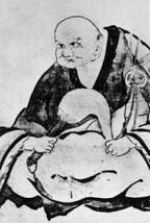 |
Hakuin
Japan (1686 – 1768) Timeline |
The Zen master Hakuin Ekaku, sometimes called Hakuin Zenji, was born Sugiyama Iwajiro in a small Japanese coastal village at the foot of Mt. Fuji.
When he was seven years old, Hakuin heard the reciting of a Buddhist sutra that described the terrors of hell. This so frightened the boy that he resolved to become a monk, in order to avoid such torments.
Though his parents opposed his decision, Hakuin took monastic vows at the age of 15.
He studied the Buddhist scriptures intensely, but was deeply shaken by reading of the painful death of a famous Chinese Chan master. The young Hakuin lost his faith in the Buddhist path for a while, hiding himself in the study of literature.
But, at the age of 22, he had his first experience of satori or enlightenment when he heard a sentence from a Buddhist scripture being recited.
After that, he dedicated himself wholeheartedly to the full realization of Nirvana, unshakable peace.
At this time, Zen Buddhism had become the court religion and, in its preeminence, lost much its inner spiritual vitality. Hakuin is credited with saving the tradition from its decline virtually single-handedly, returning Zen to its rich spiritual essence.
He organized koan training (authoring the famous koan, “What is the sound of one hand clapping?”) and re-emphasized the zazen practice of sitting meditation.
Hakuin’s reforms were highly effective, as seen by the profound impact Zen has in the world of spiritual practice today.
Some are still trying to climb that tree…
Not that there is anything wrong with it,
‘Cause without the monkey and the tree,
There is no alternate reality…..
Love this phrase… “the way is not attained through effort, but by supreme yielding.” Am working on it 🙂
Monkeys are reaching
There was a time here on this earth
In the beginning of the world cycle
When everyone was divine
That period was called heaven
Each one had a long life
There was not a single accidental death
Each one used to leave the body at their own will
when it was time to take another new body
Their bodies, souls and nature was too pure
There were no bodily or mind diseases
There were no hospitals, jails, courts or religions
There was One life style of purity, the only path of purity
As was the king so were the subjects all divine
After taking many births
we the souls became impure
We slowly came down
We acquired vices
Though our faces are of human beings
Yet our attitude is certainly of monkeys
God has shown us a very easy method
To become pure again
Just by being soul conscious and remembrance.
As long as we practice this method
We remain away from the vices
But it is not so easy to constantly
Remain soul conscious because
For half the world cycle we had been
Only body conscious as we forgot soul
Now at present again we are trying
To follow this simple and difficult path of
Soul consciousness which is the
Only way of purity
And get enlightened again.
***
This poem of Hakuin is very true, I understand that
water is this sansar
Reflection of the moon in the water is the
impossible purity in this world
Monkey is our unstable and unstoppable mind
Branch is the body consciousness (ego) which
if we let go then only we would become pure