Apr 22 2022
Walt Whitman – It is time to explain myself
[44] It is time to explain myself — let us stand up (from Song of Myself)
by Walt Whitman
It is time to explain myself — let us stand up.
What is known I strip away,
I launch all men and women forward with me into the Unknown.
The clock indicates the moment — but what does eternity indicate?
We have thus far exhausted trillions of winters and summers,
There are trillions ahead, and trillions ahead of them.
Births have brought us richness and variety,
And other births will bring us richness and variety.
I do not call one greater and one smaller,
That which fills its period and place is equal to any.
Were mankind murderous or jealous upon you, my brother, my sister?
I am sorry for you, they are not murderous or jealous upon me,
All has been gentle with me, I keep no account with lamentation,
(What have I to do with lamentation?)
I am an acme of things accomplished, and I am encloser of things to be.
My feet strike an apex of the apices of the stairs,
On every step bunches of ages, and larger bunches between the steps,
All below duly traveled, and still I mount and mount.
Rise after rise bow the phantoms behind me,
Afar down I see the huge first Nothing, I know I was even there,
I waited unseen and always, and slept through the lethargic mist,
And took my time, and took no hurt from the fetid carbon.
Long was I hugged close — long and long.
Immense have been the preparations for me,
Faithful and friendly the arms that have helped me.
Cycles ferried my cradle, rowing and rowing like cheerful boatmen,
For room to me stars kept aside in their own rings,
They sent influences to look after what was to hold me.
Before I was born out of my mother generations guided me,
My embryo has never been torpid, nothing could overlay it.
For it the nebula cohered to an orb,
The long slow strata piled to rest it on,
Vast vegetables gave it sustenance,
Monstrous sauroids transported it in their mouths and deposited it with care.
All forces have been steadily employed to complete and delight me,
Now on this spot I stand with my robust soul.
 — from Song of Myself, by Walt Whitman
/ Image by Nandhu Kumar /

I know this is a bit longer than most of the poems I send out, but don’t rush through it. Take a restful few moments to read this slowly. Enjoy the flavor of the words on your tongue, let them sweeten your thoughts.
Several of the lines from this selection ring through the decades. Find the lines that sing to you.
Like so much of Walt Whitman’s ‘Song of Myself,’ this chapter has a wonderful sense of the sacred tumult of life. He is especially meditating upon how all of life and the ages of the past “trillions of winters and summers” has led up to this moment, to this scintillating instant.
And it is in the present moment that he discovers himself resting upon the crest of the wave of eternity:
Long was I hugged close — long and long.
Immense have been the preparations for me…
Whitman isn’t interested in some sort of religious idea of perfection. For him, what is important is to inhabit the present (“That which fills its period and place is equal to any.”) and to recognize in the present (and in yourself) the fulfillment of eons (“I am an acme of things accomplished…”).
Yet, in the messy and sometimes tragic or “murderous” fullness of the present, nothing is static. The present continuously flows into the future: “…I am the encloser of things to be,” “…and still I mount and mount.”
Whitman comes to a profound realization when he sees back to “the huge first Nothing,” and proclaims, “I know I was even there.” He is not talking about some ancient event that he was present for in the historical sense. He is recognizing a fundamental truth of reality, that all of life and form is given birth from a living Void or Womb… and his awareness was there, and is still there now. In other words, he has discovered and is shouting out the realization that awareness precedes the world of physicality and form and time, that everything is born from a spacious emptiness full of living potential. That line, “I see the huge first Nothing, I know I was even there,” sounds startlingly like a Buddhist teaching that leads the practitioner to discover Nirvana or the Nothingness that is the true foundation of reality.
In this mighty vision of reality, Whitman continuously asserts that everything has led up to the immensity of the present moment, and to the vastness of the one who inhabits it — his very own Self. “All forces have been steadily employed to complete and delight me.”
Whitman invites us to call out with him:
Now on this spot I stand with my robust soul.
Recommended Books: Walt Whitman
 |
 |
|
 |
 |
| The Longing in Between: Sacred Poetry from Around the World (A Poetry Chaikhana Anthology) | The Oxford Book of English Mystical Verse | Song of Myself | Leaves of Grass | Dead Poets Society (DVD) |
|
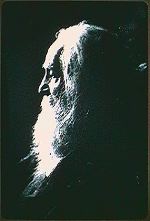
Walt Whitman
US (1819 – 1892) Timeline |
Walt Whitman grew up in Brooklyn and Long Island. He trained as a printer starting at the age of twelve. He learned to love the written word and read all he could. In his late teens he became a teacher, then turned to journalism in his 20s, eventually moving to New Orleans as editor of a local newspaper. Having witnessed the cruelties of slavery in the South, he returned to Brooklyn as a confirmed abolitionist. Whitman self-published the first edition of what would come to be seen as his masterpiece, Leaves of Grass, in 1855, revising it several times in subsequent years. During the Civil War, Walt Whitman worked as a reporter and aided the wounded in local hospitals. Whitman struggled financially for many years, but with the successful publication of the 1882 edition of Leaves of Grass he finally began to earn enough money to purchase a house and live comfortably through his final years.
In the golden age
We are soul conscious
In copper age
We feel sorrow for being
Body conscious hence
We call out O God
In the Confluence Age
We remember God with the
Divine Knowledge and
Let me explain
We become immortal.
I just encountered this poem! It was in the program for the funeral of a friend’s mother. So profound! I’ve read it several times in the 3 days since. I’ve never read Whitman – not so revered here in Australia. Will change my ignorance. Thanks.