Aug 26 2022
Rabindranath Tagore – The pang of separation
(84) It is the pang of separation that spreads throughout the world (from Gitanjali)
by Rabindranath Tagore
English version by Rabindranath Tagore
It is the pang of separation that spreads throughout the world and gives birth to shapes innumerable in the infinite sky.
It is this sorrow of separation that gazes in silence all night from star to star and becomes lyric among rustling leaves in rainy darkness of July.
It is this overspreading pain that deepens into loves and desires, into sufferings and joys in human homes; and this it is that ever melts and flows in songs through my poet’s heart.
 — from Gitanjali, by Rabindranath Tagore
/ Image by Abhijith P /

It is the pang of separation that spreads throughout the world and gives birth to shapes innumerable in the infinite sky.
Tagore’s poetry is the language of the soul, from its majestic heights to the most heartbreaking sense of separation.
We really get a sense of the void, the terrible gulf between everything that every soul quietly wrestles with…
It is this sorrow of separation that gazes in silence all night from star to star and becomes lyric among rustling leaves in rainy darkness of July.
So how then does he come to a sort of wholeness and universal empathy with his final line?
It is this overspreading pain that deepens into loves and desires, into sufferings and joys in human homes; and this it is that ever melts and flows in songs through my poet’s heart.
That sense of separation — separation from God, separation from Source, and separation from one another — is the fundamental pain of the soul. Every life pain, when we really trace its tendrils, reaches down to that root pain, the basic belief of separation. Every hunger, every craving, is an attempt to spread a thin layer of pleasure over that pain. Every self-inflicted hurt is an attempt to overpower that great ache with the sharp intensity of the moment. Most actions, when carefully dissected, are an attempt to distract ourselves from that terrible emptiness.
You can see that so much of our life force is spent in avoidance of confrontation with that gulf between self and other, the individual and the Eternal.
Most people look away, spend all their life running from that canyon of separation. But the mystic sits on the cliff edge and, though frightened, stares endlessly into the great space… until suddenly an amazing thing happens — in a flash the emptiness is seen to be not a distance but a connection, a joining. The gulf is itself the bridge spanning the distance, and we discover that we can walk upon it, that there was, in fact, never any separation or distance.
It is the very intensity of our yearning that is finally recognized as the point of connection with the Eternal. And then the pain flips, turning to such sweetness.
The next time you feel that pang of separation, just sit with it. Let your heart break. Let it break open. Feel the connection and life secretly spanning the gulf.
Recommended Books: Rabindranath Tagore
 |
|
 |
 |
|
| The Longing in Between: Sacred Poetry from Around the World (A Poetry Chaikhana Anthology) | Gitanjali | The Lover of God | The Fugitive | Lover’s Gift and Crossing |
| More Books >> | ||||
|
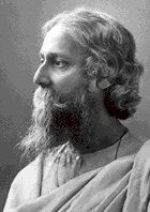
Rabindranath Tagore
India (1861 – 1941) Timeline |
Rabindranath Tagore (sometimes rendered in a more modern transliteration as Thakur or Thakura) was one of the great writers of the early 20th century.
He was born to a wealthy Brahmin family in Calcutta (Kolkata) in Bengal during the British occupation of India.
His mother died when “Rabi” was a young child and his father’s responsibilities often required travel, leaving Rabindranath to be raised by elder siblings and family servants. His family was central to regional political, intellectual, and artistic social circles, however, ensuring that the young Tagore was exposed to great art and learning from an early age.
Tagore began composing poetry by the age of six and showed such a natural gift that he, at the age of fourteen, published a set of poems under a pseudonym that was mistakenly received by critics as a long-lost masterpiece. Only later was it revealed that the author was the adolescent Tagore.
As an older teenager, Tagore was sent to study in England, but soon left school to more actively feed his wide-ranging interests through self-study.
At the beginning of the 20th century, Tagore established an ashram as a place for learning, teaching, and agricultural experimentation.
Tagore was a strong advocate for Indian self-determination in opposition to British imperial rule, while, at the same time, criticizing the most violent expressions of revolution.
During his lifetime, Tagore traveled extensively, meeting the world’s great writers, scientists, political leaders, and social reformers.
Rabindranath Tagore was also an accomplished painter, as well as a musician and prolific composer, with more than 2,000 songs to his credit.
Tagore’s poetry draws from the rich devotional poetic traditions of India, but rendered in a highly fluid, contemporary style. His impact on world poetry and literature is immense, especially writing that explores the modern mind through the mystic’s lens. Countless literary figures of the 20th century cite Tagore as an important influence and source of inspiration. Although his library of poetry is extensive, his most widely read and loved collection is The Gitanjali.
In 1913, he became the first non-European to with the Nobel Prize in Literature.