Mar 17 2023
Emily Dickinson – I taste a liquor never brewed
I taste a liquor never brewed
by Emily Dickinson
I taste a liquor never brewed —
From Tankards scooped in Pearl —
Not all the Vats upon the Rhine
Yield such an Alcohol!
Inebriate of Air — am I —
And Debauchee of Dew —
Reeling — thro endless summer days —
From inns of Molten Blue —
When “Landlords” turn the drunken Bee
Out of the Foxglove’s door —
When Butterflies — renounce their “drams” —
I shall but drink more!
Till Seraphs swing their snowy Hats —
And Saints — to windows run —
To see the little Tippler
Leaning against the — Sun —
 — from The Complete Poems of Emily Dickinson, Edited by Thomas H. Johnson
/ Image by Matheus Ferrero /

I taste a liquor never brewed —
From Tankards scooped in Pearl…
This poem should be read alongside the ecstatic wine poems of the Sufi saints.
None but the drunkard knows
the tavern’s secrets —
how could the sober unveil
the mysteries of that street?
~ Fakhruddin Iraqi
So let him weep for himself,
one who wasted his life
never having won a share
or measure of this wine.
~ Umar ibn al-Farid
Wine… Why do so many mystics from all traditions talk of wine and drunkenness when speaking of ecstatic states of enlightenment? How do I, as a person who does not drink alcohol, understand this sacred wine fixation? Is it just a universally agreed upon metaphor to shock the orthodox? Well, yes, but it is more than that. The mystic’s wine is not wine, yet it is also more than a game of words. This wine is subtle but very real. It can be experienced in a profound, even physical manner.
Inebriate of Air — am I —
And Debauchee of Dew —
In certain states, a flowing substance is felt upon the palette, with a taste of ethereal sweetness that can be compared with wine or honey. This is the amrita of yogis, the ambrosia of the Greeks, the prophetic mead of the Norse shamans, the awen of the druids. There is a sensation of drinking a subtle liquid, accompanied by a warming and expanding of the heart. The attention blissfully turns inward, the eyelids grow pleasantly heavy and the gaze may become unfocused. A giddy smile naturally spreads across the face for no apparent reason. When the ecstasy comes on strongly, the body can tremble, sometimes the consciousness even leaves the body.
With these experiences, it not only makes sense for mystics to use the language of wine. Observers sometimes mistake this state for actual drunkenness.
This is the drink of initiation.
To many modern commentators, Emily Dickinson was a victim of unfulfilled love, a recluse who had become obsessed with death. I read this poem and I hear the words of a radiant awakened soul, someone ecstatically reeling through endless summer days.
Have a beautiful day discovering that sweet, secret dew!
Recommended Books: Emily Dickinson



|
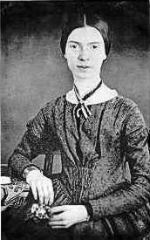
Emily Dickinson
US (1830 – 1886) Timeline |
Emily Dickinson was born in 1830 to a prominent family in Amherst, Massachusetts. Few of her poems were published during her lifetime, the bulk of her poetry having been discovered after her death in the 1880s. Despite this anonymity during her lifetime, Dickinson has come to be regarded as one of the greatest of American poets. Her unusual use of rhyme, meter, and grammar anticipates modernist trends in 20th century poetry.
She attended Amherst Academy and a year at Mount Holyoke Female Seminary.
While at the seminary, Dickinson famously refused to participate in the show of evangelical conversion sweeping through her community at the time. Much of her poetry, however, meditates on heaven and the inner life, often contrasting the private moment against public religious convention. She was clearly a critic of the common practice of religion, leading many to casually label her as an atheist, yet there is no denying that she experienced a rich inner life that she understood in religious terms. While unconventional by the religious standards of her day, the argument can be made that she was a deep mystic. If one reads her poetry side-by-side with the poet-saints of India, for example, the parallels in metaphoric language and insight become obvious.
Following her return from Mount Holyoke, Emily Dickinson almost never left Amherst again, rarely even leaving the grounds of her family home. Later in life she took to dressing entirely in white.
Much is made of Dickinson’s reclusive life, the fact that she never married, and the focus on death in much of her poetry, leading to descriptions of her as a morbid, sexually repressed recluse. One can see her in this way; or, recognizing the depth of her mysticism, we can imagine that she cultivated a self-defined monastic life of contemplation and poetry.
Thank You Ivan for this poem by Emily Dickinson. I was given a book, years ago, of
selected poems of Emily Dickinson and that started my love of poetry. This poem
was not included in that volume, and perhaps I would not have understood it years
ago. Now, I am enjoying her poetry all over again and do appreciate this poem as
well. Thank You for sharing this poem!