May 12 2023
Abhishiktananda, Swami (Henri Le Saux) – Return within
Return within
by Abhishiktananda, Swami (Henri Le Saux)
English version by H. Sandeman (?)
Return within,
to the place where there is nothing,
and take care that nothing comes in.
Penetrate to the depths of yourself,
to the place where thought no longer exists,
and take care that no thought arises there!
There where nothing exists,
Fullness!
There where nothing is seen,
the Vision of Being!
There where nothing appears any longer,
the sudden appearing of the Self!
Dhyana is this!
 — from Guru and Disciple: An Encounter with Sri Gnanananda, a Contemporary Spiritual Master, by Swami Abhishiktananda / Translated by H. Sandeman
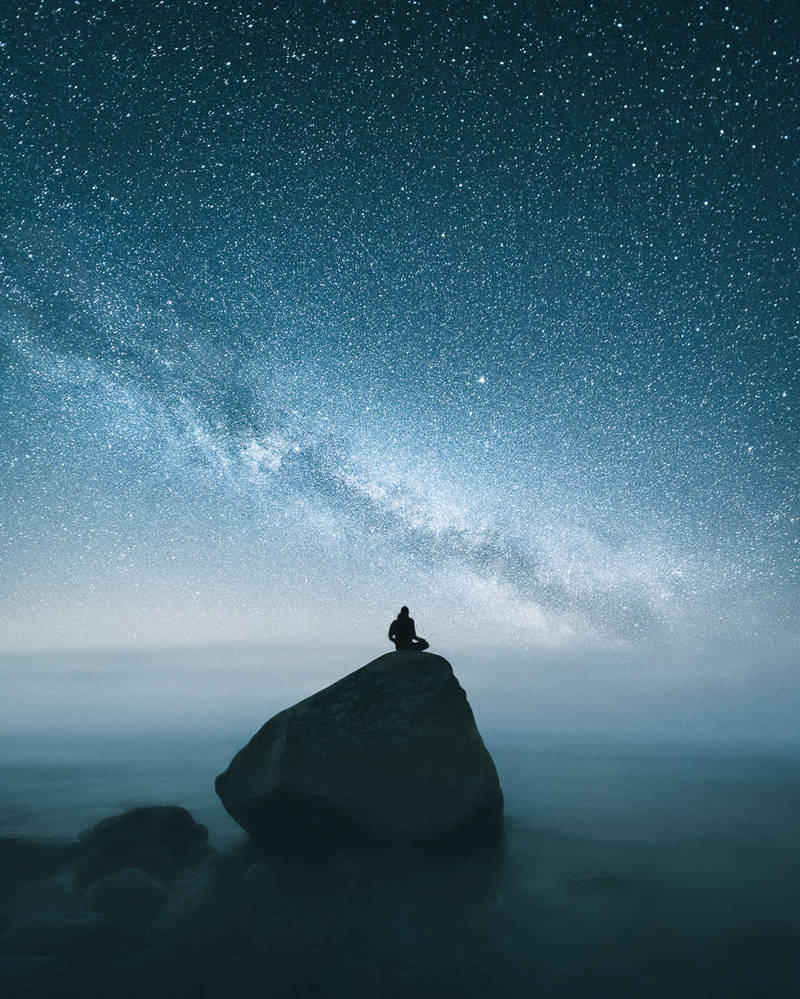
/ Image by MikkoLagerstedt /
Return within…
A powerful description of deep meditation. (The word dhyana in the last line means meditation.)
There where nothing exists,
Fullness!
Abhishiktananda keeps mentioning nothing and nothingness, but each time that nothingness is entered into, we are greeted with fullness, the vision of Being, and ultimately, the appearance of the Self.
In the practice of Advaita Vedanta, everything is recognized as the Self — which a Catholic might recognize as the purified sense of being that is utterly identified with God until only God remains. When the thinking mind is brought to deep silence (“the place where thought no longer exists”), and we get so quiet that we allow the spacious stillness to wash over us, clearing away everything, including the small, grasping ego-self, that is the place “where nothing exists.”
But, in that place “where there is nothing,” that is, nothing that feels like a thing or an object, not even the personal self-thing, we then discover an unexpected flood of life and fullness and bliss.
There where nothing is seen,
the Vision of Being!
Perception shifts and everything is seen as a radiant Unity, the Vision of Being
There where nothing appears any longer,
the sudden appearing of the Self!
One’s very identity changes. What one was has ceased to exist, swept away in the vision of vastness. One’s sense of self is no longer a collection of qualities and habits and social projections. Instead, everything is found within and that Self has no boundaries!
Dhyana is this!
That is dhyana, true meditation.
Recommended Books: Abhishiktananda, Swami (Henri Le Saux)


|
Abhishiktananda, Swami (Henri Le Saux)
France, India (1910 – 1973) Timeline |
Abhishiktananda is a fascinating mixture of Eastern and Western spirituality. He was born as Henri Le Saux into a Catholic family in Brittany, France. He was highly devout from childhood and in his youth determined to be a monk. In 1931, he made his profession as a Benedictine monk and, in 1935, was ordained a priest.
At the beginning of World War II, in 1939, he was called up for mandatory military service. His unit was captured by German soldiers, Le Saux managed to escape and, with the help of a sympathetic farmer, made his way back to French territory and, eventually, to his monastery, where he resumed his monastic activities.
Early on Fr. Le Saux felt a call to travel to India, and in 1948 he received his chance, leaving France, never to return. For the rest of his life, Fr. Le Saux would seek to combine the Catholic ideal with the purest essence of Hindu spirituality. He adopted the dress and lifestyle of a sanyasin, a Hindu renunciate, and took the name Abhishiktananda which can be translated as “Bliss of the Anointed One (Christ)”.
Abhishiktananda helped to found Shantivanam, a Christian ashram in India that sought to embody Christian spiritual ideals of service, community, and simplicity, without forcing converts and the curious to abandon the richness of their native culture. The stable life of a community administrator was not for him, however, and Abhishiktananda soon took up an itinerant life of pilgrimage to many of the great holy sites of India, proclaiming that it was entirely appropriate for a follower of Christ to bring his worship to such places.
One of his most profound early encounters was his meeting with Ramana Maharshi, the famous sage who taught the nondualist path of realizing the Self. Ramana Maharshi was near the end of his life and their few meetings were brief, but transformative for Abhishiktananda. Abhishiktananda would go on extended meditation retreats in the caves near Arunachala Mountain, where Ramana Maharshi lived and taught. Later, Abhishiktananda met another nondualist (Advaita) master, Swami Gnananada, to whom he became deeply devoted.
Outwardly, Abhishiktananda lived as a sincere, humble Hindu sanyasin; inwardly, he continuously sought to reconcile and integrate the two great spiritual traditions of Catholicism and Advaita Vedanta (nondualist Hinduism).
Lovely poem and lovely commentary, Ivan. I have been needing to “Return Within” for many months now. Life circumstances keep pulling me away. But I do remember that deep space within, the Fullness of the deep Silence, the place of the Ineffable (what Advaita has labeled “the Self”). And indeed the Silence *is* the Teacher 🙂 _/\_
Ivan, Saturday mornings I meet for Christian Meditation. If there is to be a unity of faith an acceptance of many roads to understanding it will be through meditation.
Ivan, the poem and the story included. Bless you, I’ve turned 80 now and my faith journey is my alpha and omega. Trish
Ivan, Saturday mornings I meet for Christian Meditation. If there is to be a unity of faith an acceptance of many roads to understanding it will be through meditation.
Ivan, I love the poem and the story included. Bless you, I’ve turned 80 now and my faith journey is my alpha and omega. Trish
Ivan, for a long time I have bounced back and forth between commitment to Catholicism and to Indian spirituality, mainly Swami Ramdas, Nisargadatta Maharaja, and Ramana Maharshi, with lots of love for Sri Ramakrishna as well.
A few nights ago, I found myself depressed by some Catholic theology as expounded by Bishop Robert Barron, a conservative but by no means doctrinaire Catholic prelate who is very popular among conservative–but not rabidly retrograde–Catholics. The bishop was explaining the difference between God’s subjective love (infinite, for all of us) and His objective gifts of love (more to His Son and to Mary than to us), and I suddenly wondered, “How does this guy, how do his multiple theology professors in seminary, dare to chat about God’s innermost feelings?” Catholicism offers so much detail about the ineffable, but we are forbidden to think of it as what it is, mythology.
I needed a break from this kind of stuff, and luckily you had just posted that wonderful poem by Seyyid Seyfullah Nizamoglu–now that’s the attitude toward God that seems right to me: amazement. So I ran back to your books The Longing… The Dance… and they have been sustaining me ever since. Now you post the great Abhishiktananda, the saint for those of us drawn in these two directions! Thank you from the bottom of my heart.
Thank You Ivan for this weeks wonderful poem from Abhishiktananda. I seem to do better
with a second reading and I have appreciated all the comments on this poem. I do wonder just how you find all the poets and poems you share with us. They are much
appreciated, as are your Thoughts for the Day and your commentary – such gifts.
Thank You.