Jun 12 2026
Symeon the New Theologian – We awaken in Christ’s body
We awaken in Christ’s body
by Symeon the New Theologian
English version by Stephen Mitchell
We awaken in Christ’s body
as Christ awakens our bodies,
and my poor hand is Christ, He enters
my foot, and is infinitely me.
I move my hand, and wonderfully
my hand becomes Christ, becomes all of Him
(for God is indivisibly
whole, seamless in His Godhood).
I move my foot, and at once
He appears like a flash of lightning.
Do my words seem blasphemous? — Then
open your heart to Him
and let yourself receive the one
who is opening to you so deeply.
For if we genuinely love Him,
we wake up inside Christ’s body
where all our body, all over,
every most hidden part of it,
is realized in joy as Him,
and He makes us, utterly, real,
and everything that is hurt, everything
that seemed to us dark, harsh, shameful,
maimed, ugly, irreparably
damaged, is in Him transformed
and recognized as whole, as lovely,
and radiant in His light
he awakens as the Beloved
in every last part of our body.
 — from The Enlightened Heart: An Anthology of Sacred Poetry, by Stephen Mitchell
/ Image by Mads Schmidt Rasmussen /

I have been rereading John Anthony McGuckin’s The Book of Mystical Chapters, which is a selection of short poems and insights, many of them from the desert fathers and other voices from the rich Eastern Orthodox tradition — beautiful little meditations. And one of the visionaries highlighted repeatedly is Symeon the New Theologian. Despite my Russian name, I was not raised in Orthodox Christianity myself, but I have really come to appreciate many of these profound mystics, perhaps most especially Symeon the New Theologian. This is one of my favorite poems by Symeon the New Theologian.
Symeon doesn’t urge us to merely honor or love the Beloved (Christ within the Christian tradition) from a distance. We melt into the Divine, become one with the Divine, share the same body.
I move my hand, and wonderfully
my hand becomes Christ, becomes all of Him
Some of these lines remind me of a poem often inaccurately attributed to Teresa of Avila, You Are Christ’s Hands with it’s lines– “Christ has no body now on earth but yours, / no hands but yours…”
This poem by Symeon is one I just want to drink in — it feels so deeply healing and generous to the soul.
and everything that is hurt, everything
that seemed to us dark, harsh, shameful,
maimed, ugly, irreparably
damaged, is in Him transformed
and recognized as whole, as lovely,
and radiant in His light
he awakens as the Beloved
in every last part of our body.
Have a beautiful day discovering the Beloved within.
Recommended Books: Symeon the New Theologian


|
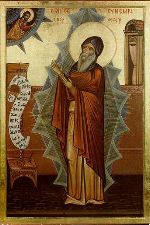
Symeon the New Theologian
Turkey (949 – 1032) Timeline |
Symeon was born into an aristocratic family in Asia Minor (Turkey) and was given the name George. This was when the region was still part of the Christian Byzantine Empire. From boyhood George was groomed for a life in politics. At age eleven, he was sent to the capital Constantinople (Istanbul) to live with his uncle who guided him in his early education.
When he was 14, George met a monk at the monastery of Studios named Symeon the Pious. George accepted Symeon the Pious as his spiritual director while continuing to prepare for a life in politics.
Somewhere around age 20, George was overcome by an ecstatic state in which he experienced God as a living presence of radiant light.
Despite this radically transformative experience, he spent several more years attempting to fulfill his family’s expectations, eventually becoming an imperial senator. However, his continuing mystical experiences were not compatible with such a public life and, at age 27, he renounced his previous life and became a monk, entering the monastery at Studios to continue under the direct guidance his spiritual director, even taking on the same monastic name — Symeon.
The closeness teacher and disciple shared worried the monastic authorities and the two were separated. The young Symeon was given the choice of remaining at Studios and no longer receiving spiritual guidance from the elder Symeon, or he could go to another monastery and keep his spiritual director.
So as not to lose the guidance of Symeon the Pious, the young Symeon chose to move to the monastery of St. Mamas in Constantinople. There, Symeon was ordained a priest and eventually became the abbot of the monastery, reviving the monastery’s life of prayer and meditation. While abbot of St. Mamas, Symeon wrote extensive treatises (called the Catecheses) as guidelines for the ideal monastic and God-focused life, emphasizing the power of contemplative prayer and meditation.
The mystical spiritual practices that he advocated led to further conflicts with authorities and Symeon was exiled in 1009 to a small hermitage on the far side of the Bosphorus.
Disciples began to gather around Symeon and soon the small hermitage grew into a full monastery. It was there that Symeon wrote his most personal work, Hymns of Divine Love, a collection of poems describing his mystical experiences.
Symeon’s doctrines and poetry emphasize not only the possibility, but the necessity of personally experiencing the Divine. He also stated that one need not be a monk or renunciate, saying that one “who has wife and children, crowds of servants, much property, and a prominent position in the world” can still directly experience communion with the divine.
Giving him the title of “Theologian” does not mean that he was a formal, rationalist Christian philosopher, as we might use the term today, especially in Western Christian and philosophical traditions. Within Orthodox Christian tradition, the epithet of “Theologian” has been only given to a few figures, specifically indicating that this is a figure with direct experience of God. In other words, he is considered to be a mystic of full Realization.
I did not even realize that I have been your subscriber for 3 whole years. Honestly I do not regret it at all. Your views on God and religion is a breath of fresh air in this age of turmoil and unrest. Take care. Keep on enlightening the folks like us. 🙏🏼