Oct 23 2017
Yunus Emre – A single word can brighten the face
A single word can brighten the face
by Yunus Emre
English version by Kabir Helminski & Refik Algan
A single word can brighten the face
of one who knows the value of words.
Ripened in silence, a single word
acquires a great energy for work.
War is cut short by a word,
and a word heals the wounds,
and there’s a word that changes
poison into butter and honey.
Let a word mature inside yourself.
Withhold the unripened thought.
Come and understand the kind of word
that reduces money and riches to dust.
Know when to speak a word
and when not to speak at all.
A single word turns the universe of hell
into eight paradises.
Follow the Way. Don’t be fooled
by what you already know. Be watchful.
Reflect before you speak.
A foolish mouth can brand your soul.
Yunus, say one last thing
about the power of words —
Only the word “I”
divides me from God.
 — from The Drop That Became the Sea: Lyric Poems of Yunus Emre, Translated by Kabir Helminski / Translated by Refik Algan

/ Image by Graham Keen /
Here we are with a rare Monday poem email…
A single word can brighten the face
of one who knows the value of words.
This is one of my favorite poems by Yunus Emre, but I have never really written up a good commentary to accompany it. Perhaps it is because it is a poem about words, the singular power of words, or the power of a singular word — and I don’t want my meditative ramblings to take away from the poem itself. It says it all so beautifully.
Ripened in silence, a single word
acquires a great energy for work.
I love that line. I have been busy with my day job of late, and I haven’t been resting in deep meditation as much as I would like. The outer world has required a lot of energy from me lately. Yet I have still managed to catch moments of silence gently flowing beneath the activity. That’s where the ripening happens.
War is cut short by a word,
and a word heals the wounds,
and there’s a word that changes
poison into butter and honey.
I think this verse is the heart of the poem for me. I read it over and over again.
I think will say no more today, and let Yunus have the final word–
Yunus, say one last thing
about the power of words —
Only the word “I”
divides me from God.


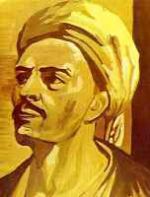
|
Yunus Emre
Turkey (1238 – 1320) Timeline |
Yunus Emre is considered by many to be one of the most important Turkish poets. Little can be said for certain of his life other than that he was a Sufi dervish of Anatolia. The love people have for his liberating poetry is reflected in the fact that many villages claim to be his birthplace, and many others claim to hold his tomb. He probably lived in the Karaman area.
His poetry expresses a deep personal mysticism and humanism and love for God.
He was a contemporary of Rumi, who settled in the same region after having moved from what is today Afghanistan. Rumi composed his collection of stories and songs for a well-educated urban circle of Sufis, writing primarily in the literary language of Persian. Yunus Emre, on the other hand, traveled and taught among the rural poor, singing his songs in the Turkish language of the common people.
A story is told of a meeting between the two great souls: Rumi asked Yunus Emre what he thought of his great work the Mathnawi. Yunus Emre said, “Excellent, excellent! But I would have done it differently.” Surprised, Rumi asked how. Yunus replied, “I would have written, ‘I came from the eternal, clothed myself in flesh, and took the name Yunus.'” That story perfectly illustrates Yunus Emre’s simple, direct approach that has made him so beloved.
In the Quantum Silence
words dissolve,
even the sense of ‘I’…
How can silence be explained in words?
MATSUO BASHŌ’S FAMOUS haiku
is a profound meditation on
the power of poetry to express
the inexpressible and convey
the unspoken eloquence of all that is.
deep silence
the shrill of cicadas
seeps into rocks
—Matsuo Bashō
(1644–94)
Let a silent smile brighten
your face in the stillness
of the autumn…:)
The Poet says the Word is important
The Musician, the Note
The Teacher, the Lesson
The Mother, the Child.
Maybe all of the above
Or maybe none.
Who can say
Except for the Poet.
Who knows
Except for the One.