Nov 09 2018
Yunus Emre – Let’s Take Yunus Emre
Let’s Take Yunus Emre
by Yunus Emre
English version by Jennifer Ferraro & Latif Bolat
Let’s be companions, the two of us.
Let’s go to the Friend, my soul.
Let’s be close intimates, the two of us.
Lets go to the Friend, my soul.
Let’s go before this life is over,
Before our bodies disappear,
Before enemies come between us —
Let’s go to the Friend, my soul.
Come on, let’s go. Don’t remain alone.
Let’s be a chisel in the Friend’s hand.
The only stop will be our sheikh’s station.
Let’s go to the Friend, my soul.
Let’s leave our towns and cities
and gladly suffer for the Friend.
Let’s wrap our arms around our Beloved’s waist.
Let’s go to the Friend, my soul.
Let’s not be bewildered by the world.
Let’s not be cheated by its sudden dying.
Let’s not sit together never touching.
Let’s go to the Friend, my soul.
Let’s give up this transient world
and fly to the lasting land of the Friend.
Let’s give up all the playthings of the nafs.
Let’s go to the Friend, my soul.
Be a guide to me on this journey.
Let’s set our destination at the Friend,
Not thinking where we begin or end.
Let’s go to the Friend, my soul.
This world isn’t everlasting.
With eyes half-open it is tempting.
Be a companion of lovers and a lover.
Let’s go to the Friend, my soul.
Before the news of death reaches us,
Before the hour when he grabs us by the collar,
Before Azrail makes his sudden move,
Let’s go to the Friend, my soul.
Let’s arrive at the Divine Truth
and inquire there about Reality.
Let’s take Yunus Emre with us —
and go to the Friend, my soul.
 — from Quarreling with God: Mystic Rebel Poems of the Dervishes of Turkey, Translated by Jennifer Ferraro / Translated by Latif Bolat

/ Image by Elizabeth Alice /
I like this image of calling to the soul to become a traveling companion on the road to the Friend.
Let’s go to the Friend, my soul.
It’s humorous when you think about it. The soul is already a part of ourselves, why should we have to coax it? We might even say that the soul is who we are. Wouldn’t the soul already be on the journey to the Friend, perhaps already at the Friend’s door?
Let’s be companions, the two of us.
Let’s go to the Friend, my soul.
Let’s be close intimates, the two of us.
Lets go to the Friend, my soul.
On that journey, best to convince the soul to be a close companion.
And what other part of the self is speaking? It would seem to be the surface sense of self, the little self, the ego, the nafs. You get the feeling that the self doing the speaking is actually the hesitant one, trying to convince itself. There’s a sort of self-teasing here, a bit of bravado while gathering courage for the journey.
Who is this Azrail who will make a “sudden move”? Azrail or Azrael is the name sometimes given to the angel of death. Many religious types have an idea that, so long as they have subscribed to the “right” form of religion, they will magically end up in some heavenly realm after death, with no journey involved. Mystics like Yunus Emre remind us that the soul’s journey is the only way to the Friend and the entire purpose of life, something to be engaged in now in the midst of life.
Let’s arrive at the Divine Truth
and inquire there about Reality.
We all need a nudge, and the best nudge comes from within.
Let’s go to the Friend, my soul.
And, oh yes–
Let’s take Yunus Emre with us
— take yourself with you.


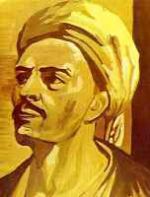
|
Yunus Emre
Turkey (1238 – 1320) Timeline |
Yunus Emre is considered by many to be one of the most important Turkish poets. Little can be said for certain of his life other than that he was a Sufi dervish of Anatolia. The love people have for his liberating poetry is reflected in the fact that many villages claim to be his birthplace, and many others claim to hold his tomb. He probably lived in the Karaman area.
His poetry expresses a deep personal mysticism and humanism and love for God.
He was a contemporary of Rumi, who settled in the same region after having moved from what is today Afghanistan. Rumi composed his collection of stories and songs for a well-educated urban circle of Sufis, writing primarily in the literary language of Persian. Yunus Emre, on the other hand, traveled and taught among the rural poor, singing his songs in the Turkish language of the common people.
A story is told of a meeting between the two great souls: Rumi asked Yunus Emre what he thought of his great work the Mathnawi. Yunus Emre said, “Excellent, excellent! But I would have done it differently.” Surprised, Rumi asked how. Yunus replied, “I would have written, ‘I came from the eternal, clothed myself in flesh, and took the name Yunus.'” That story perfectly illustrates Yunus Emre’s simple, direct approach that has made him so beloved.
Wise and timely words. Leads to inquiry, to Divine Truth.
Yes! Let’s go my Friend. There’s a cleaner place, a kinder place, the Real.
Thank you for the reminder Ivan.
Let’s remember too, on Remembrance Day.
Beautiful poem though the word Friend does not do justice to its original meaning. Maybe Yunus Emre is also warning us against hanging about in life with false friends & deities….