Archive for October, 2019

Oct 25 2019

Shiwu (Stonehouse) – Outside the door I made but don’t close

Published by under Poetry

Outside the door I made but don’t close
by Shiwu (Stonehouse)

English version by Red Pine

Outside the door I made but don’t close
I glimpse the movements of unfamiliar birds
a handful of jade is worth a whole mountain
but gold can’t buy a lifetime of freedom
the sound of icy falls on a dawnlit snowy ridge
the sight of distant peaks through leafless autumn woods
mist lifts from ancient cedars and days last forever
right and wrong don’t get past the clouds

— from The Zen Works of Stonehouse: Poems and Talks of a 14th Century Chinese Hermit, Translated by Red Pine


/ Image by Michael Levine-Clark /

This poem feels to me like a Chinese brush painting, specific details observed suggesting a panoramic landscape, yet when we try to enter the scene it becomes ephemeral and slightly elusive.

Outside the door I made but don’t close
I glimpse the movements of unfamiliar birds

That opening line about a door the poet made but does not close, I skimmed past it the first few times I read this poem, but now it grabs my attention. I love the idea of having gone to all the effort of constructing a door and then never using it because you always want it open so you can see and hear the outside world, so no barrier is created between inside and outside.

a handful of jade is worth a whole mountain
but gold can’t buy a lifetime of freedom

Two lines to contemplate and dismiss the dilemmas of wealth. People tend to commodify all of existence, placing a price tag on every experience and thing and even other people. A handful of jade is enough to buy an entire mountain. Who says that’s what a mountain is worth? Or what jade is worth? Exchanging that jade for the pretense of owning that mountain, what do we then have? What has changed for us? Can we breathe easier? Are we more free? The game of money might be worth playing, or not, but it is not the game of freedom.

the sound of icy falls on a dawnlit snowy ridge
the sight of distant peaks through leafless autumn woods

Freedom is found through other mediums of exchange, usually involving stillness, attention, compassion — and harmony with the living world all around us.

mist lifts from ancient cedars and days last forever
right and wrong don’t get past the clouds

Real freedom carries the flavor of timelessness. The world continues in its rhythms, of course, and the serial unfolding of events does not stop, but the rush of time ceases to drive them. It becomes as if one is simply watching the flow of a gentle creek; movement occurs, but it is a serene unfolding within a larger scene of rest.

When we discover this timeless place, when we find ourselves at peace in the midst of the serene beauty surrounding us, when there is no sense of “I and mine” driving the moment, where then are “right” and “wrong”? Ideas of this and not that cannot approach the open field of what is.

Let’s try to leave those doors we’ve made ajar today. Have a beautiful day!


Recommended Books: Shiwu (Stonehouse)

The Zen Works of Stonehouse: Poems and Talks of a 14th Century Chinese Hermit


Shiwu (Stonehouse)

China (1272 – 1352) Timeline
Buddhist : Zen / Chan

Continue Reading »

2 responses so far

Oct 18 2019

Buson – This cold winter night

Published by under Poetry

This cold winter night
by Buson

English version by Sam Hamill

This cold winter night,
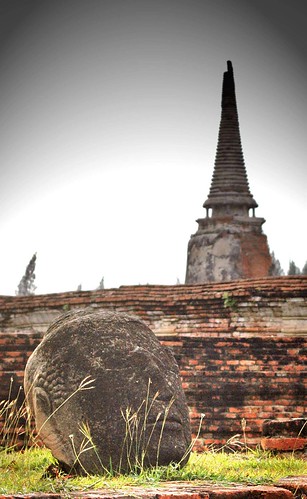
that old wooden-head Buddha
would make a nice fire

— from The Poetry of Zen: (Shambhala Library), Edited by Sam Hamill / Edited by J. P. Seaton


/ Image by thanapat /

Chilly weather this morning. Makes a person cast about for a source of warmth… Hmm…

Every time I come across this haiku it makes me laugh. It works beautifully on several levels and can suggest almost opposite meanings. Superficially, we are contemplating an act of sacrilegious vandalism — hungrily looking at a large wooden Buddha head, perhaps it is neglected or fallen, and fantasizing about setting it on fire for a little comfort. On the other hand, the head engulfed in flames is a common image in Asian iconography to represent enlightenment, a variation on the nimbus or halo — so the haiku can just as easily be saying something about warming oneself through spiritual illumination.

The haiku shocks, it even offends, at the same time that it inspires awakening — a masterful joke!


Recommended Books: Buson

Zen Poetry: Let the Spring Breeze Enter The Poetry of Zen: (Shambhala Library) The Moon Over Tagoto: Selected Haiku of Buson


Buson, Buson poetry, Buddhist poetry Buson

Japan (1716 – 1784) Timeline
Buddhist : Zen / Chan

Continue Reading »

5 responses so far

Oct 18 2019

slow realization

The slow realization
of a lifetime lived with attention:
the satisfaction of simple moments.

One response so far

Oct 16 2019

Farid ud-Din Attar – The moths and the flame

Published by under Poetry

The moths and the flame
by Farid ud-Din Attar

English version by Afkham Darbandi and Dick Davis

Moths gathered in a fluttering throng one night
To learn the truth about the candle light,
And they decided one of them should go
To gather news of the elusive glow.
One flew till in the distance he discerned
A palace window where a candle burned —
And went no nearer: back again he flew
To tell the others what he thought he knew.
The mentor of the moths dismissed his claim,
Remarking: “He knows nothing of the flame.”
A moth more eager than the one before
Set out and passed beyond the palace door.
He hovered in the aura of the fire,
A trembling blur of timorous desire,
Then headed back to say how far he’d been,
And how much he had undergone and seen.
The mentor said: “You do not bear the signs
Of one who’s fathomed how the candle shines.”
Another moth flew out — his dizzy flight
Turned to an ardent wooing of the light;
He dipped and soared, and in his frenzied trance
Both self and fire were mingled by his dance —
The flame engulfed his wing-tips, body, head,
His being glowed a fierce translucent red;
And when the mentor saw that sudden blaze,
The moth’s form lost within the glowing rays,
He said: “He knows, he knows the truth we seek,
That hidden truth of which we cannot speak.”
To go beyond all knowledge is to find
That comprehension which eludes the mind,
And you can never gain the longed-for goal
Until you first outsoar both flesh and soul;
But should one part remain, a single hair
Will drag you back and plunge you in despair —
No creature’s self can be admitted here,
Where all identity must disappear.

— from The Conference of the Birds, Translated by Afkham Darbandi / Translated by Dick Davis


/ Image by ruslik /

I don’t feature selections from it often enough, but Attar’s Mantic at-Tayr (The Conference of the Birds) is a long-time favorite of mine. The English language version by Afkham Darbandi and Dick Davis is good, but I still hope to read a truly great English translation someday.

This version maintains the two-line rhyme scheme. So read it out loud and feel the play of the rhyming couplets. Some are, admittedly, forced in English translation, but they bring a playfulness to the piece.

Moths gathered in a fluttering throng one night
To learn the truth about the candle light…

This is really a story in poetic form, an expansion on the ancient spiritual metaphor of the moth and the flame. We have a small community of moths gathered together at night. One moth flies off, sees a palace with a candle burning in the window. The moth returns and tells the other moths of the wondrous sight he has just witnessed. The “mentor of the moths” (the sheikh, their spiritual leader) states flatly, “He knows nothing of the flame.”

Another moth flies out to see the candle, flies close enough to feel the heat and the strange fluttering desire it awakens in him, and returns. Again, the mentor moth says that he clearly hasn’t understood the nature of the flame.

Finally, a moth truly overcome with love for the flame flies right into it, merges with it, and is utterly consumed. The leader of the moths approvingly says that one knows the truth.

So many things we can understand from this image. The flame, of course, is God, the Eternal One. And the moths are individual souls, spiritual seekers, lovers of God. We are the moths.

Attar is reminding us of one of the core truths only mystics seem to remember: It is not enough to think about God, or theorize about God, or pray to God, or read about God, or subscribe to the right faith in God, or even catch glimpses of God. Regardless of one’s religion or rectitude, the Divine is only ever known through direct encounter. Even the word “encounter” implies two who meet. No, the moth knows the real truth, light is known only through merging with it, and in merging, letting go of any sense of self that is separate. In this encounter there are not two, just one.

The only way to know is to be so enamored with that fiery, entrancing Beauty that we recklessly abandon the nafs, the little self, in order to merge with that dancing light.

That fluttering, moth-like self we all think we are — it has no substance anyway. The flame teaches us this.

Words fail, concepts fail, but we come to know in a greater, deeper way when we allow ourselves to be consumed.

“He knows, he knows the truth we seek,
That hidden truth of which we cannot speak.”


Recommended Books: Farid ud-Din Attar

Poetry for the Spirit: Poems of Universal Wisdom and Beauty The Drunken Universe: An Anthology of Persian Sufi Poetry Music of a Distant Drum: Classical Arabic, Persian, Turkish & Hebrew Poems Perfume of the Desert: Inspirations from Sufi Wisdom The Conference of the Birds
More Books >>


Farid ud-Din Attar, Farid ud-Din Attar poetry, Muslim / Sufi poetry Farid ud-Din Attar

Iran/Persia (1120? – 1220?) Timeline
Muslim / Sufi

Continue Reading »

One response so far

Oct 07 2019

Theodore Roethke – In a Dark Time

Published by under Poetry

In a Dark Time
by Theodore Roethke

In a dark time, the eye begins to see,
I meet my shadow in the deepening shade;
I hear my echo in the echoing wood —
A lord of nature weeping to a tree,
I live between the heron and the wren,
Beasts of the hill and serpents of the den.

What’s madness but nobility of soul
At odds with circumstance? The day’s on fire!
I know the purity of pure despair,
My shadow pinned against a sweating wall.
That place among the rocks — is it a cave,
Or winding path? The edge is what I have.

A steady storm of correspondences!
A night flowing with birds, a ragged moon,
And in broad day the midnight come again!
A man goes far to find out what he is —
Death of the self in a long, tearless night,
All natural shapes blazing unnatural light.


Dark, dark my light, and darker my desire.
My soul, like some heat-maddened summer fly,
Keeps buzzing at the sill. Which I is I?
A fallen man, I climb out of my fear.
The mind enters itself, and God the mind,
And one is One, free in the tearing wind.

— from The Collected Poems of Theodore Roethke, by Theodore Roethke


/ Image by iNeedChemicalX /

Over the weekend I came across the following article:

“Emergency Poet” Opens Literary Pharmacy to Support Mental Health

Keele University in the UK has decided to open up what they are calling a “poetry pharmacy” to issue poetic therapy and first aid. They’ve set it up so you can move through rooms based on your particular need, everything from affairs of the heart to when the world is just too much.

I love this idea! We need a poetic first aid center in every community. I suppose, in my way, I try to do that with the Poetry Chaikhana.

If this idea intrigues you, an excellent book to read on the healing power of poetry is Poetic Medicine, by John Fox.

Thinking about poetry as medicine brought to mind this poem by Theodore Roethke…

This poem by Roethke is one of those poems to keep close in difficult times.

In a dark time, the eye begins to see

The struggle against despair, disorientation, darkness. The solitary individual lost in a lost world. We have all been there at some point in our lives. Deep seekers have a particular tendency to travel through those shadowed spaces.

I know the purity of pure despair,
My shadow pinned against a sweating wall.

That despair is often a deep-seated sense that something is fundamentally wrong with the human world presented to us. It can feel uncaring, limited, violent, broken, and incomplete. In other words, it is a place that does not accept the individual as he or she is. To operate in the human world, we are forced into games of pretense and self-disguise. It is a feeling of homelessness and isolation.

What does one do when the soul is at odds with circumstance? It creates a terrible crisis. As social creatures, we align with the group mind, often without awareness or consent. The more naturally we do this, the better we fit into society and exist in the human world. But what about the eccentrics and visionaries, those who resist that psychic pull in order to answer the soul’s need to be itself and see beyond social artifice?

The edge is what I have.

They tend to dwell at the edges. That is where both danger and possibility are found. There we gain the possibility of seeing clearly for the first time, witnessing reality as a complete and self-fulfilled individual.

But the danger is very real, as well. No longer relying on socially constructed reality as our boundary we also lose our safe landmarks. The psyche becomes disoriented and fragile.

To navigate this dark and uncertain territory, the seeker and the artist must cultivate a highly refined inner sense of balance and discipline. This is an important reason for developing a vigorous spiritual practice. Without the necessary inner solidity, the tendency is to rely on dangerous crutches, like excessive drinking and drug use — a terrible problem for so many creative non-conformists.

Think of it this way: The normal consensus reality is like the rigid shell of an egg. It does an excellent job of safely containing the still-forming individual, giving protection from exposure to the unknown outside reality. But, if the individual remains within that shell forever, the soul never experiences the fullness of life. Through spiritual practice, one awakens the fire of life and takes on inner solidity not dependent on outer containment. At that point, the shell has become too confining and we break free into the open air, cracking the shell but without fragmenting the self. Spiritual practice and deepening self-awareness gives us the inner solidity needed to encounter the new world.

…Those dark periods we experience, they do actually serve a purpose, awakening clarity of vision and a compassionate heart. When we feel most vulnerable and lost, we are often going through our greatest growth and transformation, readying for the blaze of light.

Death of the self in a long, tearless night,
All natural shapes blazing unnatural light.

We must learn to work deeply amidst the darkness. We discover who we really are, slowly emerging from the shadows, for that is our stable landmark when all else shifts about.

The mind enters itself, and God the mind,
And one is One, free in the tearing wind.

=

Which poem do you keep close in your poetic medicine cabinet? What gives you comfort, clarity, or courage? Let me know.

Sending love.


Recommended Books: Theodore Roethke

Poetry for the Spirit: Poems of Universal Wisdom and Beauty The Collected Poems of Theodore Roethke Theodore Roethke: Selected Poems On Poetry and Craft The Glass House: The Life of Theodore Roethke
More Books >>


Theodore Roethke, Theodore Roethke poetry, Secular or Eclectic poetry Theodore Roethke

US (1908 – 1963) Timeline
Secular or Eclectic

More poetry by Theodore Roethke

7 responses so far

Oct 04 2019

William Butler Yeats – The Lake Isle of Innisfree

Published by under Poetry

The Lake Isle of Innisfree
by William Butler Yeats

I will arise and go now, and go to Innisfree,
And a small cabin build there, of clay and wattles made:
Nine bean-rows will I have there, a hive for the honeybee,
And live alone in the bee-loud glade.

And I shall have some peace there, for peace comes dropping slow,
Dropping from the veils of the morning to where the cricket sings;
There midnight’s all a glimmer, and noon a purple glow,
And evening full of the linnet’s wings.

I will arise and go now, for always night and day
I hear lake water lapping with low sounds by the shore;
While I stand on the roadway, or on the pavements grey,
I hear it in the deep heart’s core.

— from The Collected Poems of W. B. Yeats, by William Butler Yeats


/ Image by hideraldo dwight leitao /

Something for us today by that seeker/sage/bard/mage Yeats — a portrait of peace.

I love the rhythms of this poem. To really appreciate it, you need to say it aloud and slowly. Let it roll off the tongue.

Yeats paints with his words, running them together like brushstrokes in watercolor.

…the bee-loud glade.


…And I shall have some peace there, for peace comes dropping slow, .

In the beauty of this rustic scene, we discover stillness, something of the eternal in the sound of the water lapping at the shore and the mesmerizing hum of bees.

Listening well, we discover the one who listens. We discover “the deep heart’s core.”


Recommended Books: William Butler Yeats

The Oxford Book of English Mystical Verse Holy Fire: Nine Visionary Poets and the Quest for Enlightenment The Collected Poems of W. B. Yeats Byzantium The Secret Rose
More Books >>


William Butler Yeats, William Butler Yeats poetry, Secular or Eclectic poetry William Butler Yeats

Ireland (1865 – 1939) Timeline
Secular or Eclectic
Primal/Tribal/Shamanic : Celtic

More poetry by William Butler Yeats

8 responses so far