Archive for April, 2020

Apr 28 2020

Rainer Maria Rilke – I find you, Lord, in all Things

Published by under Poetry

I find you, Lord, in all Things
by Rainer Maria Rilke

English version by Stephen Mitchell

I find you, Lord, in all Things and in all
my fellow creatures, pulsing with your life;
as a tiny seed you sleep in what is small
and in the vast you vastly yield yourself.

The wondrous game that power plays with Things
is to move in such submission through the world:
groping in roots and growing thick in trunks
and in treetops like a rising from the dead.

— from Ahead of All Parting: The Selected Poetry and Prose of Rainer Maria Rilke, Translated by Stephen Mitchell
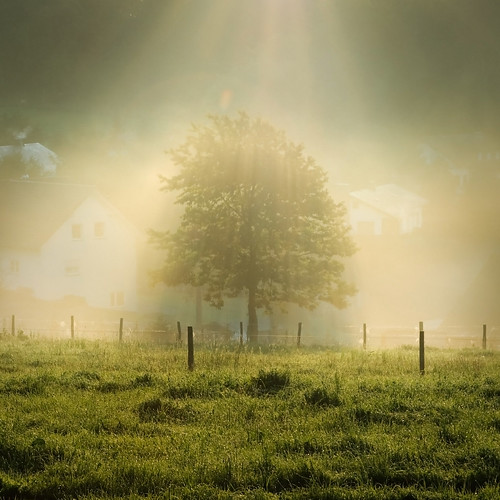

/ Image by Ben Fredericson /

This is a poem I have featured before, but I found myself reading it this morning and decided that it was a good one to share with you again…

and in the vast you vastly yield yourself.

Isn’t that a magical line? In the second verse Rilke is really saying something of deep insight about about what real power is:

The wondrous game that power plays with Things
is to move in such submission through the world…

The “power” he is talking about is obviously not power over, not the domination of the warlord or the predator. Following on his first verse, we can read power as the power of the “Lord, in all Things.” It is the power of life itself, awareness, presence. Rilke’s use of the word “power,” makes us question the assumptions of common language: Perhaps this gentle presence is real power, rather than the fleeting assertion of force and fear.

This real power plays a game in the world of things. It expresses its power through submission, rather than control. Like water, it yields and so finds its destination. It allows, and so fulfills its purpose. It is supremely humble, and so is humbly present everywhere, in all things, without prejudice or rejection. It rises from the lowest to the highest, vivifying everything it touches–

groping in roots and growing thick in trunks
and in treetops like a rising from the dead.

This power flowing through us and all our “fellow creatures” binds us all with the same life. You’ll notice, it is not even our life at all. Rilke says “your life,” the Lord’s life. It is something we participate in, a current we ride as it flows through us and the world, but it is not our own. Rilke is hinting at a larger vision in which there is only one Life flowing through a million “Things.”

Hildegard von Bingen, the great medieval mystic, called this the viriditas or greening power of God.

Too much of our relationship with the natural world is built on ideas of separation and domination. Such foolishness can only ever harm us. When we see clearly, we see as Rilke does that we are part of the same shared Life. To harm the natural world is to rebel against God. Is that language too religiously loaded? Reread Rilke’s poem, and then think about it.


Recommended Books: Rainer Maria Rilke

The Enlightened Heart: An Anthology of Sacred Poetry Ahead of All Parting: The Selected Poetry and Prose of Rainer Maria Rilke The Soul is Here for its Own Joy: Sacred Poems from Many Cultures Rilke’s Book of Hours: Love Poems to God In Praise of Mortality: Rilke’s Duino Elegies & Sonnets to Orpheus
More Books >>


Rainer Maria Rilke, Rainer Maria Rilke poetry, Secular or Eclectic poetry Rainer Maria Rilke

Germany (1875 – 1926) Timeline
Secular or Eclectic

More poetry by Rainer Maria Rilke

One response so far

Apr 28 2020

give ourselves away

What we really want
is to discover
the most fulfilling ways
to give ourselves away.

One response so far

Apr 17 2020

Shabkar – One must remain in the vastness

Published by under Poetry

One must remain in the vastness
by Shabkar (Shabkar Tsogdruk Rangdrol)

English version by Matthieu Ricard

One must remain in the vastness,
      alert and lucid,
Letting one’s gaze encompass
      the infinity of the sky,
As though seated on the summit
      of a mountain open
      to all the horizons.

— from Rainbows Appear: Tibetan Poems of Shabkar, Translated by Matthieu Ricard


/ Image by Thom Chandler /

I am acutely aware of the anxiety being felt by everyone — concerns about Covid-19, uncertainty about jobs and the economy in general, the increasingly messy political situation, all surrounded by the pressures of isolation. The first thing to remember is that, even though we are not yet able to interact with people in the ways we are used to, we are not alone. Whatever worries you may be feeling are being shared by many. Even in uncertainty and isolation, there is connection and community and, therefore, strength.

As I like to say, everything is an opportunity for awareness. Even in moments of fear, we should always be asking ourselves, what can I learn from this? How can I use this moment as a way to step free from limited ways of thinking and open my heart?

One observation that comes to mind is that when society is moving along in expected ways we are much more likely to align with the group mind. The group mind asserts that reality is a certain way and the routine functioning of day-to-day life seems to confirm it, so we enter into that shared psychic current — for good and for bad. We can list many of the ways that is a good thing, but it also lulls us into a rather narrow band of perception and self-awareness. When those outer certainties, which were never certainties in the first place, change, when the rhythms of the human world shift and become less predictable, the fear we feel is more fundamental than the question of a paycheck or health concerns; it is a fear that reality itself is falling apart. It is worth reminding ourselves that reality itself is never vulnerable and the only thing that changes is our agreed upon description of it. We are being coaxed to see reality in a new way, to see different aspects of reality, to see a wider view of reality.

One must remain in the vastness,
      alert and lucid

In chaotic or uncertain moments, it is as if we are stepping out of a dense forest onto the open plain. The change in what we see and how we understand it can be overwhelming at first. The spaces we inhabit are so different. It can feel like entering an undefined emptiness. But, of course, it is not empty; the plain too is filled with life. This is the challenge, to quickly adapt our awareness to the new terrain, to recognize its regular features, to find what is familiar and identify what is new, to be at home in a more open space. Even the forest inhabits that open space, we just weren’t as aware of it.

Letting one’s gaze encompass
      the infinity of the sky

In other words, the less rigidly we hold to some idea of how things used to be or “should” be and, instead, allow our minds to acclimate to what is happening right now, the more naturally and confidently we can step forward.

As conscious beings we always want to perceive as clearly as we can. We want to perceive as much of reality as we can. And we must remind ourselves that what we call reality is just a mental model of what actually is. When that mental model is shaken, we can try to prop it up exactly as it was before, but more rickety and at a tenuous angle, or we adjust it, improve it, strengthen it to reflect new understanding.

Moments of uncertainty are a genuine opportunity to update that mental approximation of reality. We have the opportunity to notice who has been suffering and neglected all along. We have a chance to review our assumptions and assess which ones don’t stand up to scrutiny or stress. We are invited to embrace possibilities that had previously been rejected. We can use this time for redefinition and improved perception.

Moments of uncertainty are a genuine opportunity to update our descriptions of reality, both personally and collectively, in order to more fully reflect the immensely mysterious space of being we inhabit together.

The big challenge is to not shut our eyes as our vision expands.

As though seated on the summit
      of a mountain open
      to all the horizons.


Recommended Books: Shabkar (Shabkar Tsogdruk Rangdrol)

This Dance of Bliss: Ecstatic Poetry from Around the World Songs of Spiritual Experience: Tibetan Buddhist Poems of Insight & Awakening Rainbows Appear: Tibetan Poems of Shabkar The Life of Shabkar: The Autobiography of a Tibetan Yogin Food of Bodhisattvas: Buddhist Teachings on Abstaining from Meat


Shabkar (Shabkar Tsogdruk Rangdrol), Shabkar (Shabkar Tsogdruk Rangdrol) poetry, Buddhist poetry Shabkar (Shabkar Tsogdruk Rangdrol)

Tibet (1781 – 1851) Timeline
Buddhist : Tibetan

Continue Reading »

7 responses so far

Apr 17 2020

Forget the rest

Forget the rest.
What’s important is that you love
and that you act upon that love.

One response so far

Apr 07 2020

William Stafford – Starting with Little Things

Published by under Poetry

Starting with Little Things
by William Stafford

Love the earth like a mole,
fur-near. Nearsighted,
hold close the clods,
their fine-print headlines.
Pat them with soft hands —

Like spades, but pink and loving; they
break rock, nudge giants aside,
affable plow.
Fields are to touch;
each day nuzzle your way.

Tomorrow the world.

— from The Way It Is: New & Selected Poems, by William Stafford


/ Image by Treemad Madagascar /

I know that I missed last week, no poem email. In the midst of so much uncertainty for everyone, I have been striving to keep my work hours solid and, of course, just trying to navigate the shifting social environment. First, the guidelines are about social distancing, but we still need to go to the grocery store and walk the dog, so everything must be done with care and attention. Then guidelines in our area state that we should be wearing masks and gloves in public. Going to the grocery store looks like going to the hospital. Eyes become furtive. Are people smiling a greeting behind those masks? Checkout counters now have plexiglass barriers erected.

But there is also often a friendliness during our cautious outings. People, keeping their distance, say hello with the warmth of shared experience. Everyone is going through this. Everyone’s life is disrupted. Everyone’s plans have become questions. And a sort of community emerges.

So I have been starting with little things…

I have been making a point of regularly connecting with friends through online video calls. My day job has always involved working remotely, so our weekly office video conference call continues.

Our kitchen counter once again holds jars of sprouts — alfalfa sprouts, adzuki sprouts, lentil sprouts are a favorite. We have a tray of sunflower greens happily growing near the window. I loved growing sprouts in past years but had fallen out of the practice. This seemed like a good moment to start up again. The fresh food is wonderful, of course, but even more, I love the sense of life it brings into our home. Bright, growing green things. Gently watering them each morning and evening becomes a sweet communion with the living world.

And that has led me to one of my bigger projects, starting a vegetable garden. I have a space in our yard that has been waiting for several years as I worked through my excuses. I had been telling myself that, while I liked the idea of growing vegetables, I didn’t have a natural instinct for working in the earth. Air, fire, even water come fairly naturally to me, but earth, that feels like labor. Here’s the thing, though– I have to remind myself that I have been doing that earthy work. Nearly twenty years ago, something in my passionate, erratic nature found an inner sense of fulfillment and… just settled into itself. I have been consciously cultivating steadiness and follow-through in my life ever since, as a direction and as a daily practice. I surprise myself these days by how much satisfaction I derive from the quiet rhythms of each day and its small rituals. To me, that is earth. And, through significant labor, I have learned to love it like a mole. The nearness of mundane life. Its friendly jostling. Its tactile presence.

So I have been digging in the earth this past week, running my hands through the soil. Today I’ll be mixing in some compost and turning the soil. We haven’t experienced our last frost for the season, but I’ll be planting in a couple of weeks, a few early season vegetables — and flowers for joy.

Fields are to touch;
each day nuzzle your way.

Tomorrow the world.

I hope you and your loved ones remain well and that you continue to find ways to be engaged with life, day to day and hand to earth. Have a beautiful day!


Recommended Books: William Stafford

The Way It Is: New & Selected Poems My Name is William Tell Dancing with Joy: 99 Poems Even in Quiet Places The Poetry of Impermanence, Mindfulness, and Joy
More Books >>


William Stafford, William Stafford poetry, Secular or Eclectic poetry William Stafford

US (1914 – 1993) Timeline
Secular or Eclectic

More poetry by William Stafford

6 responses so far

Apr 07 2020

fierce and gentle

See everything
with a fierce eye
and a gentle heart.

No responses yet