Archive for September, 2021

Sep 24 2021

Sanai – When he admits you to his presence

Published by under Poetry

When he admits you to his presence
by Hakim Sanai

English version by D.L. Pendlebury

When he admits you to his presence
ask from him nothing other than himself.
When he has chosen you for a friend,
you have seen all that there is to see.
There’s no duality in the world of love:
what’s all this talk of ‘you’ and ‘me’?
How can you fill a cup that’s full already?

— from The Walled Garden of Truth, by Hakim Sanai / Translated by David Pendlebury


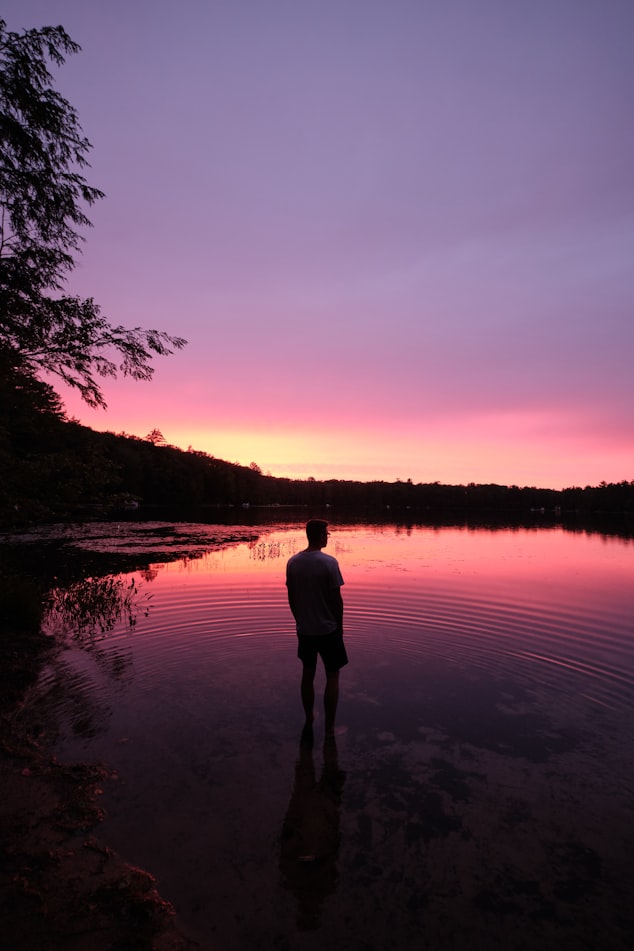
/ Image by Dyu – Ha /

When he admits you to his presence
ask from him nothing other than himself.

That’s it. Right there.

Most of us, when we seek God, we are really seeking something from God. Most of our prayers are for money, love, success in something. Now, there’s nothing inherently wrong in those things; they’re important parts of our lives. But if that’s all we ask of God, we are not asking enough.

Why ask for trinkets, when the Friend would give himself?

This reminds me of a story from the 20th century Hindu saint and spiritual ambassador, Swami Vivekananda. He was a young man, not yet committed to the spiritual life, and questioning everything about the spiritual teachings he was receiving from his guru, Ramakrishna. And his father had just died, leaving him, as the oldest son, responsible for the financial well-being of the family. He was torn between the worldly duty to provide for his mother and siblings, and his growing desire to retreat from the world to discover the deeper spiritual truths. His teacher, Ramakrishna, told him to go to the temple of the mother goddess and pray for money to provide for his family, promising that whatever he prayed for would be granted. The young Vivekananda went to the temple but was overcome with a spiritual state and found himself praying only for direct knowledge of God. He returned to his teacher, desperate, saying he forgot to pray for money. Ramakrishna told him to go a second time and pray for money. Vivekananda went, and again prayed for direct knowledge of God. He returned in tears, worried for his family. His teacher sent him back to the temple a third time, and once more Vivekananda found himself praying for God alone. When Vivekananda returned the third time, hopeless, his teacher Ramakrishna said that he had prayed for what was deepest in his heart and his prayer would be fulfilled, but Ramakrishna also promised that his family would have its basic needs met.

We are not monks, most of us. We live in the world and we have worldly needs, and when it’s important it’s okay to pray that those needs are met. But that should always be a distant second to the real and only goal — the Divine. What does it mean to have money or find that special person, but feel disconnected from the Eternal One who is our very Self? All meaning flows from that Divine Core. Without it, there is no deeper purpose or satisfaction in success, only the hunger for more.

There’s another interesting thing that happens. When we really, fully settle into that Heart of hearts, we find ourselves already at one with what we thought we sought. Then we ask ourselves why we wasted so much energy seeking so many things, when finding that source gives us the fulfillment of all things…

How can you fill a cup that’s full already?


Recommended Books: Hakim Sanai

The Longing in Between: Sacred Poetry from Around the World (A Poetry Chaikhana Anthology) Real Thirst: Poetry of the Spiritual Journey The Drunken Universe: An Anthology of Persian Sufi Poetry Islamic Mystical Poetry: Sufi Verse from the Early Mystics to Rumi Perfume of the Desert: Inspirations from Sufi Wisdom
More Books >>


Hakim Sanai, Hakim Sanai poetry, Muslim / Sufi poetry Hakim Sanai

Afghanistan (1044? – 1150?) Timeline
Muslim / Sufi

Continue Reading »

2 responses so far

Sep 24 2021

confrontation

Come to that confrontation
with yourself on all sides.
Come unarmed.
The secret: Embrace everything you find.

One response so far

Sep 17 2021

Pick up your copy of The Awakened One

Published by under Poetry

The Awakened One

The Awakened One
Buddha-Themed Haiku from Around the World
Edited by Adjei Agyei-Baah and Gabriel Rosenstock

$8.95 / £6.50 / €7.60

USCANUKFRDEITESAUS

Remember to pick up your copy of the Poetry Chaikhana’s latest publication, The Awakened One: Buddha-Themed Haiku from Around the World. This collection, edited by Adjei Agyei-Baah and Gabriel Rosenstock, is a collaboration of poets from quite literally all over the world, including contributions from Nigeria, Croatia, Malaysia, and more than a dozen other countries. Many of the haiku are rendered both in English and in the poet’s native language. Contemporary haiku are paired with classic haiku by Japanese masters, touching on themes of enlightenment, impermanence, and seeing the present moment as it is. This is an inexpensive book, so consider purchasing more than one copy to give as gifts or to donate to your local school or library. We want to let the haiku circulate and work its three-lined alchemy in the world.

No responses yet

Sep 17 2021

David Whyte – All the True Vows

Published by under Ivan's Story,Poetry

All the True Vows
by David Whyte

All the true vows
are secret vows
the ones we speak out loud
are the ones we break.

There is only one life
you can call your own
and a thousand others
you can call by any name you want.

Hold to the truth you make
every day with your own body,
don’t turn your face away.

Hold to your own truth
at the center of the image
you were born with.

Those who do not understand
their destiny will never understand
the friends they have made
nor the work they have chosen

nor the one life that waits
beyond all the others.

By the lake in the wood
in the shadows
you can
whisper that truth
to the quiet reflection
you see in the water.

Whatever you hear from
the water, remember,

it wants you to carry
the sound of its truth on your lips.

Remember,
in this place
no one can hear you

and out of the silence
you can make a promise
it will kill you to break,

that way you’ll find
what is real and what is not.

I know what I am saying.
Time almost forsook me
and I looked again.

Seeing my reflection
I broke a promise
and spoke
for the first time
after all these years

in my own voice,

before it was too late
to turn my face again.

“All the True Vows” from The House of Belonging by David Whyte.
Copyright © 1997, 2004 by David Whyte.  Used by permission of the author and Many Rivers Press (www.davidwhyte.com)  All rights reserved.


/ Image by Tevin Trinh /

I read this poem by David Whyte as a meditation on the alienation most of us feel at one time or another in our own lives. Too often we aren’t really present in our lives–

There is only one life
you can call your own…

He is saying that something powerful, even sacred, occurs when we stop contorting ourselves to reach for lives that are not our own. When we settle into ourselves, when we start to actually live our own lives, embody our own lives, we not only begin to really experience life deeply for the first time, we start to tap into “the one life that waits / beyond all others.”

Living this way, we find our true face, our true reflection.

I especially like the ending verses:

Seeing my reflection
I broke a promise
and spoke
for the first time
after all these years

in my own voice.

To rediscover our own voice, our true voice which has been socialized back into the shadows of our awareness, we have to break an old agreement, a “promise.” We must decide to no longer identify with the roles and expectations set up for us. Finally dropping the masks we wear, we discover our true face, our “reflection.” Then, “for the first time,” we can speak in our own voice.

Worth reading more than once…

David Whyte’s words hold a special place in my personal journey.

In the early 2000s, I was living with my wife on the island of Maui. It was a beautiful time in my life, but aimless. I was just doing work to get by, with no career to speak of. I was cut off from the world, by distance and by choice.

A friend sent me a series of talks by David Whyte on cassette tape, and I went for long drives along Maui’s meandering country roads, through the tall sugar cane fields and among the rows of spiky pineapple plants, listening to David Whyte’s molasses accent as he recited poetry and told stories about brilliant and troubled poets, like Antonio Machado and Anna Akhmatova.

It was Christmastime and I was quietly going through a deep and difficult self-confrontation. New Year’s Day came and went, while I hovered in that open limbo state. This combination began to ferment in my mind, the poetry and the personal crisis.

In early January it all converged. I picked up a book of conversations with the Indian sage Ramana Maharshi, read a couple of pages and—POW!—I was catapulted into an ecstatic stillness. Everything about me and my world came to a complete stop. The person I thought of as “Ivan” disappeared. It was as if some undefined, wide-open awareness was quietly witnessing the world through my eyes. An indescribable joy bubbled up inside me. The entire world was an intangible outline sketched upon a golden-white radiance, and I was a ghost happily lost in that light.

That moment set the trajectory for the unfolding of my life since. And it planted the seed for the Poetry Chaikhana. I am always thankful to David Whyte for the role he played at that transformative period in my life.

=

And have a wonderful weekend! The moon is growing full and luminous in the evening sky. In chaotic times, dance!


Recommended Books: David Whyte

The House of Belonging Where Many Rivers Meet


David Whyte, David Whyte poetry, Secular or Eclectic poetry David Whyte

US (1955 – )
Secular or Eclectic

Continue Reading »

4 responses so far

Sep 17 2021

retrain our eyes

We need to retrain our eyes to see
the spaces between and the secrets behind.

No responses yet

Sep 03 2021

Dogen – midnight – no waves, no wind

midnight — no waves, no wind
by Eihei Dogen

English version by Adjei Agyei-Baah & Gabriel Rosenstock

midnight — no waves, no wind
empty boat
flooded with moonlight

— from The Awakened One: Buddha-Themed Haiku from Around the World, Edited by Adjei Agyei-Baah / Edited by Gabriel Rosenstock


/ Image by Osman Rana /

We don’t have to hand this haiku over to the intellect to immediately understand its implications, do we? Let’s briefly sketch it out.

Midnight. A still lake, an empty boat filled with moonlight.

No activity. The mind is at rest. Emotions are calm, the will is content. In this quiet moment what we normally think of as ourselves is found to be empty, spacious, egoless. But the emptiness is not empty, it is filled with with the light of awareness. More than filled, flooded. And what does a flooded boat do? It sinks. It gives itself to the embrace of the illuminated water. Only the light and the quiet lake remain.

Or perhaps it is just a moment in time. It is what it is and nothing more: Midnight. A still lake, an empty boat filled with moonlight.

=

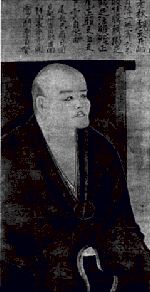
Eihei Dogen, sometimes respectfully referred to as Dogen Zenji, was a key figure in the development of Japanese Zen practice and the founder of the Soto Zen sect.

Dogen was born in about 1200 in Kyoto, Japan. At the age of 17, he was formally ordained as a Buddhist monk. Considering the Japanese Buddhism of the time to be corrupt and influenced by secular power struggles, Dogen traveled to China to discover the heart of the Dharma by studying Ch’an (Zen) Buddhism at several ancient monasteries.

Much of the Ch’an Buddhism he explored utilized koans and “encounter dialogues” to startle the consciousness into enlightenment, but Dogen was critical of this practice. Instead, he was drawn to the teachings of silent meditation.

Dogen returned to Japan in 1236. He left the politicized environment of Kyoto and settled in the mountains and snow country of remote Echizen Province, where he established his own school of Zen, the Soto school.

While he proved to be a talented writer and poet, the core of Dogen’s teaching was to transcend the mind’s addiction to language and form in order to become fully present and recognize one’s inherent enlightenment.

=

Hurricane Ida and its aftermath are very much in my thoughts. And the fires in California and elsewhere around the globe.

The earth speaks, sometimes we listen.

I hope you are all safe and well.

=

The Awakened One

The Awakened One
Buddha-Themed Haiku from Around the World
Edited by Adjei Agyei-Baah and Gabriel Rosenstock

$8.95 / £6.50 / €7.60

USCANUKFRDEITESAUS

I am still playing catching up with the release of the Poetry Chaikhana’s new publication, The Awakened One: Buddha-Themed Haiku from Around the World, edited by Adjei Agyei-Baah and Gabriel Rosenstock. Initial sales have been solid, but I am still investigating the best ways to ship copies to readers (and some of the haiku writers!) in countries such as Nigeria, Croatia, and Japan. The Poetry Chaikhana website itself is patiently waiting for me to add a new page highlighting The Awakened One. A lot of work goes into a little book!

The Awakened One is a beautiful book, a good gift to yourself and one to share with friends. Purchasing a copy is also an excellent way to support the Poetry Chaikhana. It makes a perfect companion to Gabriel Rosenstock’s explorations of haiku and awareness in Haiku Enlightenment.

May you be flooded with moonlight!


Recommended Books: Eihei Dogen

Zen Poetry: Let the Spring Breeze Enter Haiku Enlightenment: New Expanded Edition The Poetry of Zen: (Shambhala Library) The Zen Poetry of Dogen: Verses from the Mountain of Eternal Peace The Soul is Here for its Own Joy: Sacred Poems from Many Cultures
More Books >>


Eihei Dogen, Eihei Dogen poetry, Buddhist poetry Eihei Dogen

Japan (1200 – 1253) Timeline
Buddhist : Zen / Chan

Continue Reading »

2 responses so far

Sep 03 2021

through me

Ask: “What does the Eternal One
want to experience
through me?”

No responses yet