Dec 30 2022
Hildegard von Bingen – Holy Spirit of Fire
Holy Spirit of Fire
by Hildegard von Bingen
English version by Ivan M. Granger
O Holy Spirit of Fire,
life in the life of all life,
holy are you,
enlivening all things.
Holy are you,
a healing balm
to the broken.
Holy are you,
washing
blistered wounds.
O Holy Breath,
O Fire of Life,
O Sweetness in my breast
infusing my heart
with the fine scent of truth.
O Pure Fountain
through which we know
God unites strangers
and gathers the lost.
O Heart’s Shield, guarding life
and hope, joining the many members
into one body;
Belt of Truth,
wrap them in beauty.
Protect those ensnared
by the enemy,
and free the worthy
from their fetters.
O Great Way that runs through all,
from the heights,
across the earth,
and in the depths,
you encompass all and unify all.
From you the clouds stream
and the ether rises;
from your stones precious water pours,
springs well and birth waterways,
and the earth sweats green with life.
And eternally do you bring forth knowledge
by the breath of wisdom.
All praise to you,
you who are the song of praise
and the joy of life,
you who are hope and the greatest treasure,
bestowing the gift of Light.
/ Image by Julia Caesar /

As we prepare to enter the new year, I thought I would share this meditation on the universal flow of life…
This song of praise is a beautiful vision of God — a maternal vision of God, earthy, yet transcendent — flowing with life, permeating all things, exuding a good and holy greenness everywhere.
This Spirit of Fire, the Holy Spirit, is “life in the life of all life.” It is the vivifying life behind all of life. This is the “Holy Breath” that breathes through all of manifest existence, everything in nature, every form, enlivening it, making it holy, sharing its divinity. Life and all creation emerges from Spirit. It is not created in some mechanical sense but flows naturally, organically, fluidly, like breath from the body or water from a spring.
Through this divine animating spirit, all separate things are actually one: “you encompass all and unify all.”
Especially notice the lovely lines:
From you the clouds stream
and the ether rises,
from your stones precious water pours
Throughout this song tangible, physical reality, the earth itself streams, pours, exudes, and permeates. All of physical reality, even in its most solid forms of earth and rock, all of ‘solid’ reality… flows. Nothing is truly fixed or stationary. All forms possess a sort of divine inner ‘sap’ — the fluid Essence — that is its true being which shows itself as life:
springs well and birth waterways,
and the earth sweats green with life.
We have delightful language of both water and fire, and yet they seem complimentary. Why a “Spirit of Fire”? In Christian mysticism, the Holy Spirit is often associated with fire. In deep ecstasy, the awareness is flooded with a rising, blissfully searing heat, quieting the mind, opening the heart, filling one’s whole being with a sense of the interconnectedness of life. Adding to this, the inner vision is dazzled by a radiating golden-white light — “bestowing the gift of Light.” Paradoxically, amidst this inner fire of illumination, there is the simultaneous descent of a trickling honey-like sweetness down the back of the throat, making one drunk on bliss and beauty. Thus Hildegard gives us images of water and flow and secret springs, as well.
Throughout this profound reformulation of the self we find ourselves bathed in the most profound knowledge. This is not knowledge in the sense of data or information, but in some indescribable way the living breath of knowledge itself. It is gnosis, the field of knowingness itself, that fills us.
And eternally do you bring forth knowledge
by the breath of wisdom.
Yet clearly this is not a solitary vision confined to the mystic’s solitary self.
Belt of Truth,
wrap them in beauty.
This same spiritual vivification is taking place throughout the earth, through its good green life, through all things and all people, and we are, all of us, one in that life and in the eternal outpouring of that life-giving Spirit.
you encompass all and unify all.
Recommended Books: Hildegard von Bingen


|
Hildegard von Bingen |
Hildegard was born in Bermersheim, not far from Mainz, Germany to a noble family. She was the tenth and last child to be born to the family. At the age of eight, Hildegard was “given to God as a tithe” by placing her in the care of Jutta, a woman who had chosen a life of solitary seclusion. Hildegard would later describe Jutta as “uneducated,” yet she taught the girl the basic skills of reading, as well as her initial practices in the spiritual life.
Hildegard’s health was always fragile, but she had a rich interior life, by her own account receiving visions since early childhood. Hildegard describes one vision she had at the age of three of witnessing “a brightness so great that [her] soul trembled.”
This experience of divine light was repeated and magnified when she was in her forties. She wrote:
“When I was forty-two years and seven months old, the heavens opened and a blinding light of extraordinary brilliance flooded my head. It blossomed like a fire in my heart and breast, not burning but warming… and all at once I understood the inner meaning of the holy books.”
This was a light that remained a part of her perception throughout her life. Even in her seventies, Hildegard described it as a light that seemed to permeate everything without hindering her ability to see normally, as well.
She is said to have had a natural gift of clairvoyance and the ability predict the future. She was also widely respected as a healer and herbalist, having written works on natural history and the medicinal uses of plants.
Illness was intimately linked with Hildegard’s mystical life. Bouts of illness seemed to be brought on by the tensions that existed between her divine promptings and the limitations of the roles allowed to her as a woman and a nun. She had especially severe illnesses occur prior to the major decisions in her life.
Hildegard’s early life was relatively quiet. A small community of women gathered around Jutta, that eventually joined the Benedictine order. Hildegard herself took monastic vows in her teens. When Jutta died in 1136, Hildegard was elected to lead the monastic community.
It wasn’t until she was in her forties, however, that Hildegard began to gain notoriety for her visions. She was surprised to receive an inner prompting to “tell and write” her visions. She initially resisted and was soon bedridden as the inner conflict played out. Eventually she relented and began to dictate her visions.
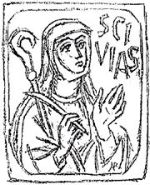
The first work she produced was Scivias, a description of a cycle of visions about the relationship of humanity and nature with God. She also composed a collection of music and poetry called the Symphonia. She also wrote extensively about medicine and herbs.
Hildegard’s fame quickly spread, bringing pilgrims and the curious, eventually overwhelming the capacity of the small community. A new, larger monastery was built between 1148 and 1150 in Rupertsberg near Bingen.
Throughout the 1150’s, Hildegard made several teaching tours through the Rhineland.
Although Hildegard had received blessings from Church authorities for most of her work, toward the end of her life she ran into conflicts for, among other things, allowing an excommunicated man who had died to be buried in consecrated ground. She refused to have the body dug up and, as a result, she was not allowed to take the eucharist — a deep wound for a devout Catholic. This ban was eventually lifted near the end of her life.
Thank You, Ivan
Hildegard was the first mystic I read about and read some of her work. Your translation
of this poem is beautiful and also your commentary. I will return to this often. . .
Peace and Every Good.
Seconding every word of Carol’s