Aug 22 2025
God technology
Religion is not a fixed collection
of beliefs and rituals.
Religion, properly understood,
is a living technology
for experiencing God.
Aug 22 2025
Religion is not a fixed collection
of beliefs and rituals.
Religion, properly understood,
is a living technology
for experiencing God.
Aug 08 2025
No use fretting over gold, beauty or fame;
by Loy Ching-Yuen
English version by Thomas Cleary
No use fretting over gold, beauty or fame;
Nurturing these, how can we calm
Our fluttering heart?
Non attachment brings deep truth,
And a truthful nature brings immortality.
Empty your heart,
Sit quietly on a mat.
In meditation we become one with All;
Tao billows like the vapors
In a mountain valley,
And its supernatural power wafts into our soul.
/ Image by Jan Canty /
A reminder to us all from a modern Taoist master to keep our life priorities straight. I like this poem’s calm clarity.
Fretting over “gold, beauty or fame…” What does that get us? Even if we succeed and attain wealth or attention, it is tainted by the ingrained habit of fretting. The satisfaction we hoped for slips away almost immediately. And each of those things will inevitably shift and recede in the cycles of time anyway — and we know it, so acquisition is tainted by the fear of loss. Having poured so much life energy into their pursuit, there is no peace or enjoyment, just a “fluttering heart.”
No use fretting over gold, beauty or fame;
Nurturing these, how can we calm
Our fluttering heart?
The human soul recoils from loss. The sticky self, having grown attached to the objects of its desires, views their loss as a loss of some part of itself. Because of attachment, each loss is perceived as a death. Yet this is a fluid world, a world of comings and goings. To the self that endlessly identifies with external things, it is a world of a thousand small deaths. Amidst the constant fear of death, the truth of one’s eternal nature is lost.
Empty your heart,
Sit quietly on a mat.
In meditation we become one with All
The solution, Loy Ching-Yuen reminds us, is in non-attachment:
Non attachment brings deep truth,
And a truthful nature brings immortality.
Non-attachment here does not necessarily mean renunciation, becoming a monk or living in a mountain cave somewhere. Non-attachment means non-identification. A person, an experience, or an object may be important, and is therefore to be cherished. But our fundamental identity remains settled within the heart. External movements do not tug at our sense of self. We can witness reality as it is from the supreme security of our true nature.
Loss and death have no claim on us. This is Loy Ching-Yuen’s immortality.
And it is naturally so. It doesn’t even require work on our part. We must simply, quietly watch the process happen.
Tao billows like the vapors
In a mountain valley,
And its supernatural power wafts into our soul.
Recommended Books: Loy Ching-Yuen
 |
 |
 |
||
| The Essential Mystics: Selections from the World’s Great Wisdom Traditions | The Book of the Heart: Embracing the Tao | The Supreme Way: Inner Teachings of the Southern Mountain Tao | ||
| Loy Ching-Yuen |
Aug 08 2025
Compassion
isn’t so much a virtue
as it is a form of
self-awareness.
Aug 01 2025
The Way It Is
by Lynn Ungar
One morning you might wake up
to realize that the knot in your stomach
had loosened itself and slipped away,
and that the pit of unfilled longing in your heart
had gradually, and without your really noticing,
been filled in — patched like a pothole, not quite
the same as it was, but good enough.
And in that moment it might occur to you
that your life, though not the way
you planned it, and maybe not even entirely
the way you wanted it, is nonetheless —
persistently, abundantly, miraculously —
exactly what it is.
 — from Poetry of Presence: An Anthology of Mindfulness Poems, Edited by Phyllis Cole-Dai / Edited by Ruby R. Wilson
/ Image by Dmitry Ganin /
I love this poem. It speaks from a place of gentle awareness of one’s self and one’s life.
One morning you might wake up
to realize that the knot in your stomach
had loosened itself and slipped away…
I think there is a tendency toward self dissatisfaction, something feels wrong, incomplete, imperfect. This is especially true for those of us who see ourselves on a spiritual journey. Perhaps we even use that feeling as motivation on our spiritual journey. It can be needed fuel.
But the years teach us that that feeling becomes a trap, a form of self-cruelty. Our lives can feel like a series of disappointments. Worse, we see ourselves as failures. And no amount of religious or spiritual practice seems to fix that feeling.
The thing is, there is no perfect “fix” for the feeling. Yes, the way we live in the world, the way we cultivate our inner awareness, these help, but they don’t fully untangle that Gordion knot. You know what does? Restful, non-reactive, non-judgmental self-awareness. Pausing from all our efforts and just noticing who we are, what we are, what our lives are.
When we do that, a surprising thing happens: We begin to see an underlying wholeness, even when there is no obvious reason for it to be there.
And in that moment it might occur to you
that your life, though not the way
you planned it, and maybe not even entirely
the way you wanted it, is nonetheless —
persistently, abundantly, miraculously —
exactly what it is.
All the anxieties and harsh judgments we have held in our bodies just somehow dissipate. All the mental projections of what we wanted but didn’t get or what we got but didn’t want, drop like a shadow screen before our eyes and we see things simply as they are. It may not fit the grand heroic story we have held in the mind for so long, but what is actually there is telling its own story, a story of fullness.
Let’s pay attention to that story. Let it bring healing.
=
I know there are terrible tragedies unfolding in the world right now. Find some quiet moments — and radiate love into the world. Don’t try to mentally solve the world’s problems in that moment. Don’t react or tighten up in anger. Just radiate love.
Don’t even “radiate” love, since that might imply that you are pushing love out from some limited personal reservoir. The love is there, already, and in abundance. Allow it through. Step aside in your quiet moments and let the love flood through you into the the parched world. See what magic it can accomplish.
Sending love to you all!
 |
|
 |
||
| Bread and Other Miracles | Poetry of Presence: An Anthology of Mindfulness Poems | Blessing the Bread: Meditations | ||

|
Lynn Ungar
US (Contemporary) |
Jul 18 2025
I find you, Lord, in all Things and in all
by Rainer Maria Rilke
English version by Stephen Mitchell
I find you, Lord, in all Things and in all
my fellow creatures, pulsing with your life;
as a tiny seed you sleep in what is small
and in the vast you vastly yield yourself.
The wondrous game that power plays with Things
is to move in such submission through the world:
groping in roots and growing thick in trunks
and in treetops like a rising from the dead.
 — from Ahead of All Parting: The Selected Poetry and Prose of Rainer Maria Rilke, Translated by Stephen Mitchell
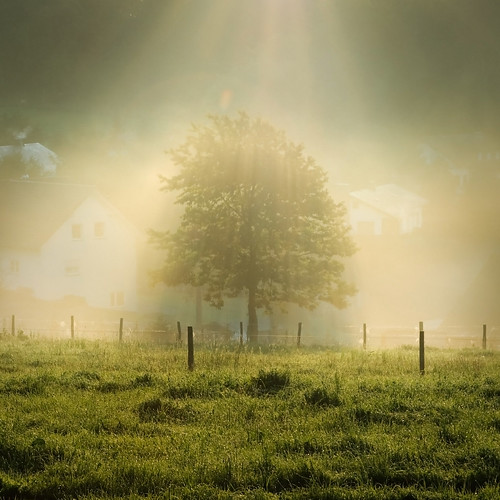
/ Image by Ben Fredericson /
This is a poem I have featured before, but I found myself reading it this morning and decided that it was a good one to share with you again…
and in the vast you vastly yield yourself.
Isn’t that a magical line? In the second verse Rilke is really saying something of deep insight about about what real power is:
The wondrous game that power plays with Things
is to move in such submission through the world…
The “power” he is talking about is obviously not power over, not the domination of the warlord or the predator. Following on his first verse, we can read power as the power of the “Lord, in all Things.” It is the power of life itself, awareness, presence. Rilke’s use of the word “power,” makes us question the assumptions of common language: Perhaps this gentle presence is real power, rather than the fleeting assertion of force and fear.
This real power plays a game in the world of things. It expresses its power through submission, rather than control. Like water, it yields and so finds its destination. It allows, and so fulfills its purpose. It is supremely humble, and so is humbly present everywhere, in all things, without prejudice or rejection. It rises from the lowest to the highest, vivifying everything it touches–
groping in roots and growing thick in trunks
and in treetops like a rising from the dead.
This power flowing through us and all our “fellow creatures” binds us all with the same life. You’ll notice, it is not even our life at all. Rilke says “your life,” the Lord’s life. It is something we participate in, a current we ride as it flows through us and the world, but it is not our own. Rilke is hinting at a larger vision in which there is only one Life flowing through a million “Things.”
Hildegard von Bingen, the great medieval mystic, called this the viriditas or greening power of God.
Too much of our relationship with the natural world is built on ideas of separation and domination. Such foolishness can only ever harm us. When we see clearly, we see as Rilke does that we are part of the same shared Life. To harm the natural world is to rebel against God. Is that language too religiously loaded? Reread Rilke’s poem, and then think about it.
Recommended Books: Rainer Maria Rilke
|
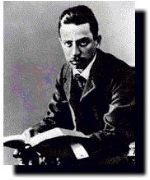
Rainer Maria Rilke
Germany (1875 – 1926) Timeline |
Jul 04 2025
Every Day as Wide as a Field
by Naomi Shihab Nye
1
Standing outside
staring at a tree
gentles our eyes
We cheer
to see fireflies
winking again
Where have our friends been
all the long hours?
Minds stretching
beyond the field
become
their own skies
Windows doors
grow more
important
Look through a word
swing that sentence
wide open
Kneeling outside
to find
sturdy green
glistening blossoms
under the breeze
that carries us silently
2
And there were so many more poems to read!
Countless friends to listen to.
We didn’t have to be in the same room—
the great modern magic.
Everywhere together now.
Even scared together now
from all points of the globe
which lessened it somehow.
Hopeful together too, exchanging
winks in the dark, the little lights blinking.
When your hope shrinks
you might feel the hope of
someone far away lifting you up.
Hope is the thing…
Hope was always the thing!
What else did we give each other
from such distances?
Breath of syllables,
sing to me from your balcony
please! Befriend me
in the deep space.
When you paused for a poem
it could reshape the day
you had just been living.
/ Image by Tito Rollis /
A poem today by the wonderful Palestinian-American poet, Naomi Shihab Nye.
Standing outside
staring at a tree
gentles our eyes
Aren’t those wonderful opening lines?
I encourage you to say the lines out loud. Standing. Staring. That alliteration, with the “st-st.” And a secondary level of alliteration with the use of the “t” sound in nearly every word of these first few lines. We can play with the lines on our tongue. St-anding. St-aring. Out-side. T-ree. Gent-les.
And then we remember to pay attention to the words, what they are saying.
She gives us permission to pause and gaze at a tree. It “gentles” our eyes. That line works on two levels. Looking at the tree makes our gaze and, more generally, our awareness gentler — somehow kinder to the world and to ourselves, at ease, at peace. But it also suggests that contemplating a tree tames the eyesight and, by extension, the mind. Do we let the eyes go wild and slice up reality into parcels that the erratic mind can then choose to latch onto or ignore? By resting with a patient green neighbor, we train the mind to cease its evasions and grasping, taming it to encounter the present moment.
Minds stretching
beyond the field
become
their own skies
We expand. The world around us opens.
Words can become windows. A poem a doorway.
Look through a word
swing that sentence
wide open
We just have to quiet down, so we can notice which phrases want to open for us — then we step through.
Kneeling outside
to find
sturdy green
glistening blossoms
under the breeze
that carries us silently
The second section of the poem seems to step back and give is a broader sense of what she is saying:
And there were so many more poems to read!
Countless friends to listen to.
Poetry. Friends. Poems as friends. Friends speaking to us through poetry, through space, through time.
Coming together, a shared community which invites us to join in. When we feel disconnected, words of wisdom, words of kindness, words of vision reconnect us.
Hope is the thing …
Hope was always the thing!
Shared hopes. Or, when hope eludes us, shared fears. The whole human experience. Sharing allows us to recognize ourselves in each other. Seeing deeply into another, we come to know ourselves more fully.
That’s where real transformation happens. When we allow ourselves to slip into the awareness of our shared being, as a good poem invites us to do, doors open in us.
When you paused for a poem
it could reshape the day
you had just been living.
=
A reminder to myself: Ivan, challenge yourself to connect with and protect vulnerable outsiders in your community. Learn to balance inner peace with a fiery voice and firm action. Raise good trouble. Upset the people you have to. Kindle a kind heart.
|
Naomi Shihab Nye
US & Palestine (1952 – ) |
Jul 04 2025
Be fully present.
Be totally naked.
Let the energy flow.
Feel everything.
Accept yourself completely.
Jun 20 2025
What Was
by Ala al-Dawla Simnani
English version by David and Sabrineh Fideler
Once I was here,
but now “I” am not:
If there’s really a “me,”
it could only be you.
If any robe warms
and encompasses me now,
that very robe —
it could only be you.
In the way of your love,
nothing was left —
neither body nor soul.
If I have any body —
If I have any soul —
then, without question,
it could only be you.
 — from Love’s Alchemy: Poems from the Sufi Tradition, Translated by David Fideler / Translated by Sabrineh Fideler
/ Image by Imad Alassiry /
With the headlines filled with war and mass traumas, the playing out of the death urge on the global stage, it is often difficult to select a poem for the Poetry Chaikhana. Certainly there are many great poems on war and death, but those have general not been the focus of the of the Poetry Chaikhana. I tend to highlight poems of individual mystical awakening, that flash of insight, the flood of bliss, the overwhelming sense of wholeness and harmony. Should we even try to make room for such poems in a time of upheaval and fear?
I think the answer is that our spiritual journey must incorporate the fullness of this human experience, even war, even injustice. This doesn’t mean that we accept what is cruel or harmful or increases suffering, but we cannot pretend that it is not playing out in the moment. We can do our best to see it honestly for what it is, why it is there, and begin to nurture mature and patient remedies — first within ourselves and individuals, then allowing ourselves to become medicine for the wider world. Be distrusting of solutions that are quick or external. Balance is always found at the center point, within. This is true for societies and cultures as much as for individuals.
Today I feature a poem not of war but of spiritual selflessness by a Persian Sufi poet, that is by a poet from Iran.
Once I was here,
but now “I” am not
Do you feel it? That sense of “I” and “me” how thin and intangible they are when you really look?
We spend most of our life energy asserting that this thing, this “me” is IMPORTANT. The problem is that that “me” is not real. The more we look for it, the more it retreats. When we finally corner it, it simply fades away, dispelled like a trick of light. What are we left with?
There is a self, but it is not a limited or selfish self. To some it borders on blasphemy to call this real Self a self at all, implying some personal possession of something so all-inclusive. Some prefer to call this center of being not “me,” but You — the Friend, the ever-present Beloved. While the “me” struts and shouts and grabs, it cannot make of itself a real and lasting thing. But that You remains, always there, waiting patiently for the braggart self to tire of its own voice and step aside.
In the way of your love,
nothing was left —
neither body nor soul.
Everything we thought we owned, everything we ascribed to that “me,” even the body itself, they all cease to be limited objects of the mind when the me itself is recognized as unreal. Body, self– these are seen, not as things that “I” am or possess, but as part of a fluid continuum of the greater You. Everything stops being things, and is, instead, a grand embodiment of the Eternal.
If I have any body —
If I have any soul —
then, without question,
it could only be you.
Have a beautiful day enrobed in the Beloved.
Recommended Books: Ala al-Dawla Simnani
|
|
|||
| Love’s Alchemy: Poems from the Sufi Tradition | The Throne Carrier of God: The Life and Thought of ‘Ala’ Ad-Dawla As-Simnani | |||
|
Ala al-Dawla Simnani
Iran/Persia (1261 – 1336) Timeline |
Jun 20 2025
We need to retrain our eyes to see
the spaces between and the secrets behind.
Jun 06 2025
Bewildered
by Kahlil Gibran
This would I have you remember in remembering me:
That which seems most feeble and bewildered in you is the strongest and most determined.
Is it not your breath that has erected and hardened the structure of you bones?
And is it not a dream which none of you remember having dreamt, that builded your city and fashioned all there is in it?
Could you but see the tides of that breath you would cease to see all else,
And if you could hear the whispering of the dream you would hear no other sound.
 — from The Prophet, by Kahlil Gibran
/ Image by Cody Black /
I hadn’t read this poem by Kahlil Gibran in some time. His words have a rare quality of directly confronting our self-doubts and fears, and then elevating us with such gentleness. He manages to rearrange our reflexive view of things in a way that is almost playful yet without discounting soul’s fears. That’s the transformative medicine of some poetry.
Rereading the words I originally wrote more than ten years ago to accompany this poem, they still fit–
It’s been a difficult week for a lot of people. Some weeks, vulnerabilities just get triggered, and life’s solid certainties fade and shift about. If it’s been that sort of week for you, don’t take it too personally. It’s going about. Sometimes we’re just being reminded to breathe, to allow the dream to reshape itself. When we listen for the breath, we participate in its rhythm. And from that soft rhythm our world is daily reborn.
That which seems most feeble and bewildered in you is the strongest and most determined.
Have a beautiful day!
Recommended Books: Kahlil Gibran
|
 |
 |
 |
 |
| The Prophet | The Beloved: Reflections on the Path of the Heart | Broken Wings | Jesus the Son of Man | Kahlil Gibran: His Life & World |
| More Books >> | ||||

|
Kahlil Gibran
Lebanon/US (1883 – 1931) Timeline |
Jun 06 2025
When we call out to God,
we are actually hearing God calling to us.
All of creation is a part of God,
and its every song, when heard with an open ear,
is really the song of God to God.
May 23 2025
My daily activity is not unusual
by P’ang Yun (Layman P’ang)
English version by Satyavayu
My daily activity is not unusual;
I just remain in spontaneous harmony.
Not grasping or rejecting,
nothing left to assert or oppose.
What use are fancy titles
and expensive clothes of vermilion and purple?
This entire mountain is free
of even a speck of dust.
Supernatural powers and miraculous activity:
fetching water and carrying firewood
/ Image by Alexander Klimm /
Something quiet today. A reminder to us of the magic found in our ordinary moments.
My daily activity is not unusual;
I just remain in spontaneous harmony.
When the mind comes to rest and ceases to kick up its own dust, we can finally, perhaps for the first time, see reality in its most beautiful, clear form.
This entire mountain is free
of even a speck of dust.
That’s when the miraculousness of each moment reveals itself.
Supernatural powers and miraculous activity:
fetching water and carrying firewood
So much beauty awaits us just beneath the disruptions of the mind. Whatever work we have before us, even when difficult or frightening, in whatever world we find ourselves moving through, let us set aside time to quiet down and truly see. We can deny the truth. We can cover it over with busyness and cruelty. But don’t be fooled. Heaven is barely held in by the surface rind of reality.
Recommended Books: P’ang Yun (Layman P’ang)
 |
 |
 |
 |
|
| This Dance of Bliss: Ecstatic Poetry from Around the World | The Enlightened Heart: An Anthology of Sacred Poetry | Haiku Enlightenment: New Expanded Edition | The Sayings of Layman P’ang: A Zen Classic | |
|
P’ang Yun (Layman P’ang)
China (740? – 808) Timeline |
May 16 2025
Via Negativa
by R. S. Thomas
Why no! I never thought other than
That God is that great absence
In our lives, the empty silence
Within, the place where we go
Seeking, not in hope to
Arrive or find. He keeps the interstices
In our knowledge, the darkness
Between stars. His are the echoes
We follow, the footprints he has just
Left. We put our hands in
His side hoping to find
It warm. We look at people
And places as though he had looked
At them, too; but miss the reflection.
 — from Through Corridors of Light: Poems of Consolation in Time of Illness, Edited by John Andrew Denny
/ Image by tanakawho /
This is a haunting poem, yet lovely and uplifting at the same time. God is a kind of a ghost in this poem, a tangible absence.
…God is that great absence
In our lives, the empty silence
Within…
And that is really the poet’s point. So often we struggle to imagine what God is, the qualities and awareness associated with that immense… Something. But this poem is a meditation on the Via Negativa, that is, the recognition that the Eternal is not a “thing” at all. Every definition or description or quality we attach to the Divine is necessarily a limitation on the Divine Nature and, therefore, incomplete. To turn God into an object that can be described is to make God a subset of Existence, when the Eternal is the Whole of Existence and beyond. The idea behind the Via Negativa is that God cannot be adequately conceptualized by the limited human intellect with attributes of a limited physical reality, and so God is best discovered through negation. In other words, God is all-encompassing, and therefore perceived as a sort of vibrant Absence, a sort of haunting Presence within the empty spaces of our perception…
…He keeps the interstices
In our knowledge, the darkness
Between stars. His are the echoes
We follow…
That ache we universally feel, that absence can feel to the soul like an existential betrayal inherent within reality. Most of us reflexively turn from that feeling and run from it, endlessly distracting our awareness so we don’t feel it so painfully. But, ultimately, that’s not very effective, and it is never satisfying.
We put our hands in
His side hoping to find
It warm.”
This is, of course, a reference the story in the Gospels when “doubting” Thomas would not believe that the risen Christ stood before him until he could touch the wounds in Christ’s side. Here the poet sees that wound as another representation of that hauntingly empty space, which reveals itself to be both real and also divine. There is a void we all sense and mostly try to ignore. When we no longer recoil and instead reach out to touch that emptiness, we hope to feel warmth, life, presence within the apparent absence — and we do.
–
Mystics encourage us to look deeper, to fully encounter that “great absence,” to sit with it. Eventually we discover to our surprise that that terrible void is, in truth, filled with immense life and an indescribable bliss. Our very being flows from that immense and spacious No-Thing-Ness. If we name It, if we describe or define It, that my help our understanding up to a point, but if we cling too tightly to those names and descriptions, we limit our full awareness and vision. This is the truth of the Via Negativa.
Recommended Books: R. S. Thomas
|
R. S. Thomas |