Dec 10 2021
Dogen – Worship
Worship
by Eihei Dogen
English version by Ivan M. Granger
Beneath the snows
the hidden world of winter grass.
And in the field of white, a white heron
hides himself.
 — from This Dance of Bliss: Ecstatic Poetry from Around the World, Edited by Ivan M. Granger
/ Image by Birger Strahl /
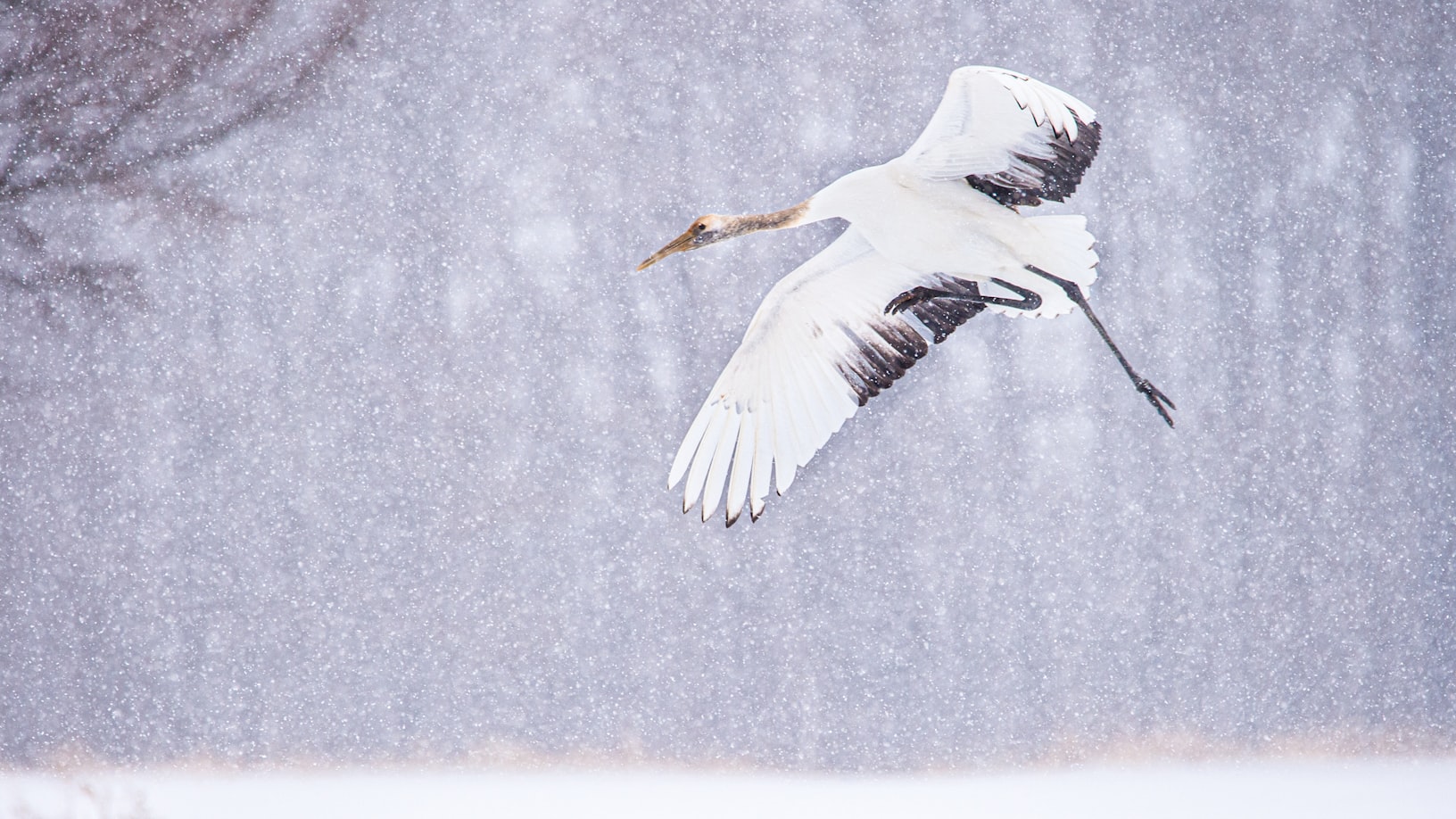
I woke up to light snow this morning in Colorado, snowflakes following meandering, individual paths down to settle on the ground, just beginning to cover it. I thought of this poem and commentary…
Looking out my window, I see a quiet winter morning, mist trickling in among the bare branches, yesterday’s snow still new upon the ground. I think of this poem…
Reading this poem, we immediately ask what a white heron in snow has to do with worship, as suggested by the title.
And in the field of white, a white heron
hides himself.
Have you ever watched a heron fishing, wading at the edge of a lake? Its entire being is focused. Even when it moves it seems utterly still. Because of these qualities, the heron is a natural symbol for the meditator.
We have a being of white — the heron, the meditator — disappearing into an environment of white — the snow-covered field. In fact, the heron is not passively disappearing, it is actively engaged in the process. He “hides himself” in the snow. How does the heron hide? Through stillness. The heron settles into its own nature. It is already as white as the snowy world it inhabits. The heron just has to grow quiet, be itself, and it naturally disappears from sight.
Snow represents the glowing world as perceived by the enlightened awareness. Everything, when draped in new-fallen snow, becomes one. Everything is the same “white” radiance. Everything comes to rest within this shared glow of being. The idea of separation is lost in that light. Beings and objects are suddenly seen as a fluid continuity within that “field of white.”
So this, according to Dogen, is what constitutes true worship: Through meditation and stillness we recognize our own incandescent nature in the midst of the bright field of being. As we settle into ourselves, we gently merge with the luminous reality that surrounds us.
Recommended Books: Eihei Dogen


|
Eihei Dogen
Japan (1200 – 1253) Timeline |
Eihei Dogen, sometimes respectfully referred to as Dogen Zenji, was a key figure in the development of Japanese Zen practice and the founder of the Soto Zen sect.
Dogen was born in about 1200 in Kyoto, Japan. At the age of 17, he was formally ordained as a Buddhist monk. Considering the Japanese Buddhism of the time to be corrupt and influenced by secular power struggles, Dogen traveled to China to discover the heart of the Dharma by studying Ch’an (Zen) Buddhism at several ancient monasteries.
Much of the Ch’an Buddhism he explored utilized koans and “encounter dialogues” to startle the consciousness into enlightenment, but Dogen was critical of this practice. Instead, he was drawn to the teachings of silent meditation.
Dogen returned to Japan in 1236. He left the politicized environment of Kyoto and settled in the mountains and snow country of remote Echizen Province, where he established his own school of Zen, the Soto school.
While he proved to be a talented writer and poet, the core of Dogen’s teaching was to transcend the mind’s addiction to language and form in order to become fully present and recognize one’s inherent enlightenment.
Beautiful commentary… ” The heron hides… through stillness” – by “settling into its own nature.” Words I needed to hear tonight. Oh to remember this! thank you! _/\_
Thank You Ivan. So much here to take in. Dogen’s beautiful poem aided by your
illuminating commentary, and your Thought for for the Day, and the interview –
While I am not a speaker of Hindi, I appreciated your responses and could well
understand them.