Aug 26 2022
visibility of being
The present is a moving thread of light
where all things barely step into the visibility of being…
as the moment keeps moving.
Aug 26 2022
The present is a moving thread of light
where all things barely step into the visibility of being…
as the moment keeps moving.
Aug 19 2022
Metempsychosis
by Jane Hirshfield
Some stories last many centuries,
others only a moment.
All alter over that lifetime like beach-glass,
grow distant and more beautiful with salt.
Yet even today, to look at a tree
and ask the story Who are you? is to be transformed.
There is a stage in us where each being, each thing, is a mirror.
Then the bees of self pour from the hive-door,
ravenous to enter the sweetness of flowering nettles and thistle.
Next comes the ringing a stone or violin or empty bucket
gives off —
the immeasurable’s continuous singing,
before it goes back into story and feeling.
In Borneo, there are palm trees that walk on their high roots.
Slowly, with effort, they lift one leg then another.
I would like to join that stilted transmigration,
to feel my own skin vertical as theirs:
an ant-road, a highway for beetles.
I would like not minding, whatever travels my heart.
To follow it all the way into leaf-form, bark-furl, root-touch,
and then keep walking, unimaginably further.
 — from Given Sugar, Given Salt: Poems, by Jane Hirshfield
/ Image by Denys Argyriou /
The title first: Metempsychosis is the transmigration of the psyche or the soul. It can be a synonym for reincarnation, though metempsychosis often implies the notion of re-embodiment in any form, not just another human body. It is the transference of self.
And this poem seems to consider this idea from several different angles.
Stories and trees.
To look at a tree, to really encounter it as a living being, as a living expression of awareness, something profound happens in us: we encounter something of ourselves in that tree. We see ourselves by truly seeing something else.
There is a stage in us where each being, each thing, is a mirror.
The boundary between human and tree falls away, and the sense of self flows between the two. And there is a supreme sweetness in this recognition of shared being with the world around us.
Then the bees of self pour from the hive-door,
ravenous to enter the sweetness of flowering nettles and thistle.
Isn’t this a wonderful image? The bees of self. We tend to think of the self as a single, solid thing, a body of sorts. But here we have the image of the self as cluster that escapes and scatters and spreads out into the world, hungry to experience the offered life all around it, so confident in itself that even barbs and stings hold their own sweetness. In Hirshfield’s metempsychosis, we don’t step from body A to body B; we pour out and taste all the world around us.
Next comes the ringing a stone or violin or empty bucket
gives off —
the immeasurable’s continuous singing,
before it goes back into story and feeling.
When we step out of our own story, when learn to connect, when we learn to become, we find everything has its song. Everything is speaking always. The world rings with being.
In Borneo, there are palm trees that walk on their high roots.
Slowly, with effort, they lift one leg then another.
Walking trees… Some types of jungle trees grow from stilted, raised roots. It is said that, over time, they actually “walk” by growing new roots in one direction, while allowing the old roots to wither.
I would like to join that stilted transmigration…
What is most fascinating to me is the poet’s assertion that she would like her skin to be a highway for ants and beetles.
I would like not minding, whatever travels my heart.
There may still be a self-protective, self-defining sense of self that reflexively hesitates, but yet she yearns to feel the many marching trails of life merging, the great slow pathways of walking trees, and the minute busy paths of ants upon the tree.
And every one of those roads is part of the journeying self.
To follow it all the way into leaf-form, bark-furl, root-touch,
and then keep walking, unimaginably further.
Recommended Books: Jane Hirshfield
 |
|
 |
 |
 |
| Women in Praise of the Sacred: 43 Centuries of Spiritual Poetry by Women | Given Sugar, Given Salt: Poems | The Lives of the Heart: Poems | The October Palace: Poems | Of Gravity & Angels |
| More Books >> | ||||

|
Jane Hirshfield
US (Contemporary) |
Aug 19 2022
Knowledge is not the accumulation of data
or the formulation of thought.
True knowledge is to merge
with the living field of knowing itself.
Aug 12 2022
Keep on knocking
by Mevlana Jelaluddin Rumi
English version by Coleman Barks
Keep on knocking
’til the joy inside
opens a window
look to see who’s there
 — from The Essential Rumi, Translated by Coleman Barks
/ Image by Daniel Gregoire /
We have made it to the other side of our journey and arrived safely in Eugene, Oregon. It is a homecoming for us, although we have been away for decades. Much is familiar, yet everything is new.
The drive out itself, while beautiful, was a bit of an ordeal. We passed through a heat wave affecting Utah and Idaho before entering the cooler weather of Oregon.
Eugene itself is lovely. The Willamette River running through town, trees and deep greens, blackberry bushes at the edges of alleyways just beginning to bear fruit. Walks along the river in the morning chill is a special treat. The downtown area is vibrant, more active than we remember in the early 90s. Trying to reorient to the idiosyncratic city layout, one way streets, unexpected loops and turns.
When we explore a town, the places we check out first to connect with the community: the natural food stores, the bookstores, coffee shops (though I rarely drink coffee), neighborhood parks. We’re making the rounds.
The ocean, just an hour-and-a-half’s drive away, calls to my wife. An afternoon trip coming up soon.
Boxes are everywhere. All the books arrived, though we did not bring all our old bookshelves, so just where will everything go? Which books make the cut for display on bookshelves and which get tucked away into closets?
Keep on knocking
’til the joy inside
opens a window
look to see who’s there
I want to say thank you to all of you, the entire Poetry Chaikhana community, for all of your thoughts and supportive messages through this move. My heart has been full through the miles traveled. Love to you all in return.
Have a beautiful day!
Recommended Books: Mevlana Jelaluddin Rumi

|
Mevlana Jelaluddin Rumi
Afghanistan & Turkey (1207 – 1273) Timeline |
Jul 15 2022
How did I ever think silence the language of love?
by Darshan Singh
English version by Barry Lerner and Harbans Singh Bedi
How did I ever think silence the language of love?
What I thought would not come to light was in plain sight.
I hear my silence talked of in every lane;
The suppression of a cry is itself a cry of pain.
The beloved’s regard was but a flash of light;
How innocent to think I’d found eternal bliss.
These, too, in the end were the gardener’s: the lightning and the wind
And that handful of pitiful straws I’d called my nest.
Darshan, the glances I’d fancied voiced my love —
Even they couldn’t convey the unplumbed depths of my longing.
 — from Love’s Last Madness: Poems on a Spiritual Path by Darshan Singh, Translated by Barry Lerner / Translated by Harbans Singh Bedi
/ Image by Daniele Levis Pelusi /
Let’s spend a little time with this poem…
This poem is a lovely way to address some of the initial encounters of mystical union.
The opening couplets explore interweaving themes of silence and awareness of the Divine. Esoteric traditions all over the world use inner silence, profound psychic stillness, as a way to open up to the vision of the Divine. But here Darshan Singh confronts the limitation of the practice–
How did I ever think silence the language of love?
What I thought would not come to light was in plain sight.
As we explore deeply, we discover layers to silence. Superficial silence is effortful. It is a striving for something not seen. It is, in effect, a rejection of the common perception of the common world.
Yet Darshan Singh shares with us his deeper realization, that the Divine speaks to us in the language of love, and that language is whispered everywhere, in all things. He seems to be urging us not to cultivate a holiness born of rejection, but one born of profound recognition of the Divine already here, already everywhere, in plain sight.
Further, in silence is discovered a quiet, all-pervading sound. So, even in silence, that silence is filled with a song, the language of love.
I hear my silence talked of in every lane;
The suppression of a cry is itself a cry of pain.
First, I love the humorous play of words with these lines: He ‘hears’ his silence, and it is talked about everywhere. His silence has sound, and the acclamation of his attainment of his silence makes his silence noisier.
And that second line says so much. Merely holding thoughts back can open a few doors, but it ultimately becomes a practice of suppression. Suppression cannot be the ultimate fulfillment, for it too is “a cry of pain.”
Where then does that leave us? How is silence and clear vision attained without suppression of thought? Think of it this way: Learning to hold thoughts allows us to finally understand deep silence. When that is discovered, when we learn to rest in that truer silence, surface thoughts are of less consequence.
We find a similar idea expressed in some Buddhist teachings and poetry that pose the question, of what consequence are clouds to the unchanging blue sky?
The beloved’s regard was but a flash of light;
How innocent to think I’d found eternal bliss.
That first ecstatic flood of light in mystic experience is life changing. Joy indescribable. Wholeness. Unity. Supreme contentment. Many mystics have trouble admitting that they have not (yet) attained the Ultimate. Too many mystics reach this level, and thinking they have found eternal bliss, rush to put out their guru shingle — only to find the experience slipping through their grasp. Like lightning, it fills the world with light, and then returns into itself.
And that’s the issue: It is an experience of enlightenment, but it is not yet capital-E Enlightenment. Any ‘experience’ is something that happens to you; it has a beginning, but it also has an end. True Enlightenment, on the other hand, must be stable, lasting. Full Enlightenment is not really an experience or an event, it is a recognition.
We don’t want to imagine ourselves satisfied by those first “glances,” as fulfilling and transformative as they may be. At this stage we want to find within ourselves “the unplumbed depths of longing” that will lead us through the adept’s initial plateau into the wide open vista of true Awakening.
Darshan, the glances I’d fancied voiced my love —
Even they couldn’t convey the unplumbed depths of my longing.
Recommended Books: Darshan Singh
|
||||
| Love’s Last Madness: Poems on a Spiritual Path by Darshan Singh | ||||

|
Darshan Singh |
Jul 08 2022
Thank you so much, everyone, for your many generous donations and for all of the wonderful, warm-hearted messages as we prepare for our move to Eugene, Oregon.
While we have not yet reached our $5,000 fundraising goal, I should be able to maintain a fairly regular poetry schedule, once we get settled.
Currently, we are now surrounded by stacks of boxes and empty bookshelves. We’re engaged in a flurry of planning, coordination, phone calls, and lifting of heavy things. It’s a strange thing to have imagined myself as leading a relatively non-materialistic life, but to then be confronted by all the stuff non-materialist me has managed to accumulate over the past few decades of living in Colorado. Because there is a financial calculation to choosing to transport everything such a distance, each object presents me with a challenge or a question: Is it useful? Is it meaningful? Have I become too attached too it? Or am I being too cavalier in the name of non-attachment and should I make more of an effort to hold onto it? We’re selling a little bit and donating a lot, and still we have so much to move. How did we ever manage to move halfway across the Pacific Ocean to Hawaii years ago? Youthful bravado, I suppose, and a willingness to go way beyond the limits of my then unrecognized chronic fatigue patterns. Trying to do things this time with more balance and wisdom, while still retaining a spark of that old bravado.
Wishing you magical adventures… and a beautiful day!
Jul 08 2022
Trying to become a Buddha is easy
by Shiwu (Stonehouse)
English version by Red Pine
Trying to become a Buddha is easy
but ending delusions is hard
how many moonlit nights
have I sat and felt the cold before dawn
 — from The Zen Works of Stonehouse: Poems and Talks of a 14th Century Chinese Hermit, Translated by Red Pine

/ Image by Dingzeyu Li /
Trying to become a Buddha is easy
but ending delusions is hard
Shiwu’s opening lines remind me of the first lines of a poem by the Indian poet Lalla:
Learning the scriptures is easy;
but living them, that’s hard.
I think both are saying something similar.
We might reword Shiwu’s lines as, “Trying to become a Buddha is easy, but becoming a Buddha is hard.” The difference in the two phrases is in the trying, the effort. Trying is the easy part. Taking on a practice, following a prescribed pathway, joining a sangha, observing the correct rituals or, as Lalla, says, learning the scriptures, those are simply the forms of spirituality. There may be intense effort, but that effort can just as easily be used by the ego to reinforce its self-identity as a “spiritual” person or to be praised by others for our spiritual “progress.”
The real dilemma is how to go beyond merely following the forms and, instead, to actually use our practices as alchemy to transform and liberate. How do we stop trying to become Buddhas and, instead, actually step free from our delusions?
how many moonlit nights
have I sat and felt the cold before dawn
The poet doesn’t seem to offer us answers… well, perhaps the hint of an answer.
Shiwu gives us the image of meditating through the night and feeling cold by the morning. On one level, that can be read as disappointment with the progress of his meditation. Hoping to be above such things, he finds he is keenly aware of his body and senses in the chilly morning.
But we can read these lines in a slightly different way, as well. A moonlit night is often used in Asian poetry to suggest the gentle illumination perceived by the meditator’s quiet mind. Sitting through many such nights only to notice the cold of the morning suggests that the enlightenment has always been there yet somehow missed or not fully realized. But then we have the dawn. This can be read as illumination in its brilliant, undeniable, all-encompassing form. Enlightenment has been found, but after the effort has ceased.
He stopped trying to become the Buddha and the dawn simply washed away his delusions.
Recommended Books: Shiwu (Stonehouse)
|
||||
| The Zen Works of Stonehouse: Poems and Talks of a 14th Century Chinese Hermit | ||||
|
Shiwu (Stonehouse)
China (1272 – 1352) Timeline |
Jul 08 2022
There is an inner perfection
the same for everyone.
The psyche may go through the motions,
but its journey is done.
Jul 01 2022
Poetry Chaikhana Move Updates
I want to say how profoundly touched I am by the many messages I have received wishing me well through this upcoming move. I haven’t been able to respond to every note, but I have read them all. Here is something I wrote to someone else also going through a move that I thought might be worth sharing:
“So much goes into a move, doesn’t it? It is not just planning and boxing and cleaning. A move becomes a sort of life review. We sift through all the things we have accumulated, furniture, books, mementos, every little thing that fills our living spaces. Each item reminds us of a memory, a time we purchased it, or when it was given to us. It can be an emotional process, reminding us of the stories of our lives, asking us what from our past we want to carry forward into the next phase.”
It’s a bit of a whirlwind around here right now, but we are so looking forward to this new phase, both personally and with the Poetry Chaikhana. We’re trying to catch the current in the midst of all the activity…
We have raised nearly two thirds of our $5,000 goal to help with the move!
The donations coming in to help with this move have been so generous! Many donations of $10, $20 and $30 have come in, along with several donations of larger amounts. I know that sometimes the smallest contributions mean the most, because they are often the most difficult to send. I am grateful to you all!
If you are still thinking of making a contribution — it is certainly welcome. It would be wonderful to reach that $5,000 goal. But if finances are too tight to send something right now, I genuinely understand. Your good wishes help too. And a friendly note of support arriving in my in-box or in the mail is always a welcome sight!
Thank you so much, everyone, for your help and encouragement through this big move. I look forward to working with you and watching the Poetry Chaikhana adapt and change in its new home!
Jul 01 2022
As air carries light poured out by the rising sun
by Jacopone da Todi (Jacopone Benedetti)
English version by Ivan M. Granger
As air carries light poured out by the rising sun,
As the candle spills away beneath the flame’s touch,
So too does the soul melt when ignited by light,
its will now gone.
Lost within this light,
the soul, dying to itself, in majesty lives on.
Why fish among the waves for wine
Spilled into the sea?
It has become the ocean.
Can wine once mingled be drawn again from water?
So it is with the soul drowned in light:
Love has drunk it in,
changed it, mixed it with truth,
until it is entirely new.
The soul is willing and yet unwilling,
For there is nothing the soul now seeks,
save for this beauty!
No longer does it hunger or grasp,
so emptied by such sweetness.
This supreme summit of the soul rises
from a nothingness shaped
and set within the Lord.
 — from This Dance of Bliss: Ecstatic Poetry from Around the World, Edited by Ivan M. Granger
/ Image by Dulcey Lima /
As air carries light poured out by the rising sun,
As the candle spills away beneath the flame’s touch,
So too does the soul melt when ignited by light…
With these recognizable images, we begin to get an idea of how the soul is transformed in exalted states. Flooded by the light of illumination, we, like wax near a fire, melt. The self is no longer a fixed, hardened thing, but something fluid and formless. In this dynamic state, the soul loses its dull opacity, becoming clear, allowing the light to shine through it.
Lost within this light,
the soul, dying to itself, in majesty lives on.
The old, inanimate self melts away, becoming a new and fluid being that expresses itself through yielding. In its yielding, the soul discovers its real life.
So it is with the soul drowned in light:
Love has drunk it in,
changed it, mixed it with truth,
until it is entirely new.
The spiritual concept of surrendering the will is difficult to accept in any age, but especially so in the modern era when accomplishment through aggressive exercise of the will is idolized.
The soul is willing and yet unwilling…
The most immediate objection is that without will, we can do nothing. On a certain level, we prove our existence by acting in the world, right?
When deeply examined, however, the will is revealed to be more complex than we might casually think. There are different expressions of will. On one level, will is volition or the impulse to act. Will can be our sense of firm determination. Will is also the capacity to choose, our free will.
Mystics regularly use terms like “self-will” to express a further understanding of what the will is and how it works. We can say that self-will is selfish will, as opposed to the willingness to be of service. Or we might say that self-will is willfulness, when we are consumed by our own private purposes and no longer pay attention to feedback from other people or the environment. But there is more to self-will than that.
Self-will isn’t always cruel or destructive, at least not in obvious ways. It is quite possible to perform great philanthropic works and still have it be an expression of self-will, for example. Self-will is will that is under the control of the ego. Its actions serve and reinforce the ego. Self-will renews the trance of the ego-self.
Most of what we call will is involved somehow in self-will. But the opposite of self-will is not inaction. There is another form of will that does not originate with the ego and does not constantly return our attention to it. This selfless will is potent, yet it is not our own. To unleash this other will in our lives requires an elegant balance between yielding and stepping forward, between selflessness and presence. We engage in action, but we are not the actors. What we normally think of as the self is not directing the action.
This frees up a great amount of trapped psychic energy, and we become awestruck witnesses to the unexpected grace and power of life acting through us — a vision of immense beauty!
For there is nothing the soul now seeks,
save for this beauty!
Recommended Books: Jacopone da Todi (Jacopone Benedetti)

|
Jacopone da Todi (Jacopone Benedetti) |
Jul 01 2022
Innocence is not naiveté.
Naiveté must be carefully removed.
Innocence is our true nature.
Jun 30 2022
I have a big announcement: The Poetry Chaikhana is moving – and so am I. After many years of living in Colorado, my wife and I have decided to move back to our hometown of Eugene, Oregon.
I am a traveler, You are my road.
I go from You to You.
~ Zeynep Hatun
Deciding to Move
We had discussed the idea of returning to Oregon before, but it never felt like the right time. My part-time job as a computer programmer is here in Colorado. We have friends and spiritual circles in Colorado that are important to us. Though we had been vagabonds as young adults, we now felt like “grown ups” who had finally settled down.
Then some big shifts began to happen. Several friends moved out of the area. Covid hit. And just as the first Covid lockdowns started, both of my wife’s parents died (unrelated to Covid). The grief she felt was magnified by the isolation of Covid world. We felt increasingly disconnected in Colorado. Reconnecting with our extended families in Oregon began to feel essential.

(Downtown Eugene, Oregon. Image: Rick Obst, Flickr)
Oregon, Poetry and Nature
In addition to people who are dear to us in Oregon, the land itself has always quietly called to us. Oregon’s deep green forests and its generous rain inspires a contemplative, quieter approach to life. A good place for poetry.
Now that all thoughts have subsided
off I go, deep into the woods,
and pick me
a handful of shepherd’s purse.
Just like the stream
meandering through mossy crevices
I, too, hushed
become utterly clear.
~ Ryokan
An Encounter and a Decision
In April, as we were driving through our neighborhood deep in conversation about the idea of a move, a huge eagle swooped down from around the corner and flew right at our car. As it passed above our car, with its bright white head and immense wingspan, we could clearly see that it held prey, what looked like a fish from the nearby lake, in its talons.

(Not our eagle, but it looked similar. Image: Jongsun Lee, Unsplash)
Encountering that eagle at that exact moment headed straight for us felt like a divine blessing, an affirmation.
When the universe speaks, we find it’s best to listen. We set aside our hesitations and agreed to move.
Just a few days later, we found a home to rent in Eugene that we loved. We committed to move at the beginning of August.
Awaken your spirit to adventure;
Hold nothing back, learn to find ease in risk;
Soon you will be home in a new rhythm,
For your soul senses the world that awaits you.
~ John O’Donohue
Poetry Chaikhana Community Support
When we first started making plans for this move, my wife and I thought we could do it quickly and cheaply, the way we did in our 20s. It turns out that moving when you are over 50 is not the same experience as when you’re young! Who knew I had accumulated so many poetry books over the past couple of decades? Even selling and donating larger things, like furniture, there is a lot to move. We are struggling to find the funds to cover all of the expenses.
It felt like it was time to once again reach out to you, the Poetry Chaikhana community.
I was surprised to realize that it has been more than five years since I last sent out a direct appeal for donations.
My strong hope is that this move will usher in a new flowering of the Poetry Chaikhana. I would love to have community support and encouragement through this move as I begin to explore new poetic avenues in a new community.
Our Goal: Let’s raise $5,000 to help with the move.
That may sound like a big number, but with a community of several thousand people across the globe, I think we can raise that sum together.
Your donation will help in several important ways:
If you have thought about making a donation to the Poetry Chaikhana in the past, if you have been touched by a poem or commentary featured in one of the Poetry Chaikhana emails, if you would like to keep the poem emails coming regularly… now is an especially helpful time to make a donation.
Ways you can help:
– Make a secure online donation in any amount through PayPal by clicking the “Donate” button on the Poetry Chaikhana website at https://www.poetry-chaikhana.com/blog/donate/
– Send a check or money order in US funds, addressed to:
Poetry Chaikhana
PO Box 2320
Boulder, CO 80306
USA
(This address will obviously be changing soon, but all mail will be forwarded once the new PO box is set up.)
I am also grateful for your help through supportive thoughts and prayers. Every contribution, financial and energetic, is sincerely appreciated.
Let the beauty we love be what we do.
There are hundreds of ways to kneel and kiss the ground.
~ Rumi
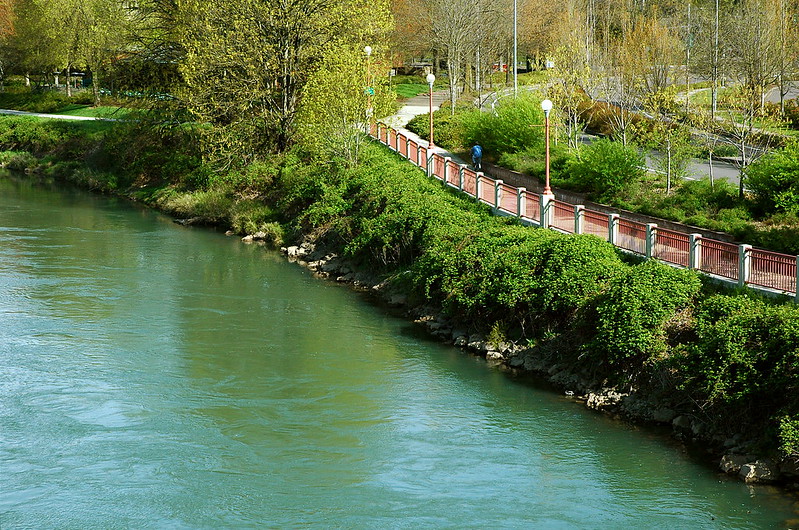
(Bike path along the Willamette River, Eugene, Oregon. Image: Don Hankins, Flickr)
Poetry and Personal Transformation
We forget how fundamental poetry is, not only to culture, but to consciousness. Poetry is meditation in the form of words. I posted this on the Poetry Chaikhana website years ago, and it’s just as true today:
“Poetry has an immediate effect on the mind. The simple act of reading poetry alters thought patterns and the shuttle of the breath. Poetry induces trance. Its words are chant. Its rhythms are drumbeats. Its images become the icons of the inner eye. Poetry is more than a description of the sacred experience; it carries the experience itself.”
The Politics of Poetry
In addition to the spiritual importance of this sacred poetry, there is also a cultural, even a political motivation behind the Poetry Chaikhana. Here’s how I described it in a interview a few years ago:
“Sacred poetry has the unique benefit of being a deeply personal expression of spiritual truth while, at the same time, being largely free from dogma. In the United States, for example, there is an increasing prejudice and fear about the Muslim world. But who can read Jelaluddin Rumi without immediately recognizing the deep truth that Islam can express? The same is true for a non-Hindu reading Lal Ded or a non-Christian reading St. John of the Cross. Sacred poetry is the natural goodwill ambassador for the world’s religions. Poetry can reach across cultural divides, soften prejudices, and shed light on misunderstandings. I hope the Poetry Chaikhana can help to facilitate that process.”
Sacred poetry is transformative on both a personal and a global level.
The Poetry Chaikhana has become a community that reaches across the globe. We have visitors from every continent and more than 220 countries and territories!
The Poetry Chaikhana is an important resource for people all over the world seeking to more deeply understand their own wisdom traditions as well as the spirituality of other cultures in an atmosphere of mutual respect.
=
Thank you for being such a supportive and inspiring community all of these years! I mean that genuinely. I have always felt that we form an extended family for each other. This community has helped me though challenges and changes and shared in my joys. I hope you feel that too. Sending love and poetic nectar from my tea house to yours!
Ivan
Jun 17 2022
The Beloved Guest
by Mahmud Shabistari
English version by Florence Lederer
Cast away your existence entirely,
for it is nothing but weeds and refuse.
Go, clear out your heart’s chamber;
arrange it as the abiding-place of the Beloved.
When you go forth, He will come in,
and to you, with self discarded,
He will unveil His beauty.
 — from The Secret Rose Garden: Mahmud Shabistari, Translated by Florence Lederer / Edited by David Fideler
/ Image by Aziz Acharki /
Again and again the great mystics and saints remind us to “cast away your existence entirely.” This is expressed in many ways in the various world traditions: to die in order to live, to lose yourself in order to be found.
Why all this morbid insistence in every tradition on self-negation? It is important to understand which “self” is being negated. The self that must be “cast away” is the false self, the little self, the ego — the nafs in Sufi terminology.
Until the ego is truly dropped, it rules our perception of reality like a miser. That ego has a secret it desperately must hide from our everyday awareness: it doesn’t really exist. At best we can say the ego is like a tension in the psyche, but it isn’t a real thing in and of itself.
So long as a person believes in the reality of that phantom ego, so long as we identify with that nagging cramp of the “me”-sense, then seeing its inherent unreality is inconceivable, terrifying. The absence of ego is mistakenly assumed to be one’s own death. Recoiling in fear, the psyche reflexively limits our perception of everything around us, crippling the consciousness, all in order to perpetuate the illusion of the ego and so protect us against “death.” The result, however, is that the simple truth remains hidden: The ego does not exist, and we are not the ego; we survive the loss of ego.
The way out of this trap is to — with deep love, infinite patience, elegant balance, and unshakable determination — loosen the ego’s bindings until it falls away naturally.
When we accomplish that, we stand in mute amazement. For, when the ego “you” has left, the Divine One “will come in,” and “unveil His beauty” to us. And, although that radiant beauty reveals itself to be everywhere, it is also recognized as contentedly abiding in the “heart’s chamber.”
Recommended Books: Mahmud Shabistari

|
Mahmud Shabistari
Iran/Persia (1250? – 1340) Timeline |
Jun 17 2022
All that loss, hurt and hope —
gather them up
into a great pure ache
until the Beloved has no choice but to kiss
your naked heart.
Jun 03 2022
Though burning has become an old habit for this heart
by Abu-Said Abil-Kheir
English version by Vraje Abramian
Though burning has become an old habit for this heart,
I dare not think of Your company.
What would a moth mean
to the fire that burns worlds?
 — from Nobody, Son of Nobody: Poems of Shaikh Abu-Saeed Abil-Kheir, Translated by Vraje Abramian
/ Image by Omer Salom /
I know that I have not been consistent with sending out the poetry emails recently. There has been a lot going on and it has been challenging to set aside the time to sit with the poetry before sending it out to you. I would rather have a solid energetic connection with the Poetry Chaikhana community than send something out casually. But I figured we could enjoy a short poem together, so why not a selection from one of my favorite Sufi poets, Abu-Said Abil-Kheir…
This short poem suggests great intimacy with the Divine, but rather than using that as an excuse to feed the ego, he discovers profound humility instead.
Though burning has become an old habit for this heart…
This sounds like a wild poetic flourish of language, but Abu-Said Abil-Kheir is actually saying something fairly specific. The heart aflame is an image that appears in the sacred language and iconography of many traditions.
In the state of deep spiritual communion, when the agitations of the mind are at rest and the attention is not seeking outward distractions, awareness settles into the heart. This is not to say that one is not aware of the outside world; rather, all of the world is gathered into the heart. It is as if the heart has expanded to encompass everything.
Simultaneously, there is a sense of heat — filled with immense love — that permeates the body. This warmth is sometimes a blazing heat that spreads out across the chest and glows in the palms of your hands.
This is the heart in fiery communion.
…So, when Abu-Said Abil-Kheir states that burning has become an “old habit for this heart,” he is declaring that he regularly enters into this fiery union.
But, he immediately follows with:
I dare not think of Your company.
Traditionally, the burning heart is seen as one of the signs of intimacy with the Beloved, God’s closeness. And here’s the problem: The moment you find yourself thinking, ‘Wow! I feel the touch of the Eternal!” — at that moment it is gone.
In trying to grasp it, define it, and define yourself by it, it slips away.
This is what is oh so difficult about true sacred experience — it is not an experience at all. It is not something with boundaries that the memory can cling to and the will can reproduce for self-validation. It is not something that we turn on and off and on again. Rather, it is a perpetual state of being that we learn to participate in with awareness.
Try to define it, or praise yourself for it, begin to think of yourself as close to the Beloved, then the closeness eludes you. That’s the ego trying to slip in where it cannot go. The only way is utter humility and deep stillness. There can be no “you” claiming the experience.
After all, even in the most bliss-filled communion, you are not really doing anything at all. In the presence of flame, the ice cube simply melts, the moth can’t help but be consumed.
What would a moth mean
to the fire that burns worlds?
What is important is not one candled moth, but the fire it loves and gives itself to.
—
The sun is out today. I think I’ll step outside and feel its warmth upon my chest.
Recommended Books: Abu-Said Abil-Kheir
|
Abu-Said Abil-Kheir
Turkmenistan (967 – 1049) Timeline |